
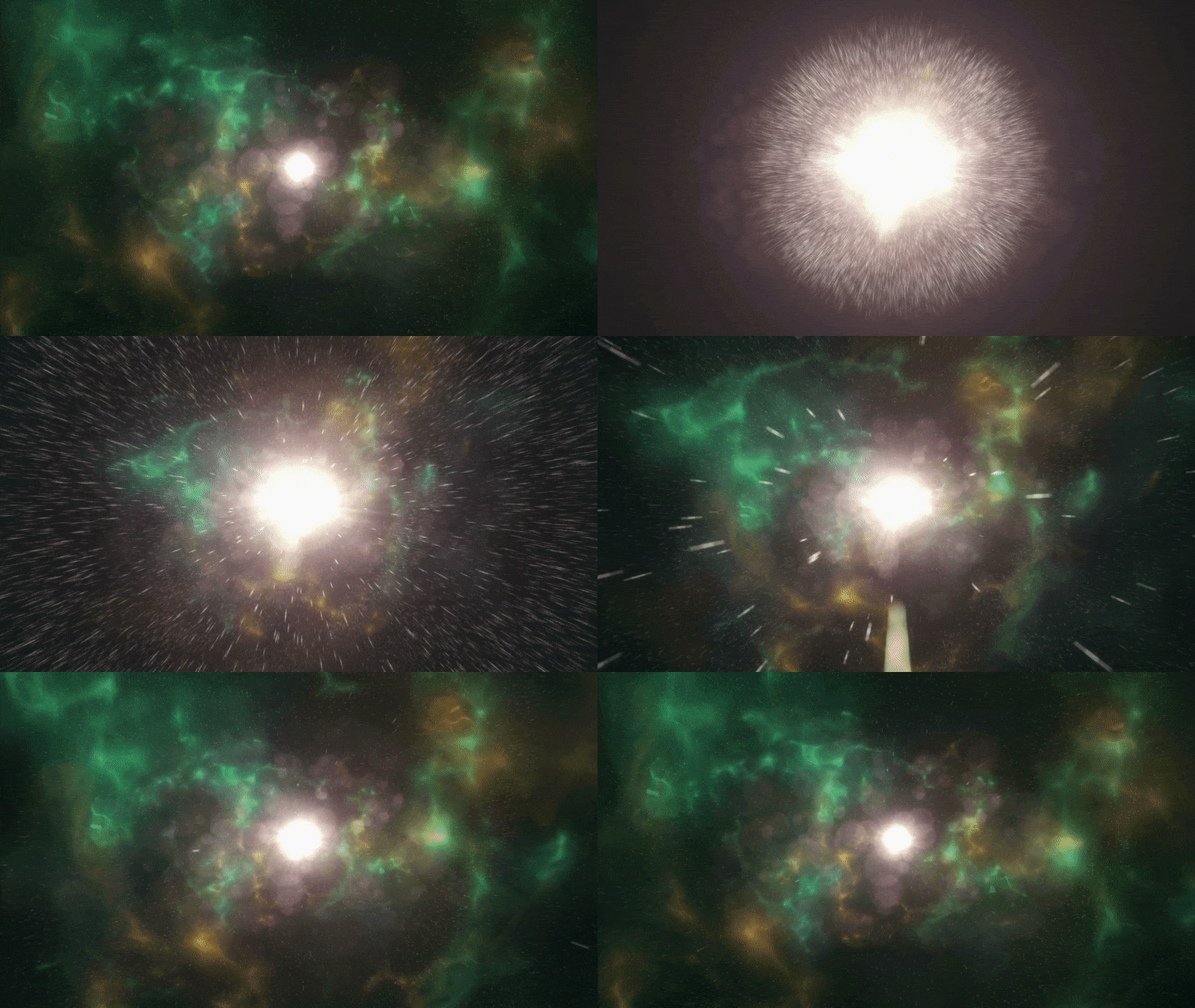
Early Universe simulations show tiny clumps forming, possibly generating gravitational waves or black holes tied to dark matter.
The very first moments of the Universe can be reconstructed mathematically even though they cannot be observed directly. Physicists from the Universities of Göttingen and Auckland (New Zealand) have greatly improved the ability of complex computer simulations to describe this early epoch. They discovered that a complex network of structures can form in the first trillionth of a second after the Big Bang. The behavior of these objects mimics the distribution of galaxies in today’s Universe. In contrast to today, however, these primordial structures are microscopically small. Typical clumps have masses of only a few grams and fit into volumes much smaller than present-day elementary particles. The results of the study have been published in the journal Physical Review D.

The researchers were able to observe the development of regions of higher density that are held together by their own gravity. “The physical space represented by our simulation would fit into a single proton a million times over,” says Professor Jens Niemeyer, head of the Astrophysical Cosmology Group at the University of Göttingen. “It is probably the largest simulation of the smallest area of the Universe that has been carried out so far.” These simulations make it possible to calculate more precise predictions for the properties of these vestiges from the very beginnings of the Universe.

Although the computer-simulated structures would be very short-lived and eventually “vaporize” into standard elementary particles, traces of this extreme early phase may be detectable in future experiments. “The formation of such structures, as well as their movements and interactions, must have generated a background noise of gravitational waves,” says Benedikt Eggemeier, a PhD student in Niemeyer’s group and first author of the study. “With the help of our simulations, we can calculate the strength of this gravitational wave signal, which might be measurable in the future.”
It is also conceivable that tiny black holes could form if these structures undergo runaway collapse. If this happens they could have observable consequences today, or form part of the mysterious dark matter in the Universe. “On the other hand,” says Professor Easther, “If the simulations predict black holes form, and we don’t see them, then we will have found a new way to test models of the infant Universe.”
Reference: “Formation of inflaton halos after inflation” by Benedikt Eggemeier, Jens C. Niemeyer and Richard Easther, 22 March 2021, Physical Review D.
DOI: 10.1103/PhysRevD.103.063525
Never miss a breakthrough: Join the SciTechDaily newsletter.
Follow us on Google and Google News.
5 Comments
… more complex structures emerge from a early state…
… that would be nice, in the case that everything has its reverse order for sure,…
Even though, it might be easy to solve this objection, it might be little bit more to the early state of the Universe to that story…
More here: https://www.sciencealert.com/universe-s-structures-reflected-in-the-first-trillionths-of-a-second-after-the-big-bang .
This paper and its press release (as well as the article above) rubs me the wrong way in so many ways, despite that they do explore a mechanism among several that a general inflation field can thermalize.
First, they use a classical idea of inflation from Guth, where it is hypothesized that inflation is temporary and in a false vacuum state of a so called “inflaton” [“Inflaton”. Wikipedia]. So when the paper refer to slow roll, it is not the observationally preferred Higgs like field which can exit through a first order transition, a second order transition or a crossover, it is decidedly a first order exit to the true vacuum.
Second, that means they have already, without mentioning it, solved the matter-antimatter problem and so thermalize by way of unstable, massive inflaton particles condensing and later decaying.
It is likely not how our universe behaves. But it is a toy model which has some interesting properties of imprinting the inflation field fluctuations onto a thermalized hot big bang state.
… The starting point of our Universe, it is an essential moment to figure out. Well, at least from the point of causal effects, things that happened before might have influence on the thing happening after…
… And one interesting point on forces, because in that sup or stew or whatever scientist call that state now days, it was interesting moment when forces started to emerge, because the carriers particles, there was non of them.
Then the gravity has more importance than other forces if it is just a curvature of the space time thingy. So, how the gravity was at those moments, how strong it was…
… and if I may add how possible it was if it is a curvature of a space time …