
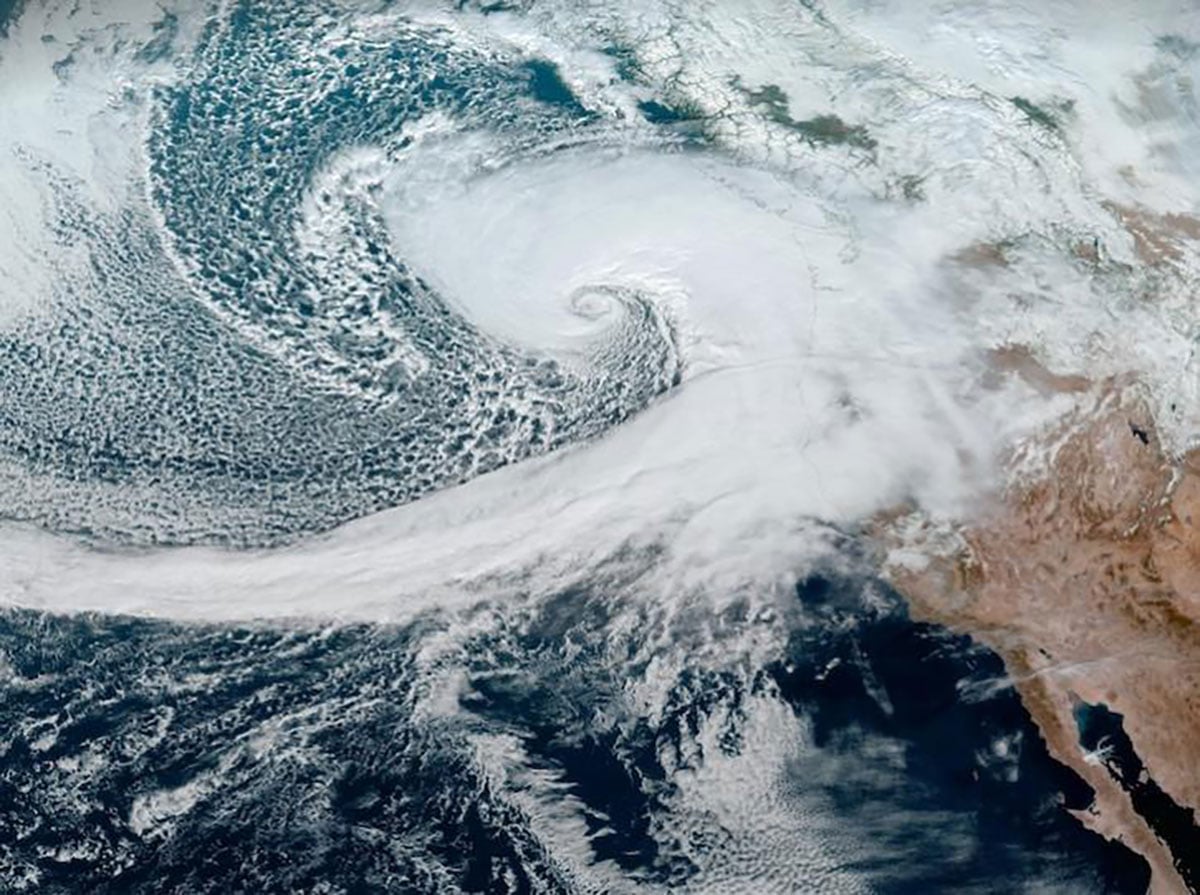
A new study shows how changes in ocean circulation could reshape global rainfall patterns.
A storm reaching California can begin with changes thousands of miles away in the Atlantic Ocean. Climate modeling suggests that as one of the planet’s major ocean circulation systems weakens, more moisture could be directed toward the West Coast while snowfall declines over Greenland.
The system is known as the Atlantic Meridional Overturning Circulation, or AMOC. It moves warm tropical water northward near the ocean surface, helping keep parts of Europe relatively mild. After the water cools and becomes denser, it sinks and flows southward through the deep ocean.
Researchers at the University of California, Riverside, examined how a slower AMOC could influence storms and atmospheric moisture far beyond the Atlantic. Their projections indicate that the consequences could extend across North America, South America, Antarctica, Greenland, and the Arctic.
“It is well known that the AMOC is a big player in the world’s climate system, and that it is slowing down. What we didn’t know is exactly how the AMOC might impact atmospheric moisture and storms outside the Atlantic region,” said Mohima Mimi, a UCR doctoral student in climate dynamics and the paper’s lead author.
“It turns out a weakening AMOC will strengthen storms across parts of North America by the end of the century, along the California coast in particular, while reducing them over Greenland and the Arctic.”
A weaker current redirects storm moisture
The study, published in Nature Communications, traced the connection from the ocean to the atmosphere. As the AMOC weakens, it changes patterns of ocean temperature. Those temperature shifts influence how much water vapor the air can carry and alter the strong high-altitude winds that guide storms across the Northern Hemisphere.
The modeling showed that these winds could intensify, allowing storms to carry more moisture toward California. Much of that water would arrive through atmospheric rivers, which are long, narrow streams of vapor that move tropical moisture toward higher latitudes.
Atmospheric rivers are essential to California’s water supply, but their strongest forms can produce flooding, landslides, and extensive infrastructure damage. That makes any projected increase important for both water planning and disaster preparation.
These rivers are long, narrow corridors of water vapor carrying moisture from the tropics to higher latitudes. “In California, atmospheric rivers are a double-edged sword,” Mimi said. “They supply much of the state’s water supply, but as they become stronger, they’re likely to also bring widespread destruction.”
Storm shifts extend across continents
The projected changes were not limited to California. The models also indicated that atmospheric rivers could become more common along the eastern coast of South America and around Antarctica.
Greenland showed the opposite pattern. With fewer storms reaching the region, snowfall would decline, reducing the amount of new ice added to the surface.
These projections were based on a high greenhouse gas emissions scenario in which the AMOC continues weakening through the end of the century. Scientists have already detected signs that the circulation is slowing as human-caused climate change warms the planet, and models suggest that continued high emissions would reinforce that trend.
Greenhouse gases come largely from burning coal, oil, and natural gas. Other major sources include methane from livestock, deforestation, industrial activity, and waste in landfills.
Wei Liu, an associate professor of climate change and the paper’s senior author, said reducing emissions could limit further disruption to the AMOC and lessen its effects on future rainfall patterns.
Better planning could limit damage
Stronger atmospheric rivers would create greater risks for flooding and infrastructure, but they could also deliver more water during individual storms. Communities may be able to make better use of that moisture by improving forecasts and expanding reservoirs or other storage systems.
The projections show why changes in ocean circulation cannot be viewed as a problem confined to the Atlantic. By altering ocean temperatures, atmospheric moisture, and storm-guiding winds, a weakening current could reshape weather patterns across distant regions.
Those shifts could affect drinking water, agriculture, ecosystems, flood control, and ice accumulation across several continents. Understanding the chain of effects gives communities more time to prepare for changes that may otherwise appear unrelated to the Atlantic Ocean.
“This research shows that the effects of the AMOC extend far beyond the Atlantic Ocean,” Mimi said. “Understanding these connections will help us better prepare for future changes in water resources and extreme weather.”
Reference: “Atlantic meridional overturning circulation slowdown modulates atmospheric rivers in a warmer climate” by Mohima Sultana Mimi, Wei Liu, Weiming Ma and Gang Chen, 4 May 2026, Nature Communications.
DOI: 10.1038/s41467-026-72555-w
Never miss a breakthrough: Join the SciTechDaily newsletter.
Follow us on Google and Google News.
5 Comments
The use of the term “COULD” weakens the argument greatly…
“It is well known that the AMOC is a big player in the world’s climate system, and that it IS slowing down.”
It is NOT well known that it is slowing down! Different studies have come to different conclusions. See here:
https://scitechdaily.com/climate-puzzle-scientists-uncover-mysterious-halt-in-the-atlantic-conveyor-belt-slowdown/
And here:
https://scitechdaily.com/defying-doomsday-forecasts-critical-ocean-current-is-still-going-strong-after-60-years/
One of the problems is that the Gulf Stream is notoriously variable and unpredictable, with gyres, meandering, and branching changing how and where the water flows. If you will pardon me taking liberties with famous quotes, “One can only swim in the same gulf stream once.”
The authors have based their speculative “coulds” about the future behavior of the Pacific on an unproven, necessary prior condition. Namely, that the Gulf Stream is slowing down, for which they have not presented good evidence.
That is not unlike me claiming that if I become prescient I could become wealthy. What are the odds? I would say somewhere between zero and none. It is like the click bait one sees on the internet asking the question, “What would have happened if Pearl Harbor had not been bombed by the Japanese?” Or if the USA hadn’t developed the A-bomb and used it? Those things happened and can’t be undone.
I don’t understand how speculation like this gets past the vaunted peer review for a scientific journal. Why is it even done? Is it to inform the world of their fantasies, or to scare the public with the outcome of something that is so terrible that a probability approaching zero is unacceptable? There are 13 instances of the use of the vague word “could” in the article, but not a single instance of a numeric probability with its associated margin of error. What does that say about the accuracy and precision of this ‘scientific’ research when the possibility of a significant prerequisite is not established?
“In California, atmospheric rivers are a double-edged sword, … They supply much of the state’s water supply, but as they become stronger, they’re likely to also bring widespread destruction.”
The unstated assumption is that they are becoming stronger. Before readers accept the assertion, I would suggest that they read the following:
https://en.wikipedia.org/wiki/Great_Flood_of_1862
“These projections were based on a high greenhouse gas emissions scenario in which the AMOC continues weakening through the end of the century.”
We get two assumptions for the price of one! Apparently, the authors have not heard that the IPCC has officially disavowed the high greenhouse gas emissions scenario (RCP8.5), invalidating the assumption that the AMOC can continue weakening (even if it were) through the end of the century.
Again, it seems that the peer review process is broken when ‘research’ is so easily criticized. Actually, it would be more accurate to characterize this paper as reporting on the output of a computer model of unknown veracity, using input that has been shown to be improbable. This is an expected outcome when there are unexamined assumptions driving the methodological exploration to support a conclusion that was decided before the computer runs were scheduled.
Maybe you could mention the studies emphasizing the long term cyclic character of the AMOC based on measures and not on models and the absence of scientific consensus on this topic