
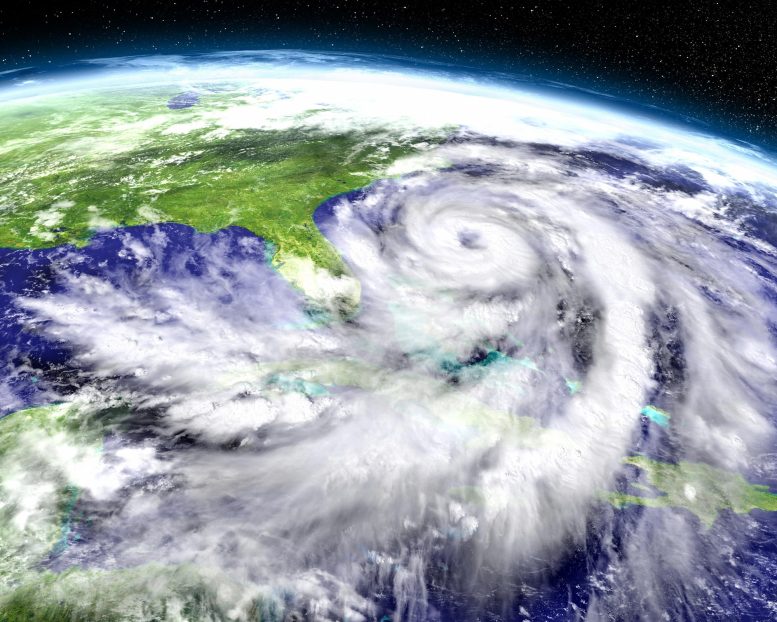
A new study has revealed super cyclones, the most intense form of tropical storms, are likely to have a much more devastating impact on people in South Asia in future years.
The international study, conducted by the University of Bristol, examined the 2020 Super Cyclone Amphan – the most costly cyclone to make landfall in South Asia – and predicted its implications under several scenarios of sea-level rise caused by global warming.
Its findings, published on May 8th, 2022 in the Royal Meteorological Society journal Climate Resilience and Sustainability, showed that if greenhouse gas emissions continue at the current rate, more than two and a half times (250 percent) of India’s population would experience flooding of greater than one meter (3.3 feet), compared to the event in 2020.
Lead author Dann Mitchell, Professor of Climate Science at the University of Bristol, said: “South Asia is one of the most climate-sensitive regions in the world, with super cyclones causing tens to hundreds of thousands of deaths in historical cases. Comparatively, very little climate impact research has been done in South Asia, despite the Intergovernmental Panel on Climate Change highlighting it as such a critical region.
“This study, in collaboration with local scientists, provides much-needed climate impact information in one of the most vulnerable regions in the world. It presents a critical piece of evidence in support of ramping down our greenhouse gas emissions to achieve the Paris Agreement climate goals, where other lines of evidence all too often focus on high-income countries where impacts are lower, and adaptation is more easily achievable.”
The researchers, which included scientists from Bangladesh, used sophisticated climate model projections to anticipate the scale of those affected by cyclones in the rest of this century.
The Impact of Paris Agreement Climate Goals
Although the increasing number of people at risk is anticipated to be more modest in Bangladesh, estimated to rise by 60% to 70%, this factors in declining coastal populations in the future. Encouragingly, the research team went on to show if the Paris Agreement climate goals of 2 degrees Celsius warming above pre-industrial levels are adhered to, population exposure to flooding dropped close to zero there.
But even in this climate warming scenario, the exposures in India still showed an alarming increase of between 50% to 80% is expected to experience flooding in the future.
The main objective of the Paris Agreement, a global framework to tackle climate change, is to hold the global average temperature increase to well below 2°C (3.6°F) above pre-industrial levels and endeavor to limit the temperature increase to 1.5°C (2.7°F).
Saiful Islam, Professor of Hydrology at the Bangladesh University of Engineering and Technology (BUET), and contributing author of the study, said: “The latest IPCC report has mentioned with high confidence that tropical cyclones with higher intense categories will be more frequent in the future. This study shows that population exposure in Bangladesh and India will be increased up to 200% in the future for extreme storm surge flooding (greater than 3 meters or 10 feet) from intense cyclones under high emission scenarios. Hence, a strong, rapid and sustained greenhouse gas reduction is essential to achieve goals of the Paris Agreement and to reduce losses and damages of highly vulnerable countries like Bangladesh.”
Reference: “Increased population exposure to Amphan-scale cyclones under future climates” by Dann Mitchell, Laurence Hawker, James Savage, Rory Bingham, Natalie S. Lord, Md Jamal Uddin Khan, Paul Bates, Fabien Durand, Ahmadul Hassan, Saleemul Huq, Akm Saiful Islam, Yann Krien, Jeffrey Neal, Chris Sampson, Andy Smith and Laurent Testut, 8 May 2022, Climate Resilience and Sustainability.
DOI: 10.1002/cli2.36
Never miss a breakthrough: Join the SciTechDaily newsletter.
Follow us on Google and Google News.
1 Comment
“… if greenhouse gas emissions continue at the current rate, more than two and a half times (250 percent) of India’s population would experience flooding of greater than one meter, …”
The problem is, this is based on models that are acknowledged to run warm. There is no empirical evidence to support the claim that anthropogenic CO2 emissions are driving the annual atmospheric increase in CO2. During 2020, when anthropogenic emissions declined by as much as 18% in April, there was no measurable decline in the flux rate, seasonal peak, or slope of the ramp-up phase during Winter/Spring. There was no discernible difference in the shape of the 2020 seasonal atmospheric concentration compared to the previous year. That doesn’t get mentioned, but is begging to be explained.
https://wattsupwiththat.com/2021/06/11/contribution-of-anthropogenic-co2-emissions-to-changes-in-atmospheric-concentrations/
https://wattsupwiththat.com/2022/03/22/anthropogenic-co2-and-the-expected-results-from-eliminating-it/