
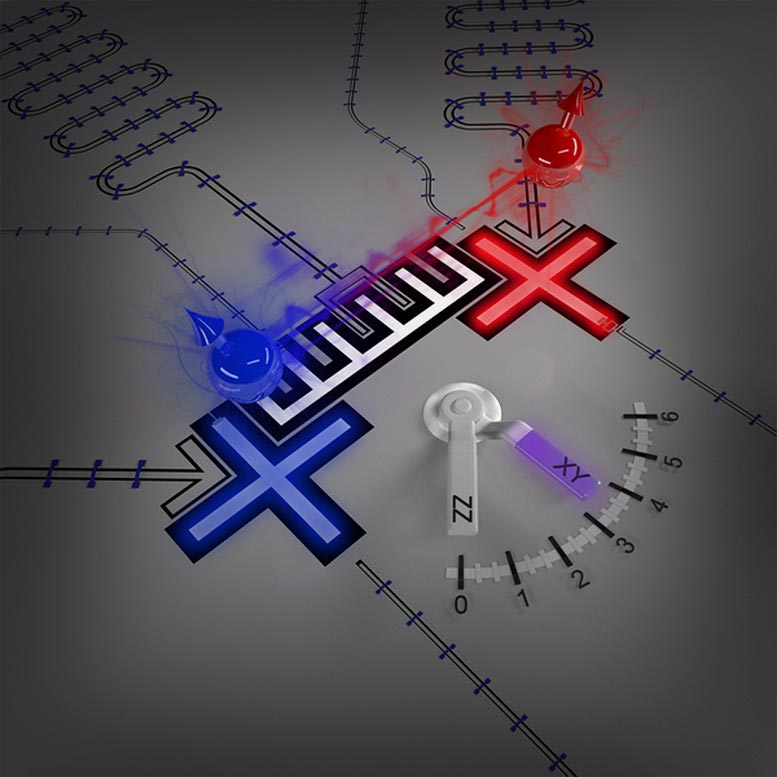
MIT researchers demonstrate a way to sharply reduce errors in two-qubit gates, a significant advance toward fully realizing quantum computation.
MIT researchers have made a significant advance on the road toward the full realization of quantum computation, demonstrating a technique that eliminates common errors in the most essential operation of quantum algorithms, the two-qubit operation or “gate.”
“Despite tremendous progress toward being able to perform computations with low error rates with superconducting quantum bits (qubits), errors in two-qubit gates, one of the building blocks of quantum computation, persist,” says Youngkyu Sung, an MIT graduate student in electrical engineering and computer science who is the lead author of a paper on this topic published on June 16, 2021, in Physical Review X. “We have demonstrated a way to sharply reduce those errors.”
In quantum computers, the processing of information is an extremely delicate process performed by the fragile qubits, which are highly susceptible to decoherence, the loss of their quantum mechanical behavior. In previous research conducted by Sung and the research group he works with, MIT Engineering Quantum Systems, tunable couplers were proposed, allowing researchers to turn two-qubit interactions on and off to control their operations while preserving the fragile qubits. The tunable coupler idea represented a significant advance and was cited, for example, by Google as being key to their recent demonstration of the advantage that quantum computing holds over classical computing.
Still, addressing error mechanisms is like peeling an onion: Peeling one layer reveals the next. In this case, even when using tunable couplers, the two-qubit gates were still prone to errors that resulted from residual unwanted interactions between the two qubits and between the qubits and the coupler. Such unwanted interactions were generally ignored prior to tunable couplers, as they did not stand out — but now they do. And, because such residual errors increase with the number of qubits and gates, they stand in the way of building larger-scale quantum processors. The Physical Review X paper provides a new approach to reduce such errors.
Record Fidelity With Controlled-Z and iSWAP Gates
“We have now taken the tunable coupler concept further and demonstrated near 99.9 percent fidelity for the two major types of two-qubit gates, known as Controlled-Z gates and iSWAP gates,” says William D. Oliver, an associate professor of electrical engineering and computer science, MIT Lincoln Laboratory fellow, director of the Center for Quantum Engineering, and associate director of the Research Laboratory of Electronics, home of the Engineering Quantum Systems group. “Higher-fidelity gates increase the number of operations one can perform, and more operations translates to implementing more sophisticated algorithms at larger scales.”
To eliminate the error-provoking qubit-qubit interactions, the researchers harnessed higher energy levels of the coupler to cancel out the problematic interactions. In previous work, such energy levels of the coupler were ignored, although they induced non-negligible two-qubit interactions.
“Better control and design of the coupler is a key to tailoring the qubit-qubit interaction as we desire. This can be realized by engineering the multilevel dynamics that exist,” Sung says.
The next generation of quantum computers will be error-corrected, meaning that additional qubits will be added to improve the robustness of quantum computation.
“Qubit errors can be actively addressed by adding redundancy,” says Oliver, pointing out, however, that such a process only works if the gates are sufficiently good — above a certain fidelity threshold that depends on the error correction protocol. “The most lenient thresholds today are around 99 percent. However, in practice, one seeks gate fidelities that are much higher than this threshold to live with reasonable levels of hardware redundancy.”
Building Better Devices with High Coherence
The devices used in the research, made at MIT’s Lincoln Laboratory, were fundamental to achieving the demonstrated gains in fidelity in the two-qubit operations, Oliver says.
“Fabricating high-coherence devices is step one to implementing high-fidelity control,” he says.
Sung says “high rates of error in two-qubit gates significantly limit the capability of quantum hardware to run quantum applications that are typically hard to solve with classical computers, such as quantum chemistry simulation and solving optimization problems.”
Up to this point, only small molecules have been simulated on quantum computers, simulations that can easily be performed on classical computers.
“In this sense, our new approach to reduce the two-qubit gate errors is timely in the field of quantum computation and helps address one of the most critical quantum hardware issues today,” he says.
Reference: “Realization of High-Fidelity CZ and ZZ-Free iSWAP Gates with a Tunable Coupler” by Youngkyu Sung, Leon Ding, Jochen Braumüller, Antti Vepsäläinen, Bharath Kannan, Morten Kjaergaard, Ami Greene, Gabriel O. Samach, Chris McNally, David Kim, Alexander Melville, Bethany M. Niedzielski, Mollie E. Schwartz, Jonilyn L. Yoder, Terry P. Orlando, Simon Gustavsson and William D. Oliver, 16 June 2021, Physical Review X.
DOI: 10.1103/PhysRevX.11.021058
Never miss a breakthrough: Join the SciTechDaily newsletter.
Follow us on Google and Google News.
4 Comments
Computation that has error rate doesn’t sound right to me at all.
Wow. The quantum computing breakthroughs are exciting. However, please protect all that hard work and investment from being stolen through cyber theft. It seems we work so hard to advance technology and time after time we basically hand it over for free to the Chinese Communists through weak cyber security. It’s so pathetic but it just keeps happening.
The quantum computing breakthroughs are exciting. However, please protect all that hard work and investment from being stolen through cyber theft. It seems we work so hard to advance technology and time after time we basically hand it over for free to the Chinese Communists through weak cyber security. It’s so pathetic but it just keeps happening.
I agree with Joe!