
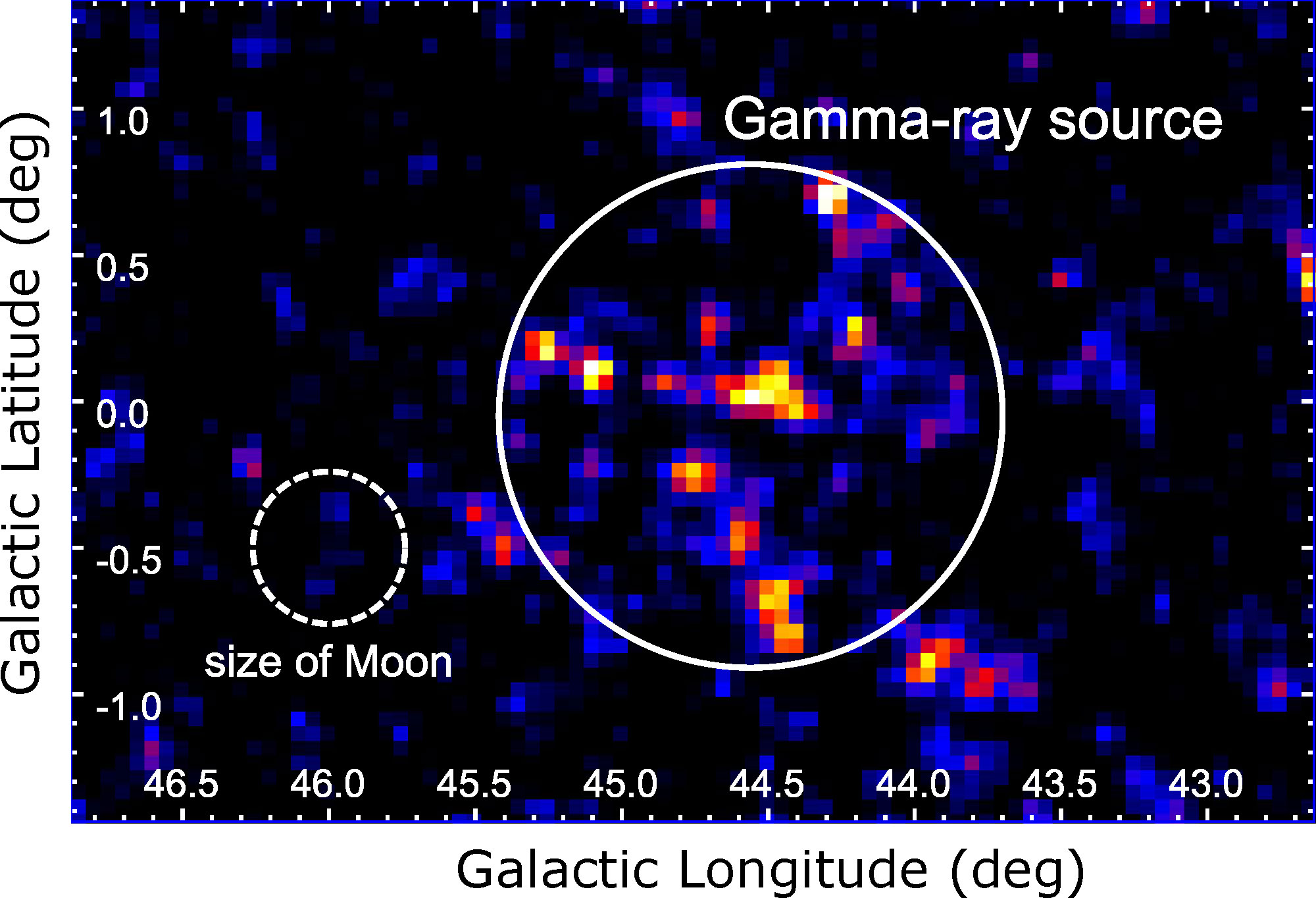
Scientists have identified an accelerator that produces the highest-energy protons in our galaxy, a finding that could clarify the nature of the fast-moving particles filling the space between stars.
Across the Milky Way, charged particles race through space with energies beyond the reach of even the most powerful accelerators built on Earth. Known as cosmic rays, these particles consist mainly of protons, with a smaller number of electrons. Some carry more energy than particles accelerated by the Large Hadron Collider near the border of Switzerland and France, despite that machine pushing protons close to the speed of light.
An international group led by Hiroshima University has now conclusively identified a Galactic source capable of accelerating cosmic ray protons to the highest energies. By combining observations from three major facilities on Earth and in space, the researchers established the nature of an object called LHAASO J1912+1014u. The result may help explain the origin and behavior of energetic particles that travel through the space between stars and affect processes across the Milky Way.
The findings were published in The Astrophysical Journal.
One source clears the PeVatron threshold
“This immense energy makes cosmic rays important in astronomy and astrophysics,” said first and corresponding author of the study Tsunefumi Mizuno, associate professor at Hiroshima University’s Hiroshima Astrophysical Science Center. He explained that these energies are measured in electron volts — the energy an electron gains when it moves from a resting state and increases its electrical potential by one volt. “The highest energy of galactic cosmic rays can reach and exceed one quadrillion (1015) electron volts, or a peta electron volt (PeV). Finding a cosmic-ray proton accelerator above that PeV level, called a proton PeVatron, is one of the most exciting topics in modern astrophysics, and we identified one such object previously known as LHAASO J1912+1014u.”
Since 1990, the Japan- and China-led Tibet AS gamma experiment, followed by China’s Large High Altitude Air Shower Observatory (LHAASO), has detected dozens of gamma-ray sources above 0.1 PeV. Among them was LHAASO J1912+1014u.
Gamma rays are the most energetic form of electromagnetic radiation and can be produced where cosmic rays are accelerated. Their energies are typically about one-tenth those of the cosmic ray particles that created them, making sources of sub-PeV gamma rays possible PeVatron candidates. Earlier work suggested that LHAASO J1912+1014u might be a pulsar wind nebula or another remnant of a massive stellar explosion.
“However, data from Tibet AS gamma and LHAASO experiments alone cannot clearly identify proton PeVatrons because PeV cosmic ray electrons can also produce the lower energy gamma-rays,” Mizuno said, explaining that the experiments’ image resolution is limited, so researchers cannot delve deeply enough to confirm a proton PeVatron.
Three observatories supply the missing evidence
Other observatories had gathered the information needed to distinguish between proton and electron acceleration. These included NASA’s Fermi Large Area Telescope (Fermi-LAT), whose instrument development and operation involved Hiroshima University, Japan’s FOREST Unbiased Galactic plane Imaging survey with the Nobeyama 45-meter telescope (FUGIN), and NASA’s Chandra X-ray Observatory.
LHAASO J1912+1014u was discovered in 2024 in the constellation Aquila, near Altair, one of the three stars forming the Summer Triangle. Astronomers initially regarded the object as a supernova remnant, but that interpretation changed after emissions exceeding 100 TeV were detected.
“With data from multiple experiments, we have studied LHAASO J1912+1014u in detail,” Mizuno said. He noted that the experiments provide data across a wide wavelength range from radio to gamma-rays, enabling this broad investigation with comprehensive multiwavelength modeling.
Fermi-LAT measured gamma rays with energies near one gigaelectronvolt (GeV), equal to one billion electron volts. Chandra supplied lower-energy X-ray observations, while FUGIN traced still lower-energy radio emissions. When these measurements were combined with tera-electron-volt (TeV) observations from LHAASO and other instruments, the researchers could reconstruct the source across a broad energy range and test competing explanations.
Three clues identify proton acceleration
Three pieces of evidence pointed to a proton PeVatron. First, gamma-ray emission extended continuously from more than 100 trillion electron volts down to 400 million electron volts. According to Mizuno, the shape and span of this emission made an electron accelerator unlikely on energetic grounds.
Second, the GeV gamma ray map closely followed the distribution of interstellar gas measured in FUGIN radio observations. That connection is expected when high-energy protons collide with surrounding gas and generate gamma rays.
Third, Chandra detected only very weak diffuse X-ray emission. A powerful population of high-energy electrons would be expected to produce stronger X-rays, so their absence further supported proton acceleration.
“This research is achieved by team effort. There is an old Japanese saying: ‘One arrow is easy to break, but three arrows bundled together are not,’” Mizuno said. “In this study, three arrows — Fermi-LAT GeV gamma-ray data, FUGIN radio data and Chandra X-ray data — are bundled together through a detailed multiwavelength modeling, revealing that our target, LHAASO J1912+1014u, is a cosmic-ray proton PeVatron.”
Beyond identifying the object as a proton PeVatron, Mizuno emphasized that the analysis also revealed properties of the particles being accelerated, information needed to understand the source itself. Dozens of other possible proton PeVatrons remain in the Milky Way, and the researchers now plan to examine those candidates systematically.
Reference: “Hadronic Scenario for Galactic PeVatron LHAASO J1912+1014u Supported by Fermi-LAT γ-Ray Data and FUGIN CO Data” by Tsunefumi Mizuno, Hidetoshi Sano, Takeru Murase, Tomohiko Oka, Hiromasa Suzuki and Naohito Nakahara, 16 July 2026, The Astrophysical Journal.
DOI: 10.3847/1538-4357/ae680d
This work was performed in part under US Department of Energy (DOE) Contract DE-AC02-76SF00515. This work was also supported in part by a University Research Support Grant from the National Astronomical Observatory of Japan (NAOJ); the Japan Society for the Promotion of Science (JSPS) KAKENHI (23K25882, 23H04895, 22H00152, 24H00246, 24K17093).
Never miss a breakthrough: Join the SciTechDaily newsletter.
Follow us on Google and Google News.