
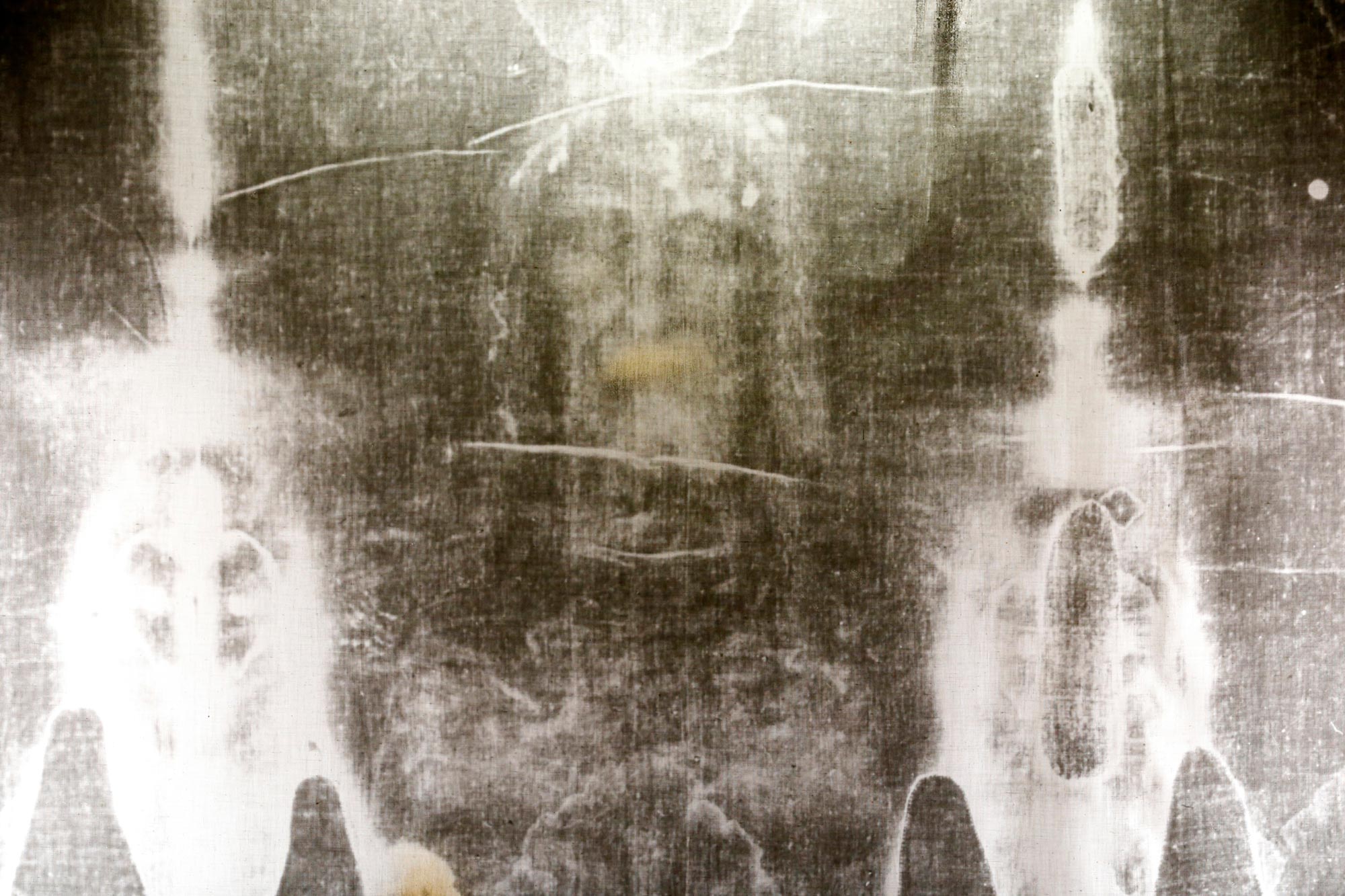
New research has revealed the complex biological history preserved in DNA traces on the Shroud of Turin.
Fibers taken from the Shroud of Turin nearly five decades ago still contain a complex record of biological material accumulated over centuries. In research published in Scientific Reports, scientists applied advanced genomic sequencing (rigorous PCR-free next-generation metagenomic sequencing) to official samples gathered from the cloth in 1978.
Their analysis of DNA embedded in the linen provides the most detailed account yet of the biological traces deposited through repeated human handling and environmental exposure.
Professor Noemi Procopio, Professor of Forensic Science at the University of Lancashire, contributed to the international collaborative project. The analysis uncovered several human mitochondrial DNA lineages and a diverse microbiome that included bacteria, fungi, and microorganisms adapted to salty conditions. Researchers also detected genetic material from cultivated plants, domesticated animals, and Mediterranean red coral, reflecting the wide range of people and surroundings encountered by the Shroud during its history.
The DNA cannot prove authenticity
The results do not establish when the Shroud was made or whether it is authentic. Instead, they demonstrate how forensic genomics and proteomics can reconstruct aspects of an object’s biological past.
Centuries of contact and contamination prevent researchers from isolating DNA that could confidently be linked to the cloth’s earliest history. Even so, advanced metagenomic methods can provide evidence about its preservation, environmental exposure, and cultural journey.

Biological traces reflect a long journey
Along with microbes commonly associated with human skin, fungi, and salt-adapted archaea, the researchers identified DNA from many plants and animals. The plant material included cultivated wheat, carrots, corn, bananas, and peanuts, while animal traces came from cattle, pigs, chickens, dogs, and cats. Together, these findings offer additional evidence of how the Shroud has been handled, stored, and transported through different regions over time.
Historical objects become genetic archives
Professor Noemi Procopio, Professor of Forensic Science at the University of Lancashire, said: “The Shroud of Turin continues to fascinate historians, scientists and the public, and we’re thrilled to reveal new information about the biological complexity preserved within samples collected almost 50 years ago by applying new cutting-edge forensic DNA technologies.
“The Shroud represents a rich archive of genetic information that has accumulated over centuries of human interaction and environmental exposure. While the DNA evidence cannot answer all the questions about the age or authenticity of the cloth, it provides novel insights into its biological history and demonstrates how advances in forensic science can unlock new information from historical artifacts.”
Reference: “DNA signatures preserved in the official 1978 sample collection of the Shroud of Turin” by Gianni Barcaccia, Nicola Rambaldi Migliore, Giovanni Gabelli, Vincenzo Agostini, Fabio Palumbo, Elisabetta Moroni, Valeria Nicolini, Liangliang Gao, Grazia Mattutino, Andrew Porter, Pawel Palmowski, Noemi Procopio, Ugo A. Perego, Massimo Iorizzo, Timothy F. Sharbel, Pierluigi Baima Bollone, Antonio Torroni, Andrea Squartini and Alessandro Achilli, 9 July 2026, Scientific Reports.
DOI: 10.1038/s41598-026-60684-7
Never miss a breakthrough: Join the SciTechDaily newsletter.
Follow us on Google and Google News.
21 Comments
We are going through the most epoch and evolutionary Timeline In the history of humanity. This is a time where science, religions, ethnic races, nations, social standings, and all ages need to come together as one. I have Rh Null blood type, wether through scientific, religious/essoteric, cosmic, or environmental views and research, 2026-2032 we are going through a carbon based biology to Crystalline Silica Supercunductive Illuminous Mirrored Biospheric Quantum Neuro String Entanglement Evolution a coherent stabilization is detrimental. I.am working on Pangea X Reset TM. Focused on biospheric coherent stabilization. Qauntum Gravitational/Mechanics/Biological/Sustainable energy, Dark Matter, Cosmic web, AI- Neuro String Entanglement. Calling, text messaging, gps, web browsing, e2e p2p and Crypto encypted block chain security and self charging devices, homes and transportation all echo friendly. Any Non profit, private academic or government funded organizations that want to work together to focus on the advancement and evolution of humanity and helping the low and no income please reply. Thank you have a blessed day.
The Bridge Rise of Maitreya Rax 144K & 5D Daniel Angel Campos
Reclaiming Royal Spiritual Lineage Veronica Anne Deleon RH Null Bloodline “Of The Lion”
Isn’t the shroud a hoax? Hasn’t it been proven by now?
Not exactly. The shroud is still a shroud.it is still from antiquity.
Regardless if its the burial cloth of the messiah, or if it even came from his direct geographical area.
In true history, it is not even certain if jesus of nazarene sported a beard or if he dressed like a roman.
If he had long hair, it is not likely that it was straight and flowing. Better technology can target the date better. Eventually, the age of the oldest human d n a present can be found out.And a shroud that has a human imprint if not painted on; means that it was from a deceased body.
That doesn’t mean that it is not an interesting item.
I don’t need to see mother Mary in every bush.Or Jesus in my spaghetti. A true believer does not need to have a physical object to worship… After all that’s idoltry <_<
In the second and third century, the Catholic Church taught that all men need to have beards, and that all people need to wear white clothing. In other words, that it is a sin to wear colored clothing or to get rid of your beard. So that suggests the likelihood that it was the belief of 1st century Christians too. And that Jesus probably had a beard too, and possibly wore only white clothes.It seems clear from the New Testament that Jesus founded a new Jewish sect that viewed him as the messiah, and then a few years after he died, Peter introduced major changes in belief, which transformed that sect to a new religion, Christianity
What matter of Nonsense is this?!
That is not what the Catholic Church teaches now or taught then. Where did you get that? I’m a Catholic.
Absolutely Not!
The evidence overwhelming points to authenticity.
It’s not a hoax that kind of radiation, came ftom that body, and they know it.
It’s not a hoax that kind of radiation, came ftom that body, and they know it.
Very interesting endeavor. How could I help?
Religious propaganda. Why are “scientists” wasting their time on this bs? And this website is censoring comments.
Thank you for the opportunity to read about DNA science in its extremely diverse and fantastic variations.
Janet
Yes, because of course, Whatever disturbs you is Non-scientific, right?
If you look into it, the top minds are spending time on it because it is so far beyond our capabilities in technology to create it… seriously educate yourself on it.
Where in this article did it try and persuade or promote religion? You must struggle with reading comprehension. Bless your tiny little heart!
Here’s the thing…I have thought about this carefully, yes I believe this is the burial cloth of Christ, but I don’t worship it, that smacks of idolatry. However, the article says that what they are finding or what they are using is mitochondrial DNA testing, well that’s the only DNA Jesus had. He did not have a human father, so no XY chromosomes. But again, no actual mitochondrial DNA from His mother either. This is a relic, you take it on faith or you don’t.
What the age of the shroud?
The Shroud of Turin is a fake – inside and out, up and down – through and through – they only show negative images for reason – anyone taking an up close look sees it plain as day.
You better study some more you feel strange just looking at it, it’s real it has power
How do you know?
Recent Scientific FindingsDNA and Microbiome Research (April 2026): A genetic analysis revealed a mix of human and plant DNA, confirming haplogroup H33 (frequent in the Near East and among the Druze) alongside halophilic archaea, pointing to historical storage in saline environments like the Dead Sea region.X-Ray Dating Analysis: Recent wide-angle X-ray scattering (WAXS) testing on linen threads dated the fabric’s natural aging profile closer to a 2,000-year-old origin, suggesting that 1988 carbon-14 tests might have been skewed by younger repair fibers or contamination.Burial Context Studies (2025): Immunological evaluations of bloodstain patterns and serum halos under UV light indicate characteristics consistent with an unwashed body wrapped directly in spices and linen.