
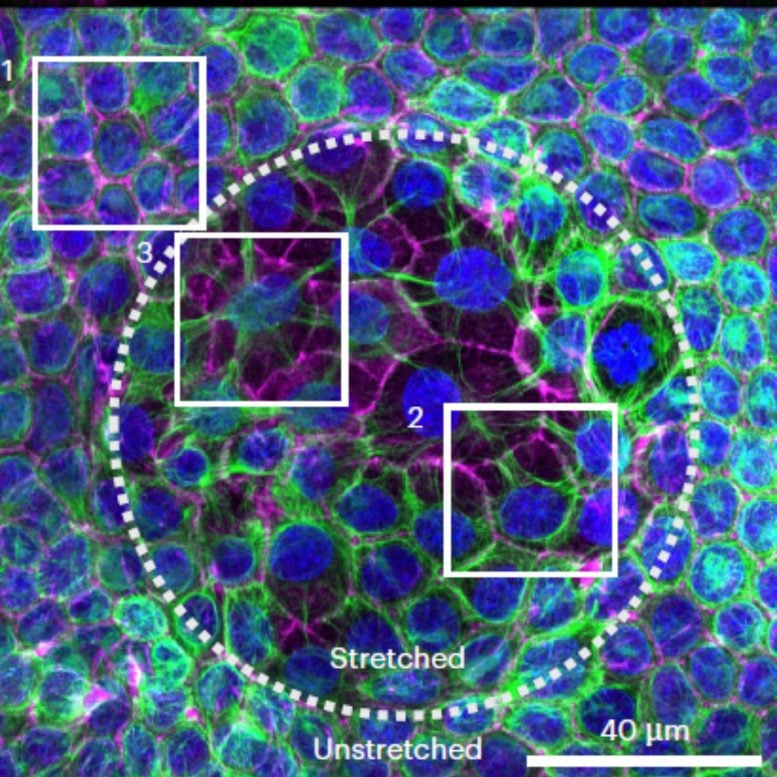
When tissues are stretched for hours, their cells rebuild their internal support system.
A cell’s nucleus is usually anchored inside a protective web of protein fibers. But when tissue remains stretched for hours, that arrangement can break apart.
Researchers have discovered that epithelial cells respond to prolonged strain by rebuilding their internal skeleton across entire groups of cells. As the new structure takes shape, the nucleus is gradually forced out of the keratin network that once surrounded it.
The unexpected response could change how scientists understand the physical demands placed on tissues during growth, movement, and normal organ function. It may also offer clues about diseases in which keratin networks are weakened or improperly organized.
How Epithelial Tissues Withstand Strain
The study, led by the Institute for Bioengineering of Catalonia (IBEC) and published in Nature Physics, examined epithelial tissue. This type of tissue forms the skin and lines many organs, cavities, and internal surfaces. Because epithelial cells are tightly connected, they must endure physical stress as a coordinated sheet rather than as isolated cells.
That stress can be considerable. Tissues stretch as embryos grow, lungs fill with air, the bladder expands, and mammary glands change during pregnancy and lactation. Cells must remain connected and functional through these repeated changes in shape.
Keratin helps make that possible. It belongs to a family of proteins known as intermediate filaments, which form durable networks inside cells. Unlike the more dynamic actin cytoskeleton, keratin is particularly important for helping epithelial tissues resist deformation and physical damage.
Keratin’s Slow Response to Stretching
Scientists have long known that keratin acts as a mechanical support system. What remained unclear was how the network behaves when stretching continues not for seconds or minutes, but for hours or days.
To recreate that kind of sustained strain, the researchers grew engineered epithelial tissues and placed them in a custom microfluidic device that could stretch them under controlled conditions. Live-cell microscopy allowed the team to follow changes inside the cells over time, while computer simulations helped reveal the forces driving those changes.
Keratin did not immediately stiffen or reinforce the cells when stretching began. Instead, the response unfolded slowly.
Cells Build a Shared Support Network
Over several hours, fine keratin filaments moved away from their original positions and assembled into thick, star-shaped bundles. These structures extended across cell boundaries, connecting neighboring cells through a shared support network.
The tissue reorganized as a group, creating a larger structure that distributed stress across multiple cells.
The transformation began at junctions where three cells met. Keratin gradually disappeared from these points and accumulated elsewhere in increasingly dense bundles. The process first appeared in scattered cells, then spread outward as neighboring cells joined the growing network.
Computer modeling indicated that the movement of keratin also generated forces inside the cells. Those forces had an unexpected target: the nucleus.
Keratin Bundles Push the Nucleus Free
“Simulating the intracellular dynamics revealed that the same process that forms these striking bundles also generates forces that ultimately push the nucleus out of its cage,” says Marco Pensalfini, assistant professor at Queen Mary University of London, who developed the model with Marino Arroyo, a professor at the Polytechnic University of Catalonia and principal investigator at the International Center for Numerical Methods in Engineering. “Computational modeling allowed us to connect what we observed in experiments with the underlying physical mechanisms.”
Live imaging showed the event unfolding in real time. As the bundles became thicker, the keratin mesh surrounding the nucleus grew thinner and less connected. The nucleus eventually separated almost completely from the network, remaining attached to only a small amount of filament.
The researchers call this process “nuclear uncaging.”
Protection or Greater Vulnerability?
The nucleus is more than a container for DNA. It can sense physical forces transmitted through the cytoskeleton, and those forces can affect its shape, its internal organization, and potentially the activity of genes. Separating it from a strained keratin network could therefore have consequences beyond structural support.
Whether nuclear uncaging is helpful or harmful remains unresolved.
“One of the most intriguing questions raised by our study is whether this uncaging process ultimately protects the nucleus or makes it more vulnerable,” says Xavier Trepat, an ICREA research professor at IBEC, principal investigator of the Integrative Cell and Tissue Dynamics group, and co-lead author of the study.
“On the one hand, removing the keratin cage could expose the nucleus more directly to mechanical forces. On the other, and perhaps counterintuitively, disconnecting the nucleus from a highly stressed cytoskeletal network may actually protect it by preventing force transmission. Understanding which of these effects dominates will require future studies examining how nuclei respond to prolonged mechanical stress.”
Actin Controls Keratin Remodeling
The team also discovered that keratin does not control this response alone. Actin, another major part of the cytoskeleton, appears to restrain how quickly keratin reorganizes.
When the researchers weakened the molecular connections between actin and keratin, the bundles formed almost three times faster. This showed that the two filament systems work together to regulate how tissues adjust to long-lasting strain.
“These findings may help us better understand how tissues adapt to prolonged stretching in a wide range of biological contexts,” says Tom Golde, a postdoctoral researcher in Trepat’s group and first author of the study. “Similar mechanical conditions occur during embryonic development and in organs that repeatedly expand and contract, such as the bladder or the mammary gland. We also think that the mechanisms we uncovered could be relevant to diseases in which the keratin network is altered.”
Keratin mutations are associated with disorders in which tissues become unusually fragile, particularly in the skin. The newly identified response does not yet provide a treatment or establish how nuclear uncaging behaves in disease, but it gives researchers another mechanism to investigate.
Reference: “Dynamics of supracellular keratin bundling and nuclear uncaging in stretched epithelia” by Tom Golde, Marco Pensalfini, Nimesh Chahare, Pere Roca-Cusachs, Gerhard Wiche, Guillaume T. Charras, Marino Arroyo and Xavier Trepat, 27 July 2026, Nature Physics.
DOI: 10.1038/s41567-026-03371-8
Never miss a breakthrough: Join the SciTechDaily newsletter.
Follow us on Google and Google News.