
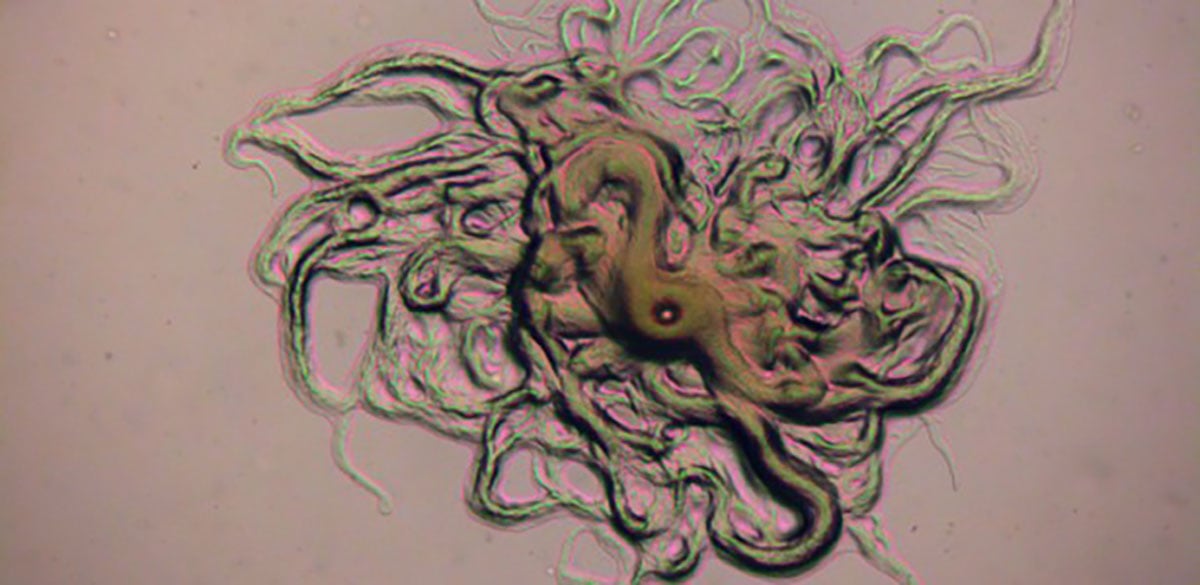
Pathogens that cause columnaris disease, previously found only in Asia and the United States, were identified in samples from São Paulo, Minas Gerais, and Paraná.
A nearly transparent bacterial colony can be easy to miss under a microscope. Yet identifying it matters for fish farms, where columnaris disease can damage the skin and gills of fish and kill young animals within days.
Researchers have now identified columnaris-causing Flavobacterium bacteria in Brazil, including species previously reported in fish farms in Asia and the United States. The pathogens were found in Nile tilapia (Oreochromis niloticus), commonly sold as Saint Peter, as well as native Brazilian fish such as tambaqui, pacu, and Amazon spotted catfish. The findings point to a need for closer disease surveillance and vaccines adapted to the strains circulating in Brazilian aquaculture.
“The initial identification of bacteria of this genus is done through visual examination of the colonies under a microscope. But since these microorganisms glide through the culture medium, depending on the medium used, the colony can become transparent and almost invisible. Therefore, extra care is needed during visual examination,” says Daniel de Abreu Reis Ferreira, the study’s first author.
Ferreira conducted the work while completing his doctorate at the Aquaculture Center of São Paulo State University (CAUNESP) in Jaboticabal, supported by a scholarship from FAPESP. Researchers from Zambeze University in Mozambique also contributed to the study, which was published in Microbial Pathogenesis.
Until recently, the four Flavobacterium species examined in this research were classified together as Flavobacterium columnare, the species that gave columnaris disease its name. The infection produces pale lesions across the skin and fins and can cause tissue death in the gills.
“The bacteria feed on epithelial cells and kill the fish within a few days, especially larvae and fry,” explains Fabiana Pilarski, a professor at CAUNESP who supervised Ferreira’s doctoral research.
Pilarski is also an associate researcher at the Science Center for the Development of Aquaculture Health, based at the Fisheries Institute.
Native fish expand the known host range
The researchers isolated 11 bacterial strains, six of which belonged to Flavobacterium oreochromis. In Brazil, this species had previously been associated only with tilapia, the most widely farmed fish both nationally and worldwide.
The latest analysis detected F. oreochromis in native species raised for food, including tambaqui (Colossoma macropomum), lambari (Astyanax lacustris), and pacu (Piaractus mesopotamicus). This indicates that the bacterium can infect a broader range of commercially important fish than previously recognized.
The researchers also documented the first known case of Flavobacterium davisii in an Amazon spotted catfish (Pseudoplatystoma punctifer).
“This case shows that the bacterium can also infect Siluriformes, a different order of fish from those it usually colonizes, which broadens the range of potential hosts for this pathogen,” Ferreira explains.
Warm water favors growth and persistence
Laboratory tests showed that pathogens previously reported only in Asia and the United States can grow under environmental conditions common in Brazil. F. davisii and F. inkyongense reached their optimal growth at 28 °C, close to the average temperature of inland waters across the country.
Two additional species, F. oreochromis and F. indicum, grew better under even warmer conditions. F. indicum reached its highest growth rate at 35 °C, suggesting that rising water temperatures could create more favorable conditions for the pathogen.
At 28 °C, the bacteria also produced substantial amounts of biofilm, a layer that helps microbial communities attach to surfaces and withstand unfavorable conditions.
“A biofilm is a protective matrix that allows bacteria to remain dormant when conditions are unfavorable and resume multiplication when the environment becomes conducive,” says Pilarski.
Biofilms can remain on tanks, nets, tools, and other equipment used during fish production, allowing bacteria to persist between outbreaks.
“This underscores the importance of robust hygiene and disinfection protocols to prevent the colonization of equipment used for fish handling,” Ferreira adds.
Biofilm production declined significantly at 35 °C in nearly all of the species tested. F. davisii was the exception, continuing to produce substantial biofilm at that temperature even though its ability to move was reduced.
“This suggests an adaptation – what we call a metabolic trade-off – in which it loses by moving less but gains by producing biofilm and surviving,” Ferreira explains.
Control may require salt and vaccines
Previous work from other research groups indicates that Flavobacterium bacteria are sensitive to salinity. Adding salt to farm water could therefore make it harder for the pathogens to establish themselves, although scientists still need to determine safe and effective salt concentrations for each fish species.
Researchers are also sequencing and studying the bacterial genomes to identify possible targets for vaccination. Their goal is to create autogenous vaccines, which are produced specifically from the strains found at an individual farm or production facility.
Because columnaris disease primarily attacks exposed tissues, researchers believe a bath vaccine could offer an efficient way to protect young fish. Instead of injecting each animal separately, producers could immerse large groups in water containing a weakened form of the relevant bacterium.
“Since columnaris disease primarily affects the skin, a vaccine in the form of a bath treatment using the weakened bacterium would be ideal, benefiting young fish in particular. This is a stage when the immune system is still developing, and because they’re small, large numbers of fingerlings could be vaccinated simultaneously,” says Pilarski.
Reference: “Molecular identification and phenotypic characterization of Flavobacterium spp. from Brazilian aquaculture fish” by Daniel de Abreu Reis Ferreira, Amarildo Petim Siragi Ussene, Elielma Lima Sousa, Carolina de Souza Pereira, Zacarias Junior Vilanculo, Daiane Vaneci da Silva, Inácio Mateus Assane, Diogo Teruo Hashimoto and Fabiana Pilarski, 6 May 2026, Microbial Pathogenesis.
DOI: 10.1016/j.micpath.2026.108536
Funding: Fundação de Amparo à Pesquisa do Estado de São Paulo
Never miss a breakthrough: Join the SciTechDaily newsletter.
Follow us on Google and Google News.