
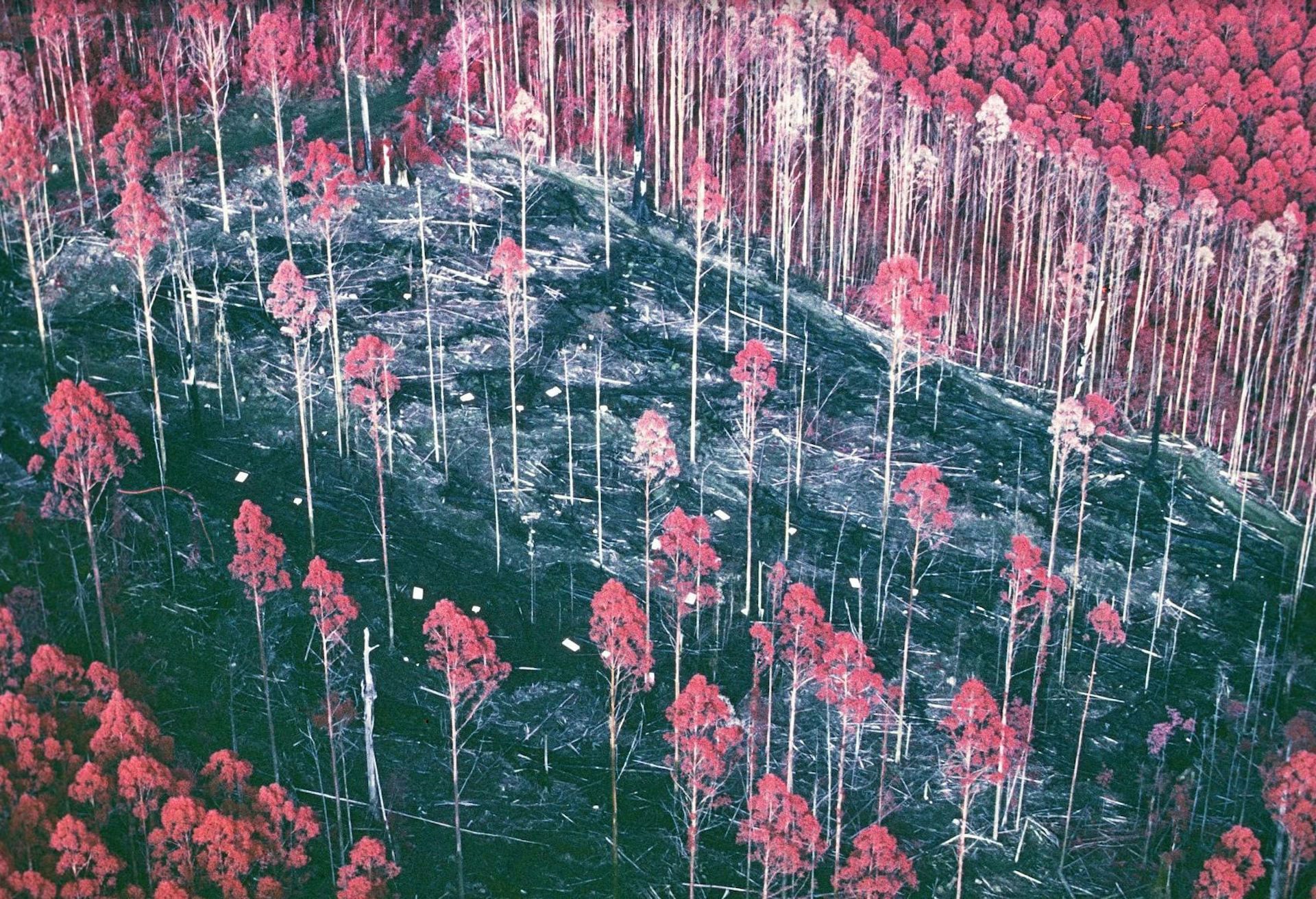
A decades-old experiment in Victoria’s mountain ash forests is challenging assumptions about the trade-offs between timber production and conservation.
Should a forest remain untouched, or should some trees be harvested to sustain nearby communities and economies? Australians have debated these competing approaches for decades, often treating conservation and timber production as mutually exclusive choices.
Research into a largely forgotten experiment in Victoria’s mountain ash forests suggests the answer is more complicated.
Clearfell logging, which removes every tree from a section of forest, has faced sustained criticism since the 1970s. Conservationists argued that the practice destroys habitat for rare wildlife and diminishes ecological value. Foresters countered that mountain ash forests naturally regenerate after catastrophic bushfires, making clearfelling a comparable disturbance.
The dispute became deeply polarized, but the central scientific questions persisted. Researchers still lacked clear evidence showing how clearfelling affected these forests over time and whether less intensive harvesting methods produced better outcomes.
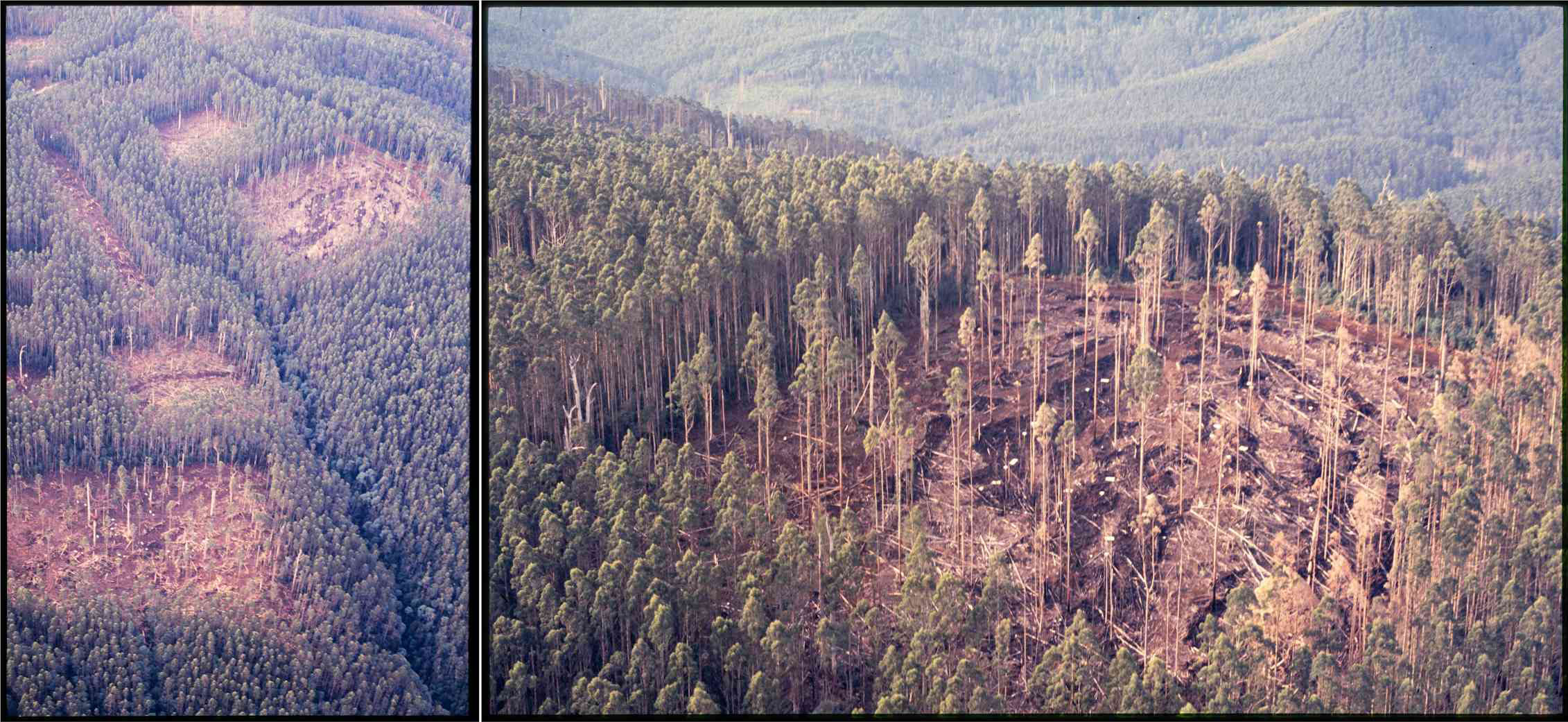
A landmark experiment
During a major restructuring of Victoria’s timber industry in the mid 1980s, the state government invested the equivalent of A$26 million today to investigate alternatives to clearfelling. The project focused on silviculture, the science of establishing, growing, and managing forests.
Between 1987 and 1989, researchers established the Silvicultural Systems Project at Tanjil Bren in Victoria’s Central Highlands and Cabbage Tree Creek in East Gippsland.
The landmark experiment compared forest regeneration under a broad range of management approaches. Researchers tested conventional clearfells (250–350 meters wide), smaller patch clearfells (50–140 m wide), and heavy thinning that removed 50–70% of the trees. Large areas of unharvested forest remained untouched to provide benchmarks for comparison.
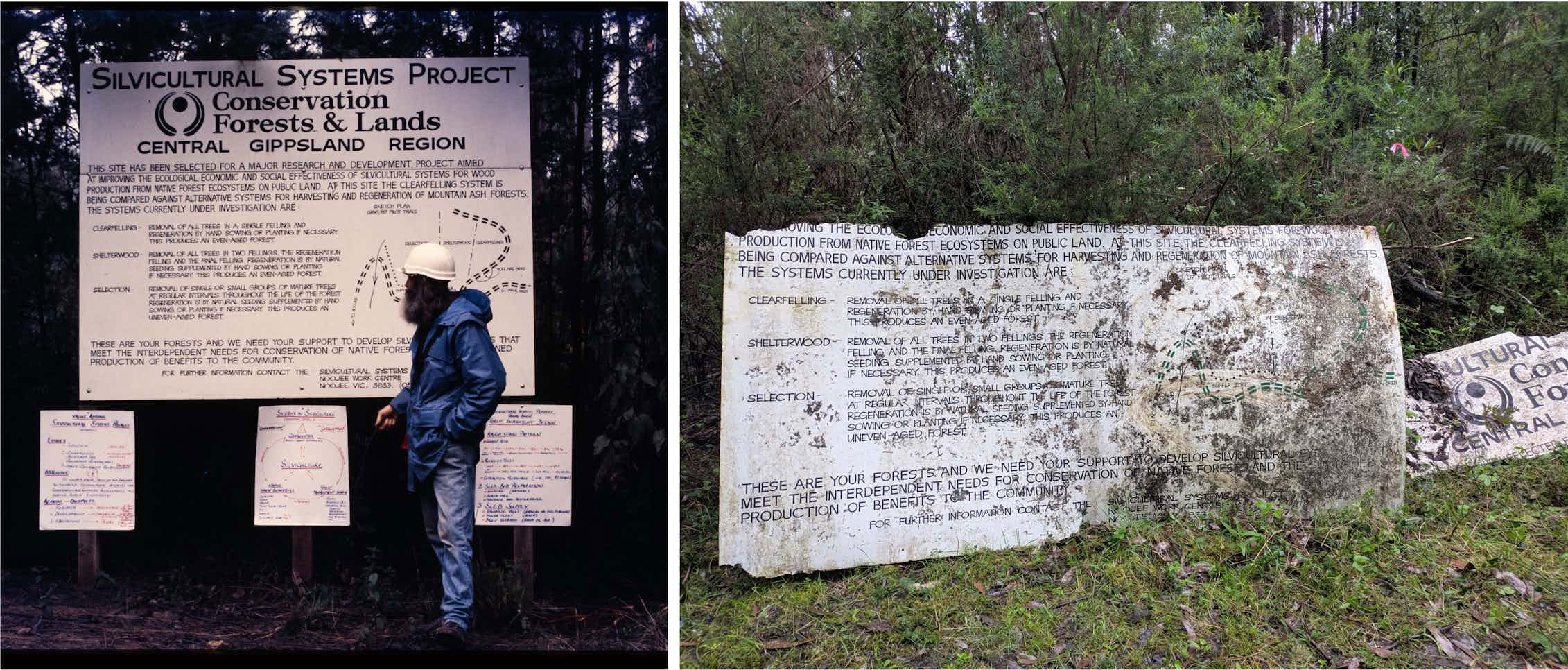
The forest at Tanjil Bren was dense mountain ash regrowth from the 1939 fires. Hundreds of survey plots were established and thousands of seedlings were monitored. By the early 2000s, the results were clear: mountain ash regenerated best on clearfell sites. Where tall canopy trees were retained or the cleared patches were small, common understory species such as acacia dominated.
The findings were published. The access road grew over. The project sign collapsed. The experiment was forgotten. The debates continued.
But the trees kept growing.
Thinning produced an unexpected outcome
In 2014, we visited the Tanjil Bren site as part of a University of Melbourne subject on silviculture in native forests. A colleague, Simon Murphy, had been involved in its establishment and suggested our students see the long-term outcomes of different silvicultural systems side-by-side. What we found was astounding.
The original results still held: 30 years later, the mountain ash in the large cleared patches and clearfelled areas was vigorous and abundant. But it was the heavily thinned parts of the forest that really caught our attention.
The trees left behind after thinning were enormous. While they were only 80 years old, the largest averaged well over a meter in diameter at chest height, and some were more than 1.5 m. Thinning had given these trees more space and resources to grow, and they had responded dramatically. The largest trees in the thinned stands were 20% bigger in diameter than those in the unharvested control areas.
More remarkable still: the thinned stands of trees had stored as much or more carbon in their wood than the unharvested control areas. In just 30 years, the heavily thinned forest had not only recovered all the carbon removed during harvesting, but had also gained enough additional carbon to equal the increase seen in the unharvested controls.
These findings have profound implications. Bigger trees are more resistant to fires, so when the next fire occurs, they are more likely to survive. Bigger trees are also more likely to form hollows – a critical and declining habitat for rare species such as the greater glider and Leadbeater’s possum.
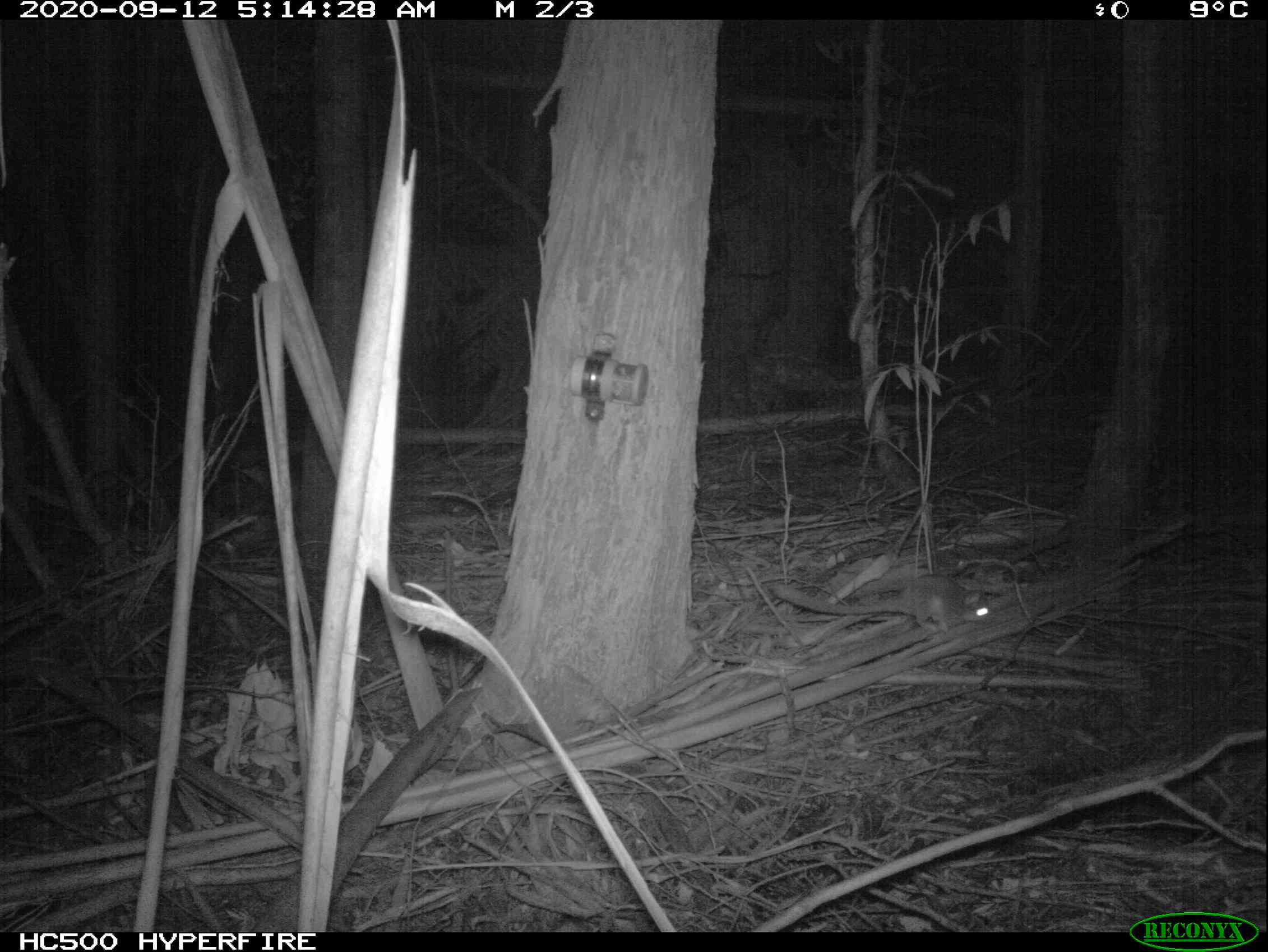
The acacia trees that grew in most of the silvicultural treatments are also vital for Leadbeater’s possums, which use it to forage and move around the forest. Camera traps across the sites confirmed this: Leadbeater’s possums were found in every silvicultural treatment plot we surveyed – but none of the unharvested areas.
Forest management needs more than one answer
The Tanjil Bren SSP offers three important lessons.
First, long-term silvicultural experiments are irreplaceable. Australia’s forests contain many forgotten experiments that could transform our understanding of how forests respond to human intervention. But all too often, they end up neglected, unfunded, and forgotten. We should find them before it is too late.
Second, forest thinning is not a trade-off. Our findings show this for mountain ash, and other studies in North America have shown this for conifer forests. It can deliver wood for local industry, absorb carbon and improve habitat for wildlife. It is a win-win-win outcome that challenges the false dichotomy of conservation versus production that has dominated public debate for decades.
While thinning cannot (and should not) be done everywhere, it may be a useful tool to create more variety in tree ages and sizes, particularly in forests impacted by clearfelling or high-severity fire.
Third, and perhaps most importantly: there is no silvicultural silver bullet for managing forests. The long-forgotten experiment at Tanjil Bren has taught us that there are options available for managing our forests beyond clearfelling that can contribute to the societal demand for wood, maintain carbon stocks, and conserve biodiversity.
Reference: “Alternative Silvicultural Systems Maintain Multiple Values in Tall Eucalypt Forest” by Kaitlyn L. Hammond, Craig R. Nitschke, Raphaël Trouvé and Patrick J. Baker, 01 July 2026, Forest Science.
DOI: 10.1007/s44391-026-00076-6
Adapted from an article originally published in The Conversation.
Never miss a breakthrough: Join the SciTechDaily newsletter.
Follow us on Google and Google News.
12 Comments
Interesting result. It reminds me of a recent documentary about US California redwoods, which obviously are an unrelated species. Laws had been passed to save redwoods by allowing felling by permit only in a designated recovery area. Numerous redwoods were planted. First they grew vigorously. Due to planting density, they started crowding each other out, dying, and seedling trees became rare. Local native peoples who had lived in balance with flora and fauna in redwood forests were consulted. (What a late after thought!) They had always thinned redwood trees as the trees grew taller because they overcrowd each other as they continue towards eventual massive size well beyond human life spans. Indigenous peoples were given control of the search area, they employed ancient management practices that include thinning, and the redwoods began thriving again. I think we humans need to acknowledge our symbiotic roles in these systems.
Isn’t this common sense that the more air and light the trees get the faster they’re going to grow. With less Forest debris that breeds fungal and possibly organisms that damage trees.
No. It’s not common sense. It’s attribution after the fact.
Common sense would have been if you could have answered this question correctly before the experiment.
Even if you could, and if this were common sense, experimental confirmation is essential for science. Science doesn’t accept “common sense” at face value.
I live way up in the mountains, and I have seen clearcut logging, and I have seen thinning logging. In every place where they clearcut, 30 years later the forest is still a mess. All the trees are only about 20 feet tall, but the land is now severely overgrown even thought the trees are only 20 feet tall. It’s an abnormal forest with trees only inches apart. It’s a super dense forest. The fire hazard is now far far higher. There is no grass between the trees, only other trees. You can’t walk through it. Larger animals are kept out. Only smaller animals can get in but only on the edges. Proper thinning results in a normal looking forest within 1 year. Some tall trees mixed with medium height trees, and some smaller trees with short grass inbetween. Dear, and other large animals can travel through this forest, and the short grass means that fires are far less of a problem. From what I have seen. Clearcut is EVIL, and thinning is proper forest management.
That tells us something about the constant mantra about how lack of forest management is what’s causing the increased wildfires, a favorite among climate science deniers. The logging itself can cause lots of underbrush
“… a favorite among climate science deniers.”
That is not an objective statement! It shows your obvious bias. At its core, all science should be skeptical. That is, it should resist abandoning the prevailing paradigm based on uninformed consensus, and insist on solid evidence before supporting a new paradigm. Ultimately, the decision on what is provisionally true should be based on evidence, not on consensus or political leaning. This study demonstrates that for Australian mountain ash, heavy thinning produces results similar to clearfelling (or what we call “clear cutting” in the USA), but with some very large trees surviving that are apparently better at sequestering carbon. That may not be true for all desirable species. One should be guided by sound, repeatable experiments, with a defined goal such as a preference of ash over acacia.
Your complaint about logging can best be addressed by requiring loggers to clean up their waste by chipping.
There are good reasons to criticize current forest management, not the least of which includes commonly banning clear cutting. People who denigrate others because they ask uncomfortable questions do not understand the nature of science. People who have already made up their minds as to what the ‘truth’ is are a threat to both science and society. I’ve always been partial to the idea that “an open mind holds more truth than a closed mind.”
>While thinning cannot (and should not) be done everywhere, it may be a useful tool to create >more variety in tree ages and sizes, particularly in forests impacted by clearfelling or high->severity fire.
Where is the evidence to support your claim in this supposed to be a scientific discussion? (Fake info/disinformation/misinformatio) Hidden agenda inserted into a supposed to be a scientific discussion?
What is the support for your claim that this isn’t a scientific discussion, other than your comments? Ambiguous assertions alone, without facts, don’t establish the truth of the assertions. It is no better than claiming the moon is made of cheese. The authors provide details, including dates, and the outcome of the old experiment. What do you provide?
No doubt about it, nature knows best and thinning would appear to be a more natural procedure!
Such human arrogance. The entire article’s attitude is that humans have the right to do anything we want to the forests.
Conversely, can you make a cogent argument that humans, who are a product of evolution, don’t have the right? Implicit in your rant is the idea that humans are somehow different from the herbivores that may kill seedlings by eating them, or elephants that push over mature trees to eat the leaves. With respect to your complaint, there are birds (kites and falcons) native to Australia that will pick up burning branches and fly with them to an area adjacent to a wildfire to spread the fire. Who gave them the ‘right’ to spread fires?
I am curious how the carbon in the forest is measured, does it account for below ground carbon and mycelium networks. Recent research finds that mycelium continues to sequester sugars into the surrounding soils and trees, so above ground measurements favoured by foresters are severely underestimating the carbon sequestration of mature trees.