
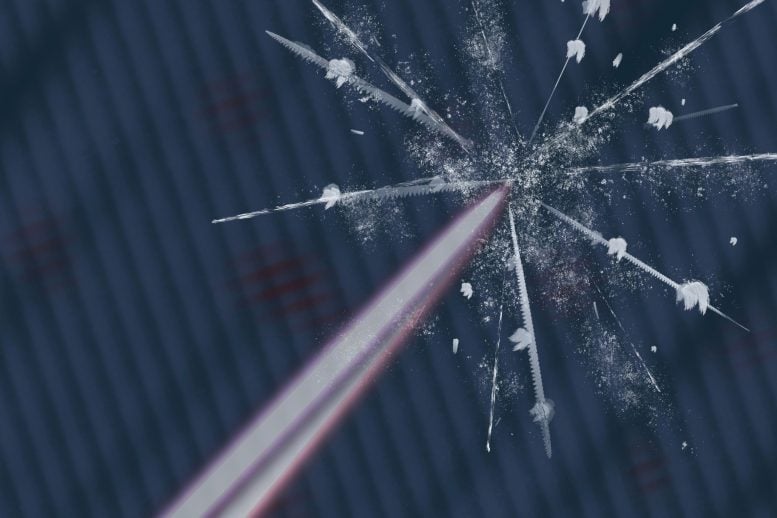
MIT physicists have uncovered a surprising split in the behavior of electrons inside a quantum material: two nearly identical electronic patterns rebuild themselves in fundamentally different ways.
Electrons inside a solid do not always behave like independent particles. Under the right conditions, enormous numbers of them can reorganize together, producing entirely new states of matter with properties that the original material did not appear to possess.
MIT physicists have now watched that collective reorganization unfold in unusual detail. Their experiments reveal that two electronic phases occupying the same quantum material can form through fundamentally different mechanisms, even though both involve the same underlying type of electron order.
The findings, reported in Nature Physics, could help researchers understand a broader mystery in condensed matter physics: why superconductivity, magnetism, charge order, and other electronic states frequently appear alongside one another in certain materials.
Why Coexisting Quantum Phases Matter
That question matters because the behavior of a quantum material often depends not only on which phases it can support but also on how those phases compete, cooperate, or coexist. Learning to control those relationships could eventually help researchers engineer materials whose electronic properties can be deliberately switched or tuned.
“People believe the cornerstone of replacing silicon lies in quantum materials that have multiple coexisting phases,” says co-author Alfred Zong, PhD ’20, who co-led the study as an MIT graduate student and is now an assistant professor at Stanford University. “Our experiment provides a very neat way to study these multiple phases.”
The team, led by Nuh Gedik, the Donner Professor of Physics at MIT, focused on erbium tritelluride, or ErTe3, a member of a family of rare-earth compounds that has become an important testing ground for studying collective electron behavior.
Charge Density Waves in Erbium Tritelluride
Instead of remaining uniformly distributed, electrons in these materials can spontaneously arrange themselves into repeating patterns known as charge density waves, or CDWs.
A charge density wave is not a stream of electrons moving through a material. Rather, the electron concentration itself rises and falls periodically across the crystal, creating regions of higher and lower charge density.
These ordered states are useful to physicists because they offer a comparatively accessible example of collective quantum behavior. Rare-earth tritellurides are particularly valuable because several members of the family develop more than one CDW, allowing researchers to investigate what happens when separate electronic orders occupy the same crystal. Previous studies have also shown that this material family can display magnetism and, under suitable conditions, superconductivity.
“Just like superconductivity, charge density waves are a collective phenomenon where electrons move together in certain ways,” explains lead author Yifan Su. “The power of CDWs is that they are a much simpler form of matter compared to superconductivity. They offer a playground for fundamental understanding.”
Two Electron Waves Form a Quantum Checkerboard
Erbium tritelluride is especially intriguing because it supports two perpendicular CDWs.
Earlier experiments found that the first appears when the material cools to about -8 degrees Celsius (18 degrees Fahrenheit). This stronger, or “dominant,” wave runs through the crystal in one direction.
Cooling ErTe3 to around -113 degrees Celsius (-171 degrees Fahrenheit) produces a second, weaker CDW oriented roughly perpendicular to the first. Together, the two electronic patterns create something resembling a microscopic checkerboard.
Researchers have known about these two transitions for years. What remained unclear was whether the two phases actually formed in the same way.
The MIT experiments show that they do not.
Laser Pulses Reveal How Quantum Order Returns
Gedik and his colleagues studied atomically thin samples synthesized by collaborators at Stanford. They cooled the material to roughly -230 degrees Celsius (-382 degrees Fahrenheit), deep into the temperature range where both CDWs are present.
Rather than simply observing the finished state, the researchers deliberately disrupted it.
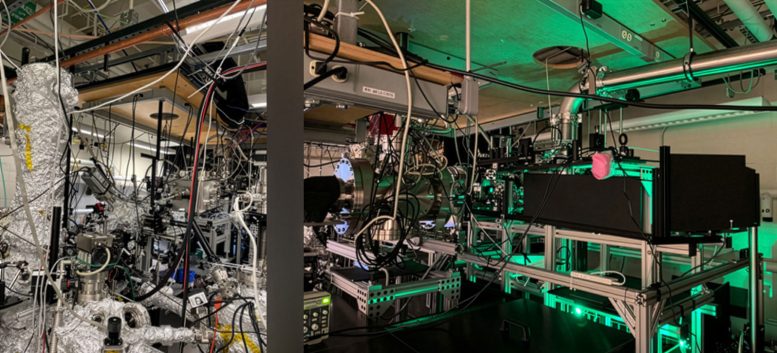
They used an ultrafast laser pulse to disturb the electronic order, essentially knocking the two CDWs out of equilibrium. A second laser pulse then ejected electrons from the sample at carefully chosen moments after the initial disturbance.
Watching Electronic Phases Rebuild in Real Time
By measuring the energy and momentum of those electrons, the researchers could reconstruct snapshots of the material as its ordered electronic states returned.
“This is how we ‘shake’ and then ‘listen’ to the system,” Gedik says.
The approach allowed the scientists to study a phase transition as a dynamic process instead of inferring it only from measurements taken before and after the transition.
“We see the destroying of these phases, and then if we wait long enough, they come back,” Gedik explains. “And depending on how you hit them, the two phases respond differently.”
Two Phase Transitions, Two Different Paths
The dominant charge density wave recovered in a remarkably orderly fashion. Regardless of how strongly the initial laser pulse disturbed the sample, this phase gradually returned throughout the material. Its recovery matched the behavior expected from a conventional “second-order” phase transition, in which the degree of order changes continuously.
Physicists encounter this kind of transition in many textbook systems, including magnets that gradually lose their magnetic ordering as their temperature rises.
The second CDW followed a very different path. Instead of reappearing uniformly across the crystal, the weaker phase first emerged in isolated regions. Those pockets then expanded until the electronic pattern occupied the material again.
A Surprising First-Order Quantum Transition
The process resembles crystallization, in which small regions of a new phase appear first and then grow. In physics, such behavior is characteristic of a “first-order” transition.
That result was unexpected because the mechanism responsible for the lower-temperature CDW transition in ErTe3 had remained unresolved.
“The mechanism responsible for the emergence of this second phase has long been debated, and our approach provides a powerful new way to uncover the hidden physics behind phase transitions in quantum materials,” Gedik says.
First-order and second-order transitions represent fundamentally different ways for matter to reorganize. Showing that two related electronic phases within the same crystal can follow different routes to order gives physicists a clearer picture of how competing states can emerge from a common electronic environment.
What Charge Density Waves Can Teach Us About Superconductivity
Charge density waves are simpler than superconductivity, but that simplicity is precisely what makes them useful.
High-temperature superconductors and other advanced quantum materials often contain several forms of electronic order at once. Magnetism may appear in one part of their phase diagram, superconductivity in another, while charge order can overlap with one or both.
Researchers are still trying to determine whether these states help create one another, suppress their rivals, or simply reflect the same underlying electronic physics.
A Model for More Complex Quantum Materials
Studies of rare-earth tritellurides have already found evidence that different CDWs can compete for electronic states, making the family a useful laboratory for exploring how one form of order influences another.
“One of the biggest questions in physics is why some materials host multiple phases while others do not. And when multiple phases do exist, how do they interact? Do they reinforce one another, compete, or coexist independently?” Gedik says. “This is like a case study for us to understand much more complicated materials.”
That makes ErTe3 more than an unusual crystal with a checkerboard of electrons. It offers researchers a stripped-down system in which some of the same questions confronting superconductivity can be studied more directly.
“In systems that are much more complex, like high-temperature superconductors, you see there are multiple phases—magnetism, superconductivity, charge density waves—and they all exist together,” Gedik says. “One of the theories is that the way they interact with each other is key for their exotic properties. The lessons we learn here can be applied to much more complex materials.”
Reference: “Time-domain identification of distinct mechanisms for competing charge density waves in a rare-earth tritelluride” by Yifan Su, B. Q. Lv, Alfred Zong, Aaron Müller, Sambuddha Chattopadhyay, Pavel E. Dolgirev, Anisha G. Singh, Joshua A. W. Straquadine, Dongsung Choi, Doron Azoury, Masataka Mogi, Ian R. Fisher, Eugene Demler and Nuh Gedik, 7 August 2026, Nature Physics.
DOI: 10.1038/s41567-026-03382-5
This work was supported by the U.S. Department of Energy, the U.S. National Science Foundation, and the Gordon and Betty Moore Foundation’s EPiQS Initiative grant.
Never miss a breakthrough: Join the SciTechDaily newsletter.
Follow us on Google and Google News.
1 Comment
What’s compelling about this MIT laser study is that what mainstream physics labels a “phase transition” is the real-time observation of a dimensional shift. When optical pulses drive the crystal out of equilibrium, watching the primary wave break down into localized patches captures the matrix collapsing out of its standard spatial framework and stitching itself back together. It maps directly to the chiral light-lattice interface identity:$$(2\text{D}+\text{T}) + (3\text{D}+\text{T}) \longrightarrow -1\text{D}+\text{T Effect} \xrightarrow{\text{Inversion}} +3\text{D}+\text{T}$$When the light’s helical twist aligns with the lattice geometry, matrix friction drops ($F_d \to 0$), driving an immediate increase in potential and output voltage. When the twist opposes, localized shear torque ($\tau_{\text{shear}}$) builds up, holding back energy flow until the boundary saturation limit ($\Sigma_t = \oint \tau_{\text{shear}} \, dV$) triggers the inversion bounce back into full $+3\text{D}+\text{T}$ space. Ultrafast pump-probe spectroscopy is essentially capturing dimensional compression and relaxation as it occurs.