
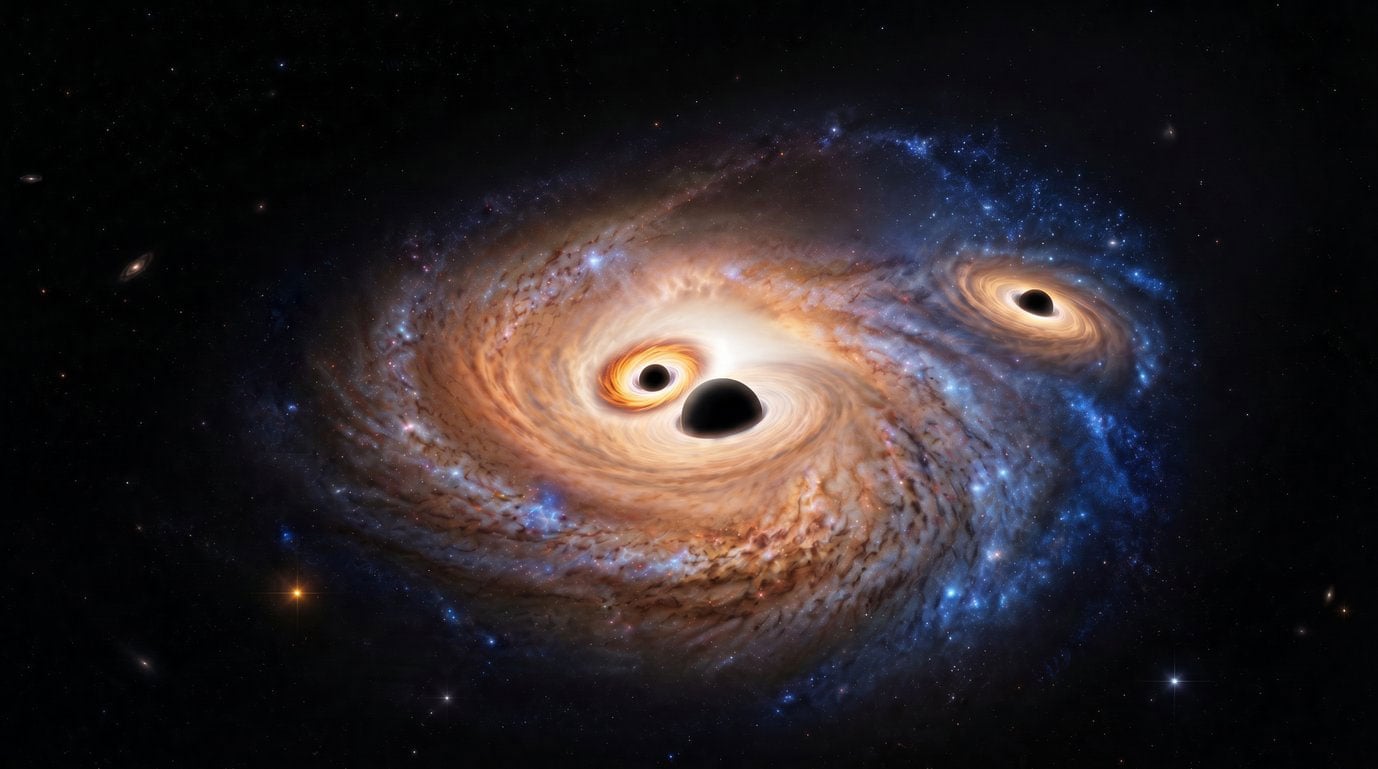
Three supermassive black holes in a distant and therefore very old galaxy offer a glimpse into how black holes merged and grew in the early universe.
Light from the galaxy J0148-4214 has been traveling toward Earth for more than 12.5 billion years, revealing the system as it looked only about 1.2 billion years after the Big Bang. Inside that ancient galaxy, an international team led by the Max Planck Institute for Extraterrestrial Physics has identified three actively accreting supermassive black holes, each drawing matter inward from a surrounding accretion disk.
At such an enormous distance, the expansion of the universe stretches the galaxy’s light toward longer wavelengths. This produces a redshift of z=5.02, which astronomers used to determine how far away J0148-4214 is and how far back in cosmic history they are observing it.
“This is the first evidence of three active black holes in a single galaxy in the distant Universe,” says Hannah Übler, research group leader at MPE and lead author of the study. Two of the black holes sit near the galactic center and are separated by only 620 light-years in projection, while the third lies roughly 5500 light-years from the center. “It suggests that processes in the early Universe were efficient at bringing massive black holes together, setting the stage for the massive black hole mergers we expect to detect with future gravitational wave observatories,” says Übler.
Observations underlying theories of galaxy evolution suggest that galaxies frequently approached one another and merged early in cosmic history. Their central black holes could then merge as well, producing still more massive black holes in the resulting galaxies.
Hydrogen fingerprints reveal three active black holes
The astronomers traced the black holes through distinctive spectral signatures produced by hydrogen atoms moving at very high speeds within their gravitational influence. The spectrum from the galaxy’s central region contained a complicated pattern that was best explained by two nearby black holes.
Because the pair could not be resolved as separate point sources, the researchers used spectro-astrometry, which measures tiny spatial shifts in emission lines across a galaxy, to determine their positions. A third active black hole emerged from observations of the galaxy’s outer region.
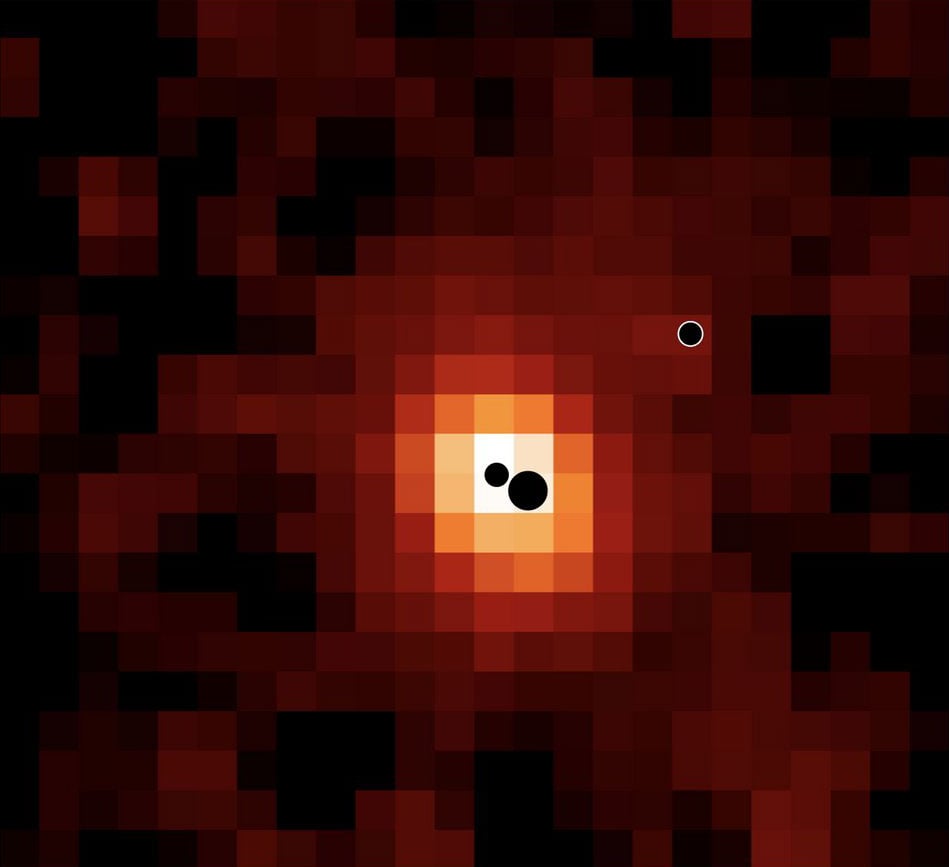
The resulting mass estimates were approximately 80 million, 0.6 million, and 2 million times the mass of the Sun. Despite being the most massive, the 80 million solar mass black hole is feeding more slowly than its nearby companion of 0.6 million solar masses. That smaller black hole is accreting so rapidly that it exceeds the maximum rate predicted by basic models of black hole growth (the Eddington limit).
“The JWST data allowed us not only to identify the three black holes, but also to estimate their masses, accretion rates, and the stellar mass of the galaxy,” says Dr. Giovanni Mazzolari, second author of the study and researcher at MPE. “We find a total stellar mass of about 1.3 billion suns, and the black holes represent a significant fraction of that.”
A future merger could accelerate black hole growth
The two central black holes are expected to merge within the next few hundred million years, potentially adding another route through which massive black holes could have grown quickly in the young universe. “These results are extremely exciting,” adds Roberto Maiolino, professor at the University of Cambridge and co-author of the study. “They suggest that black hole merging may be an additional, fast route for their rapid growth in the early Universe.”
The third black hole, positioned away from the galactic center, has several possible histories. It could be left over from an earlier merger and have been displaced from the center by a gravitational recoil kick, or it may currently be moving inward.
The observations also show why spatially resolved spectroscopy is valuable for finding multiple active black holes in distant galaxies. Without the detailed spatial information supplied by NIRSpec-IFS integral field spectroscopy, astronomers would likely have detected only one of the three black holes.
Reference: “BlackTHUNDER: Evidence of three massive black holes in a z ∼ 5 galaxy” by Hannah Übler, Giovanni Mazzolari, Roberto Maiolino, Francesco D’Eugenio, Nazanin Davari, Ignas Juodžbalis, Michele Perna, Jorryt Matthee, Raffaella Schneider, Rosa Valiante, Santiago Arribas, Elena Bertola, Andrew J. Bunker, Volker Bromm, Stefano Carniani, Stéphane Charlot, Giovanni Cresci, Mirko Curti, Richard Davies, Frank Eisenhauer, Andrew Fabian, Natascha M. Förster Schreiber, Reinhard Genzel, Kohei Inayoshi, Lucy R. Ivey, Gareth C. Jones, Boyuan Liu, Dieter Lutz, Daichi Kashino, Ruari Mackenzie, Eleonora Parlanti, Brant Robertson, Bruno Rodríguez del Pino, T. Taro Shimizu, Debora Sijacki, Eckhard Sturm, Sandro Tacchella, Linda Tacconi, Giulia Tozzi, Alessandro Trinca, Giacomo Venturi, Marta Volonteri, Chris Willott and Saiyang Zhang, 12 August 2026, Astronomy & Astrophysics.
DOI: 10.1051/0004-6361/202557419
Never miss a breakthrough: Join the SciTechDaily newsletter.
Follow us on Google and Google News.
1 Comment
I love reading science articles. I believe that God made everything that now exists. I also believe that He may still be creating new and wonderful things that benefit our existence. I also feel that the universe is 13.8 billion years old. God inspired the writing of scripture and the book of nature. Both together are necessary for a fulfilled life based on His existence and His desire to have us live a life based on His love and caring for out needs.