
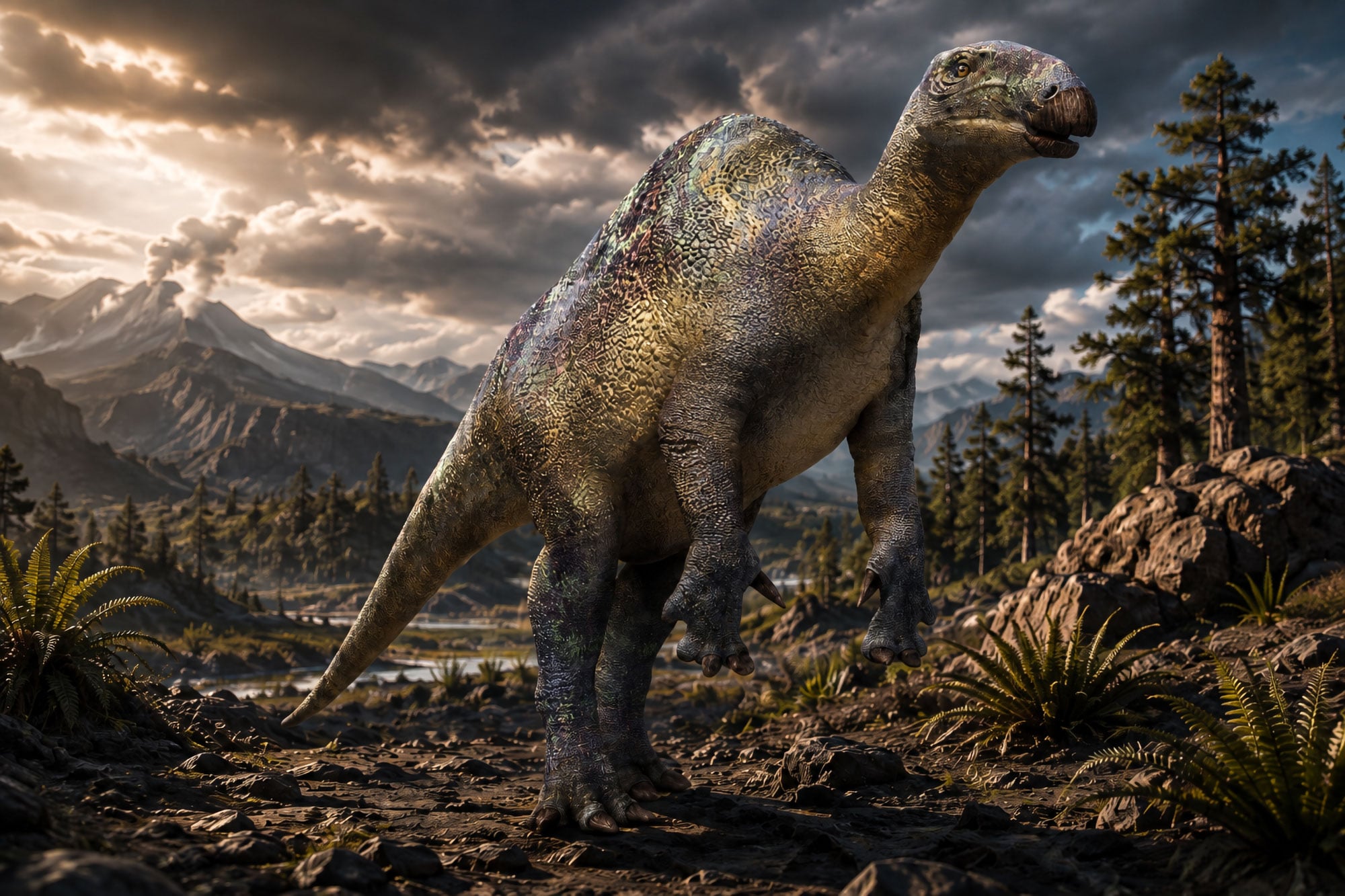
A small iguanodontian fossil from Japan adds evidence that Late Cretaceous coastal ecosystems supported dinosaurs of widely different body sizes.
Iguanodontians were widespread plant-eating dinosaurs that lived from the Late Jurassic through the Late Cretaceous. Their movement between Asia, North America, and Europe helped shape their diversification across Laurasia, making fossils from Japan especially useful for understanding how the group evolved and spread.
Recent discoveries in Japan have strengthened evidence that iguanodontians lived in coastal environments along eastern Asia. Yet much of the Japanese fossil record remains incomplete. Although researchers have described a nearly complete skeleton of a large iguanodontian (approximately 8 meters in length), most specimens consist only of isolated teeth and other fragmentary remains, leaving important questions about their ecology and diversity unresolved.
A forgotten fossil waited two decades
One such fossil was discovered in 1999 on the grounds of the Iwaki City Ammonite Center in Fukushima Prefecture. The site lies within the Obisagawa Member of the Ashizawa Formation (formed approximately 90-88 million years ago), part of the lower Upper Cretaceous Futaba Group, which preserves sediments deposited in a shallow-marine environment.
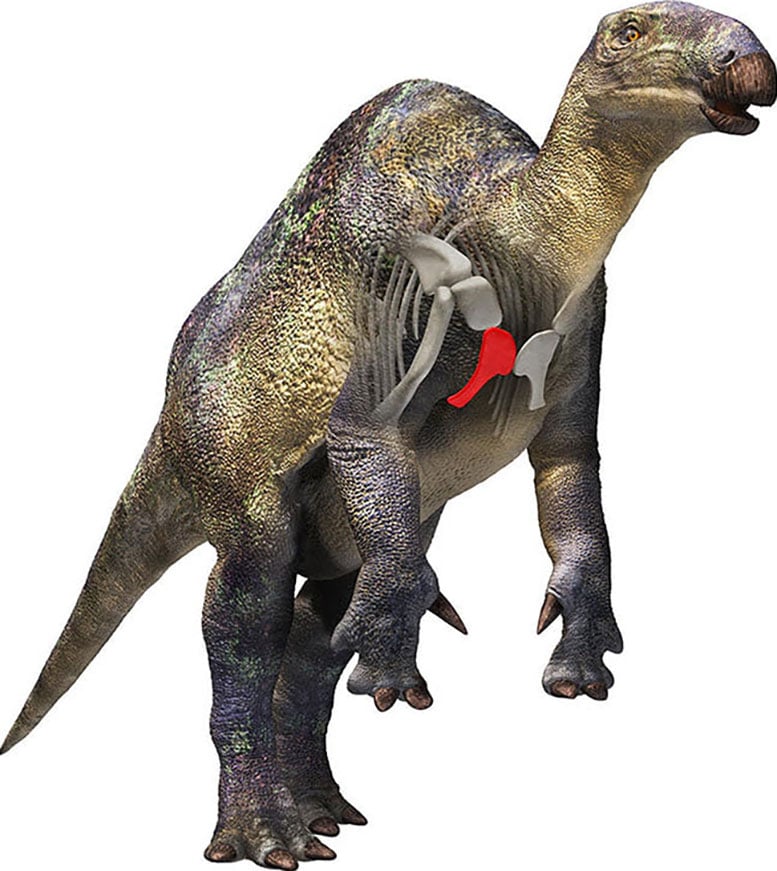
The isolated bone was initially thought to be the sternal plate, or breastbone, of a hadrosauroid dinosaur. Despite that tentative identification, the specimen remained unstudied for more than 20 years.
A smaller dinosaur expands coastal diversity
A detailed morphological analysis has now identified the fossil as the right sternal plate of an indeterminate styracosternan, a derived iguanodontian group that includes hadrosauroids. Comparisons with related species suggest that the animal was approximately 3 meters long, making it substantially smaller than other iguanodontians previously recovered from the same formation.
Larger iguanodontians, including hadrosauroids, are already known from Late Cretaceous Japan. The presence of this much smaller animal, therefore, suggests that iguanodontians spanning a wider range of body sizes occupied coastal environments in East Asia, adding new evidence for the diversity of these ancient ecosystems.
Reference: “An iguanodontian sternal plate from the Upper Cretaceous Ashizawa Formation (Futaba Group) of Fukushima Prefecture, Japan” by Masami Kondo, Kohei Tanaka, Fumiaki Utagawa, Junki Yoshida and Darla K. Zelenitsky, 2026, Paleontological Research.
DOI: 10.2517/prpsj.250042
Never miss a breakthrough: Join the SciTechDaily newsletter.
Follow us on Google and Google News.