
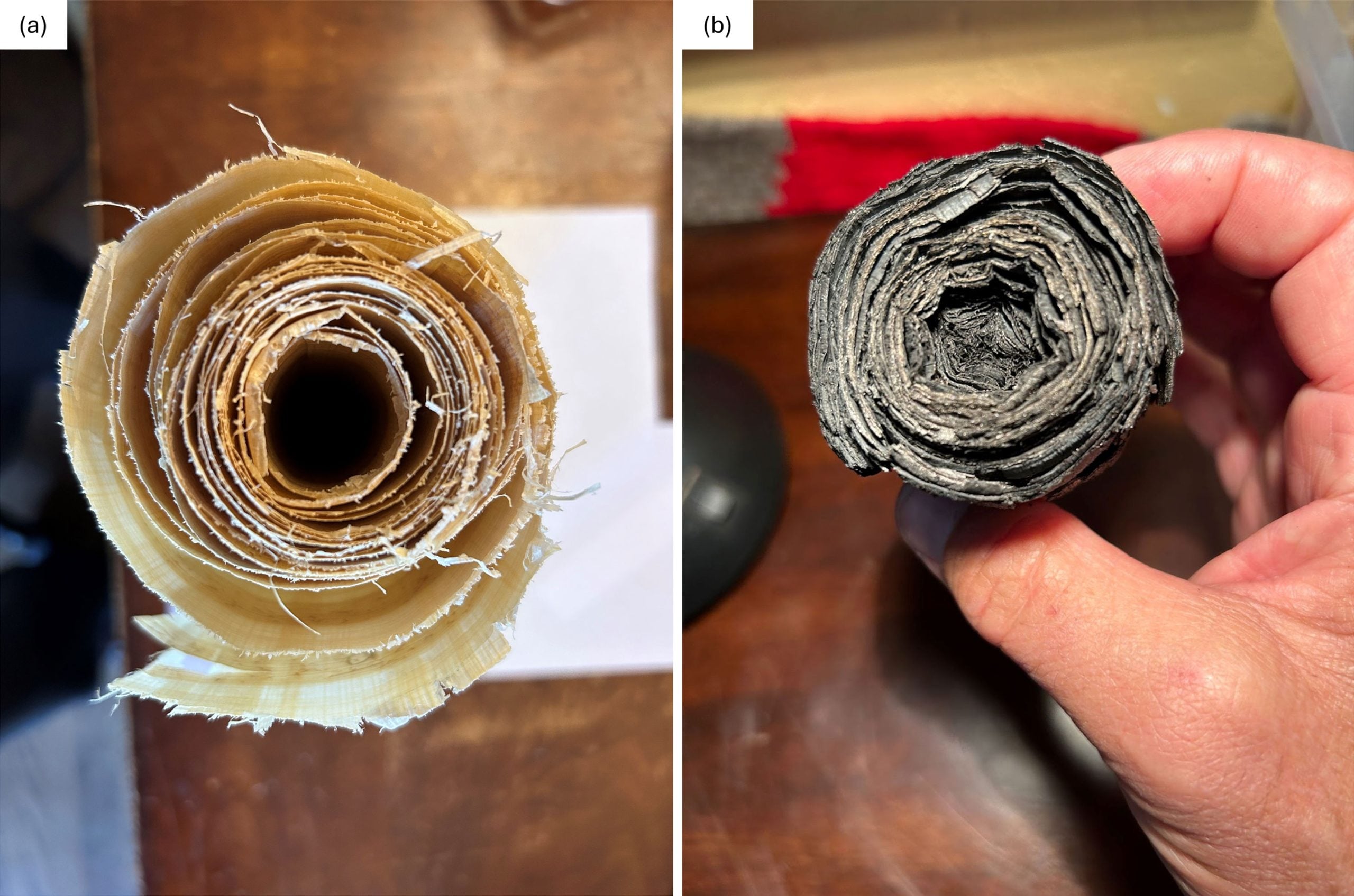
Researchers recreated a damaged ancient scroll to test a new way to study the past.
Lead in ancient ink could help researchers read the Herculaneum papyri, Roman scrolls buried when Mount Vesuvius erupted in 79 CE. Many are now too brittle to open, and reading them with X-rays poses its own problem. The ink and papyrus are both carbon-based, making the writing difficult to distinguish from the material beneath it.
Researchers have found lead in some letters on fragments from the scroll collection. Because X-rays can distinguish lead from papyrus more easily, a team tested whether the metal could help reveal writing inside similarly damaged scrolls. They made their own versions, wrote on them with ink containing different concentrations of lead, and subjected them to intense heat. Scans then allowed them to recover some of the words.
The findings appeared in the open access journal PLOS One. The study’s authors include Douglas Seiler, an affiliate of the University of California, Berkeley, Jacob Michael LaManna of the U.S. National Institute of Standards and Technology, David Kreimer of the University of California, Berkeley, and colleagues.
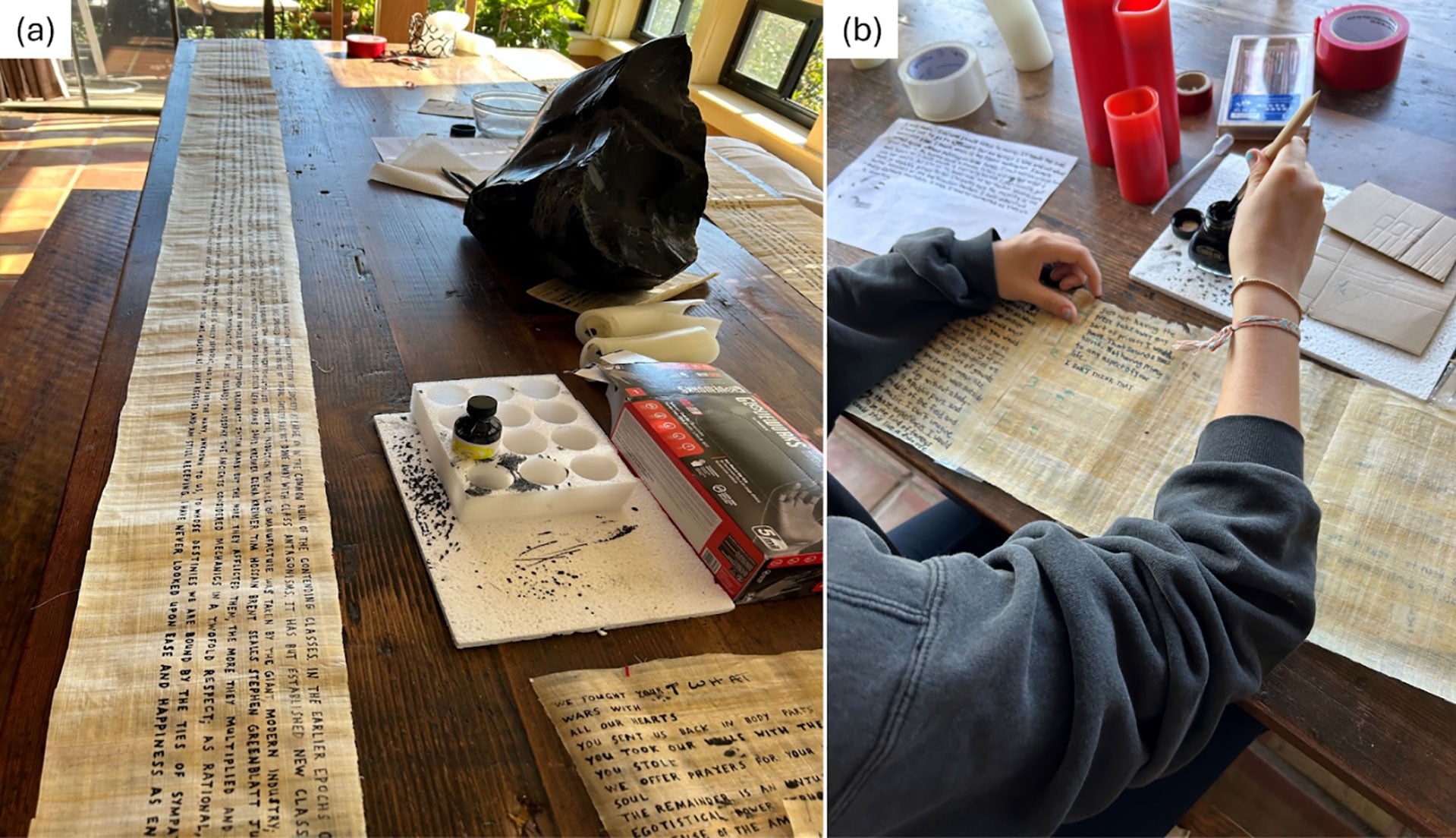
Reading scrolls too brittle to open
The replicas mimicked the damage caused by the eruption that buried the ancient scrolls beneath 65 to 70 feet, or about 20 to 21 meters, of rock and ash. The extreme heat carbonized the papyrus, turning it into brittle, carbon-rich material. The originals were later discovered in the ruins of Herculaneum, near Naples, Italy. Some have been opened and read, revealing previously unknown writings by Epicurus and other ancient thinkers, while many remain too fragile to examine that way.
Recent work combining artificial intelligence with X-ray tomography has allowed researchers to virtually unroll some scrolls and read portions of their text. Tomography uses X-ray measurements to build images of an object’s internal structure. Software can then digitally separate and flatten the papyrus layers, although distinguishing the ink remains a challenge.
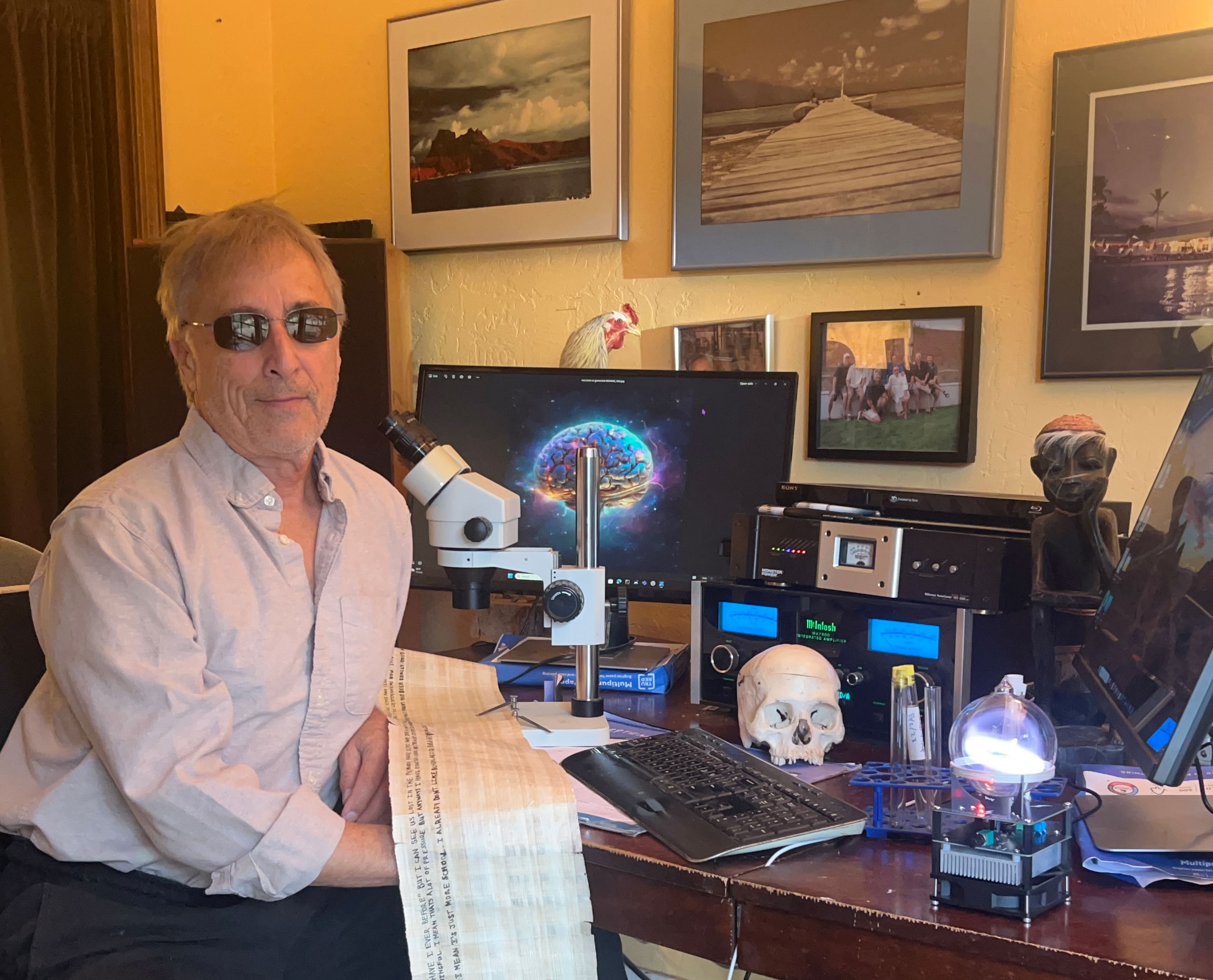
X-rays recover words from recreated scrolls
To investigate how lead might help, the team wrote on new papyrus using inks with varying lead concentrations, rolled it into scrolls, and carbonized the replicas in a high-temperature furnace. They examined the resulting scrolls with X-ray fluorescence, a technique that can identify elements within a material. It detected lead at every concentration tested. X-ray tomography, paired with a custom software program, then enabled the researchers to reread some of their writing.
Seiler said, “It’s amazing what you can get electrons to do.”
The results support a proposed approach for the ancient collection. Researchers could first screen scrolls for lead, then attempt to virtually unroll those containing it. The replica experiments suggest this could offer a way to read some of the more complex Herculaneum scrolls, although they do not establish how much text the approach would recover from the originals.
The recreated scrolls could also help researchers improve the software used to decipher hidden writing. Unlike an unread ancient scroll, each replica contains text the team already knows. That gives researchers a reference for training an algorithm to interpret the scans correctly, potentially improving its ability to read ancient texts.
Reference: “A model carbonized papyrus scroll opens a novel path to identifying readable scrolls of the Herculaneum Library” by Douglas Seiler, Jacob Michael LaManna, Michael McOsker, David Kreimer, Michael Cyrus Daugherty and Jens Dopke, 16 September 2026, PLOS ONE.
DOI: 10.1371/journal.pone.0353485
The work conducted at NIST, was funded (just use of equipment & staff) by the Department of Commerce, Radiation Physics Division, and the Center for Neutron Research.
Never miss a breakthrough: Join the SciTechDaily newsletter.
Follow us on Google and Google News.