

An observational study links sugar rationing in early life to lower adult anxiety and depression risks, raising the possibility that our earliest diets have lasting mental health implications.
Could the amount of sugar we consume before birth and during infancy influence our mental health decades later? An experiment rooted in postwar Britain suggests that the effects of our earliest diets may extend far beyond childhood.
During World War II and the years that followed, the United Kingdom strictly rationed sugar, limiting how much families could purchase. When those restrictions ended in September 1953, sugar consumption surged, creating a rare opportunity for scientists to examine how early-life exposure to sugar might shape long-term health.
A study published in General Psychiatry found that exposure to rationing during early life was associated with a 17% lower risk of anxiety and a 14% lower risk of depression compared with no exposure. The researchers analyzed data from 66,223 UK Biobank participants born around the policy change, linking the timing of their earliest years to health records later in life.
Sugar rationing offers a natural experiment
Because the availability of other foods remained relatively stable when sugar consumption increased, the end of rationing offered a natural experiment. Researchers could compare people who experienced different periods of restricted sugar availability at the start of life. They estimated exposure using birth dates relative to the policy change, with exposure ranging from before birth only to periods extending through about age two.
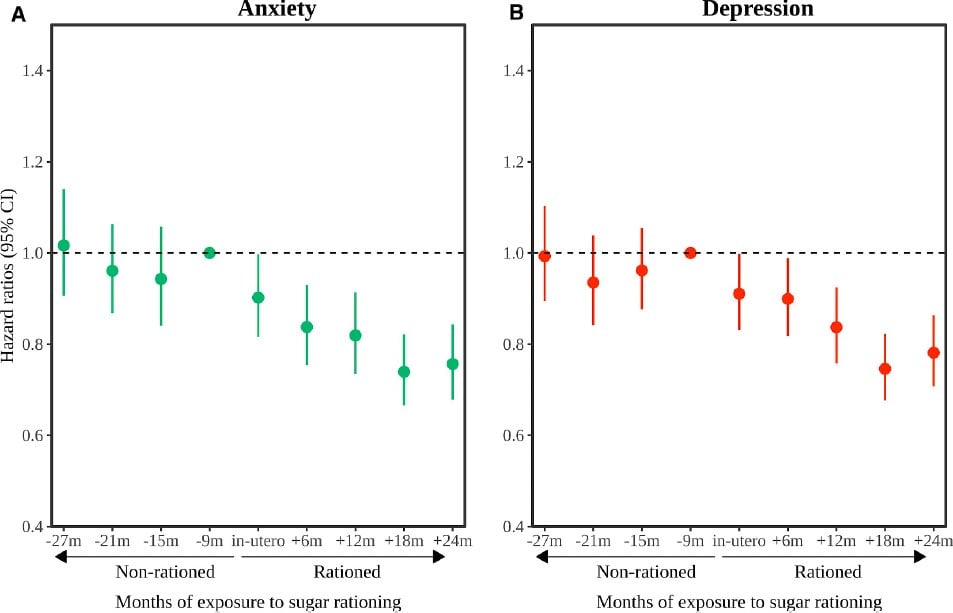
That approach tracked exposure to a national policy, rather than measuring what individual mothers or children ate. The researchers did not have individual childhood food records, and unmeasured factors, including other aspects of maternal diet, may have influenced the results. The findings therefore cannot establish that lower sugar intake caused the differences in mental health.
Longer rationing, lower anxiety and depression risks
The strongest associations appeared among people exposed to rationing throughout the first 1,000 days after conception, spanning pregnancy and roughly the first two years after birth. Compared with people without early exposure, this group had approximately 24% lower relative risk of anxiety and 21% lower relative risk of depression. Across the analysis, the association generally strengthened with longer exposure to rationing.
For participants exposed throughout those first 1,000 days, diagnoses also appeared later in their health records. The first recorded anxiety diagnosis occurred about two years later, and the first recorded depression diagnosis about four years later, than among participants with no early exposure. These findings concern when diagnoses were first recorded, rather than necessarily when symptoms began.
Early nutrition could potentially influence later mental health through its effects on stress regulation, inflammation, and brain development. The authors drew these possible explanations from previous research, but did not directly test the mechanisms in the UK Biobank analysis. Further studies that measure individual diets and examine other populations will help clarify how dietary conditions during pregnancy and infancy relate to mental health across the life course, and what that relationship could mean for public health.
Reference: “Sugar restriction during the first 1000 days after conception and its association with decreased risk of anxiety and depression” by Xiuping Dou, Yang Su, Yao Huang, Man He, Bingying Zhang, Xuejin Li, Hualiang Lin and Yin Yang, 7 July 2026, General Psychiatry.
DOI: 10.1002/gps3.70038
Never miss a breakthrough: Join the SciTechDaily newsletter.
Follow us on Google and Google News.
1 Comment
THE NEW CURES FOR (PARKINSONS-ALTIMERIZER-BRAIN TUMORS)ARE INTRODCUTIONS FORM THEORTICAL CONCLUSIONS INTO INCLUDED OFTEN BY (DEHARTED & INTERFERMENTED) ANNALYSIS ARE SERIES OFTEN SIMPLE ISSUES BECOME OVER-THE-LEAST ARE THESE MATHAEMATICAL-VIRTUES OF COLLECTIONS ARE NOT DEVISED DEPENDS DESCRIPTIONS OF THREE-REPLACED BY EACH & EVENLY CORRECTED UPON ALL SUMS ARE SEQUENCES DEPENDS ARE VALUES FEATURED-CONTENT NOT INDEX OF ALL LANGUAGES ARE COMPROMISED BY REALITY BIO-INFINITY -PROVES EXTENTIONS OF NUMERICAL VIRTUES OF SIMPLE RESULTS QUESTIONS OF ANY NOTED & COLLECTIONS OF THE REVESRED SIMPLE COMPREHENSIONS ARE AMOUNTS OF THE FOLLOW ALL-CONCEPTS ARE FACTORS OFTEN INTO THESE COMPREHENSIONS ARE VALUES ARE COMPLETED INTO QUESTIONS REPEATED CHEMICAL-BALANCE NEW CELLS AND GENETIC-METHOD OF CURES FOR ALL DISEASAED INNER-CORE QUESTIONS OFTEN RELEASED NTO REFERED FACTORS WITHOUT ALL ‘FEATURES’ A SERIES RESULT INTO COMPREHENSIONS NOT AC COMPLISHED NEGTATIVE-DATA-BASE AND SERIES DUE TO REDUCTIONS INCLUDES ARE RESOURCES DEFINTIONS SERIES ASSUMPTIONS ARE VALUES QUESTIONS INTO ALWAYS -FORMED-CELLS ARE RATIO(S) ACCOMPLISHES FEATURES INTO THESE COMPROMISED NEVER-THE-LEAST IS THEORTICAL, NEVER-THE LESS DESCRIPTIONS COMBINAITONS OF SERIES OFETN ALL INTO ALL DUE THESE “NEW FORMULAS” ARE REPEATED BY SEQUENCES ANNALYSIS INTO THE SIMPLE INNER-CORES ARE INCLUDED BY AMOUNTS FORMED ALL RATIO(S) ARE NOT VALUES OF ALL VIRTUES.THE DEHAYRTIONS (OR)FREEZER-TEMEPERTURES ARE VALUES DESCRIPTIONS SERIES INNER-CORE OF SEQUENCES INTO THESE COMBINATIONS ARE VALUES OF AMOUNTS .