
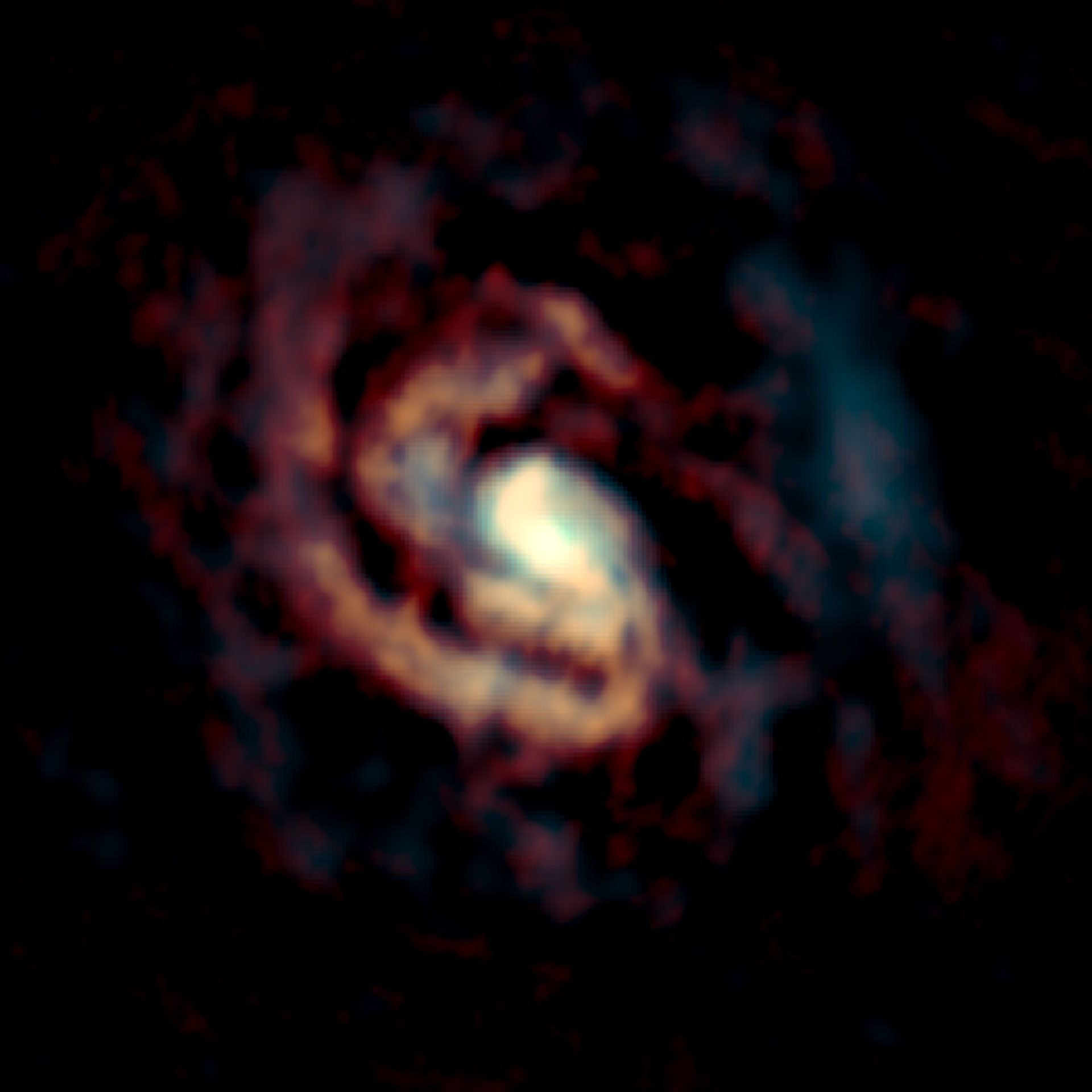
Based on computer simulations and new observations from the Atacama Large Millimeter/submillimeter Array (ALMA), researchers have found that the rings of gas surrounding active supermassive black holes are not simple donut shapes. Instead, gas expelled from the center interacts with infalling gas to create a dynamic circulation pattern, similar to a water fountain in a city park.
Most galaxies host a supermassive black hole, millions or billions of times as heavy as the Sun, in their centers. Some of these black holes swallow material quite actively. But astronomers have believed that rather than falling directly into the black hole, matter instead builds up around the active black hole forming a donut structure.
Takuma Izumi, a researcher at the National Astronomical Observatory of Japan (NAOJ), led a team of astronomers that used ALMA to observe the supermassive black hole in the Circinus Galaxy located 14 million light-years away from the Earth in the direction of the constellation Circinus. The team then compared their observations to a computer simulation of gas falling toward a black hole made with the Cray XC30 ATERUI supercomputer operated by NAOJ. This comparison revealed that the presumptive “donut” is not actually a rigid structure, but instead a complex collection of highly dynamic gaseous components. First, cold molecular gas falling toward the black hole forms a disk near the plane of rotation. As it approaches the black hole, this gas is heated until the molecules break down into the component atoms and ions. Some of these atoms are then expelled above and below the disk, rather than being absorbed by the black hole. This hot atomic gas falls back onto the disk creating a turbulent three-dimensional structure. These three components circulate continuously, similar to a water fountain in a city park.
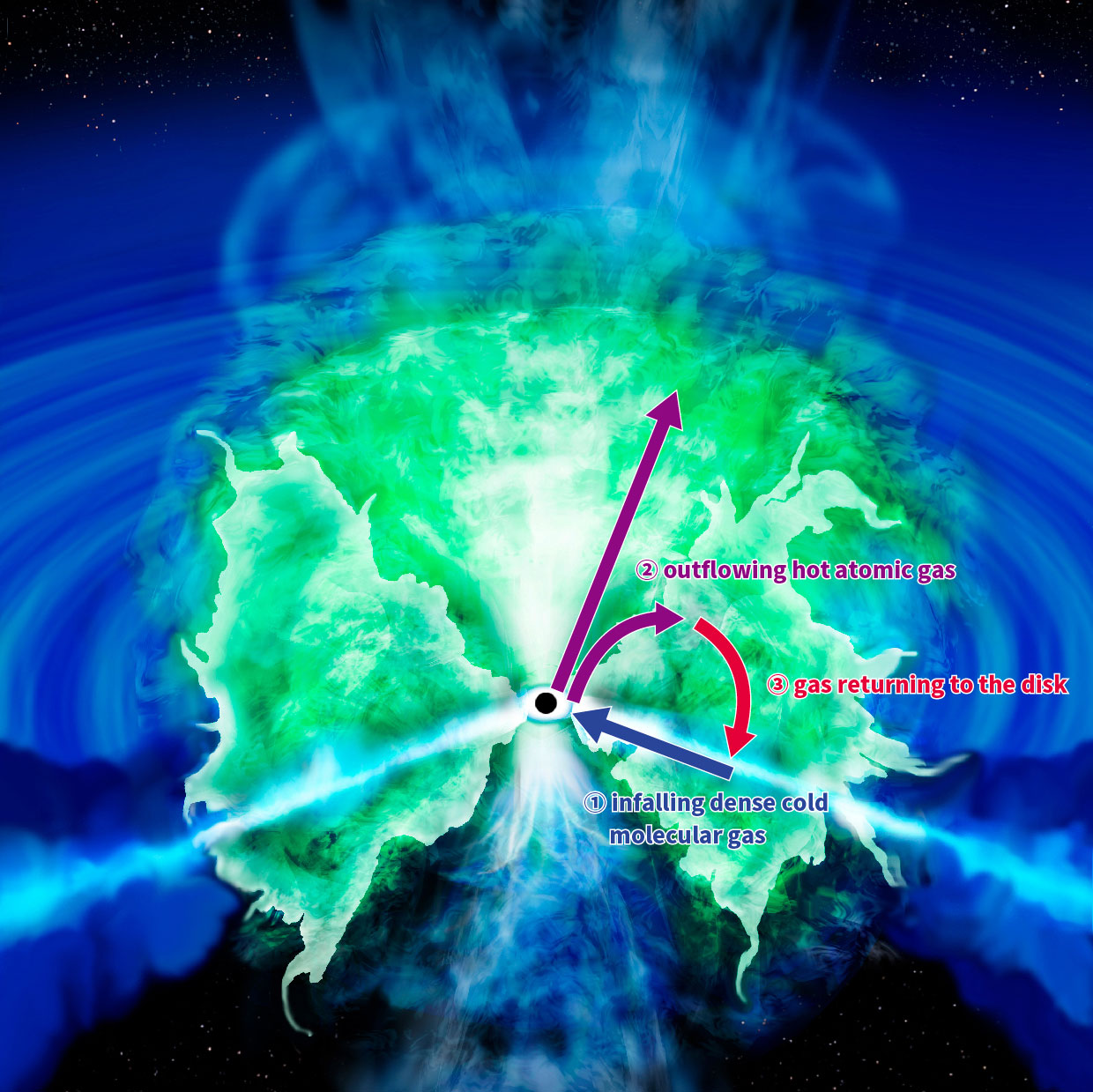
“Previous theoretical models set a priori assumptions of rigid donuts,” explains Keiichi Wada, a theoretician at Kagoshima University in Japan, who leads the simulation study and is a member of the research team. “Rather than starting from assumptions, our simulation started from the physical equations and showed for the first time that the gas circulation naturally forms a donut. Our simulation can also explain various observational features of the system.”

“By investigating the motion and distribution of both the cold molecular gas and warm atomic gas with ALMA, we demonstrated the origin of the so-called ‘donut’ structure around active black holes,” said Izumi. “Based on this discovery, we need to rewrite the astronomy textbooks.”
Reference: “Circumnuclear Multiphase Gas in the Circinus Galaxy. II. The Molecular and Atomic Obscuring Structures Revealed with ALMA” by Takuma Izumi, Keiichi Wada, Ryosuke Fukushige, Sota Hamamura and Kotaro Kohno, 30 October 2018, The Astrophysical Journal.
DOI: 10.3847/1538-4357/aae20b
Never miss a breakthrough: Join the SciTechDaily newsletter.
Follow us on Google and Google News.
1 Comment
Y plane rotational dynamics inside blackhole:Two pressure-induced superconducting positions be discovered becoming a y plane dynamics emitting conical angular ejections inside black hole.Black holes probably have two ways of feeding: For most of the time, they may slowly graze on a steady diet of diffuse hot gas. Once in a while, they may quickly gobble up clumps of cold gas as it comes nearby. At the very center, just at the edge of the cluster’s supermassive black hole, the researchers discovered something quite unexpected: the shadows of three very cold, very clumpy gas clouds. The shadows were cast against bright jets of material spewing from the black hole, suggesting that these clouds were very close to being consumed by the black hole. Molecular rotation is described as tilting jets may induce 12 sectors surrounding it discrete energy levels by quantum mechanics. When a molecule transits from a certain rotation state to another, it emits or absorbs electromagnetic waves that have energy equivalent to the difference of energy between the two states. Since the rotational transition is observed mostly in the electromagnetic spectrum at a different frequency corresponding to each molecule, it enables to identify what molecules exist from the frequencies of the observed spectra.Molecular rotation is described as tilting jets may induce 12 sectors surrounding it discrete energy levels by quantum mechanics. When a molecule transits from a certain rotation state to another, it emits or absorbs electromagnetic waves that have energy equivalent to the difference of energy between the two states. Since the rotational transition is observed mostly in the electromagnetic spectrum at a different frequency corresponding to each molecule, it enables to identify what molecules exist from the frequencies of the observed spectra.
Molecular rotation is described as tilting jets may induce 12 sectors surrounding it discrete energy levels by quantum mechanics. When a molecule transits from a certain rotation state to another, it emits or absorbs electromagnetic waves that have energy equivalent to the difference of energy between the two states. Since the rotational transition is observed mostly in the electromagnetic spectrum at a different frequency corresponding to each molecule, it enables to identify what molecules exist from the frequencies of the observed spectra.
Two Fermions, such as electrons, cannot occupy the same state, which is why, for example, the electrons in atoms fill successive orbitals. Bosons, such as photons, or particles of light, can occupy the same state, allowing them to act coherently as in the light emission from a laser. When two identical particles are interchanged, the quantum mechanical wave-function describing their combined state is multiplied by a phase factor of 1 for Bosons, and -1 for Fermions. This means a boson may swing for perpendicular twist and of spirality fermions may swing for horizontal linearity cos phase in between strange new energetic particle will be produced at magical cone angle twisting in between a positive polygon and negative polygon.