
Close Menu
    Facebook X (Twitter) Instagram
    SciTechDaily
    • Biology
    • Chemistry
    • Earth
    • Health
    • Physics
    • Science
    • Space
    • Technology
    Facebook X (Twitter) Pinterest YouTube RSS
    SciTechDaily
    Home»Space»Hubble Image of Elliptical Galaxy With 200 Billion Stars
    Space

    Hubble Image of Elliptical Galaxy With 200 Billion Stars

    By Hubble Space TelescopeMarch 18, 20192 Comments2 Mins Read
    Facebook Twitter Pinterest Telegram LinkedIn WhatsApp Email Reddit
    Share
    Facebook Twitter LinkedIn Pinterest Telegram Email Reddit
    Elliptical Galaxy With 200 Billion Stars
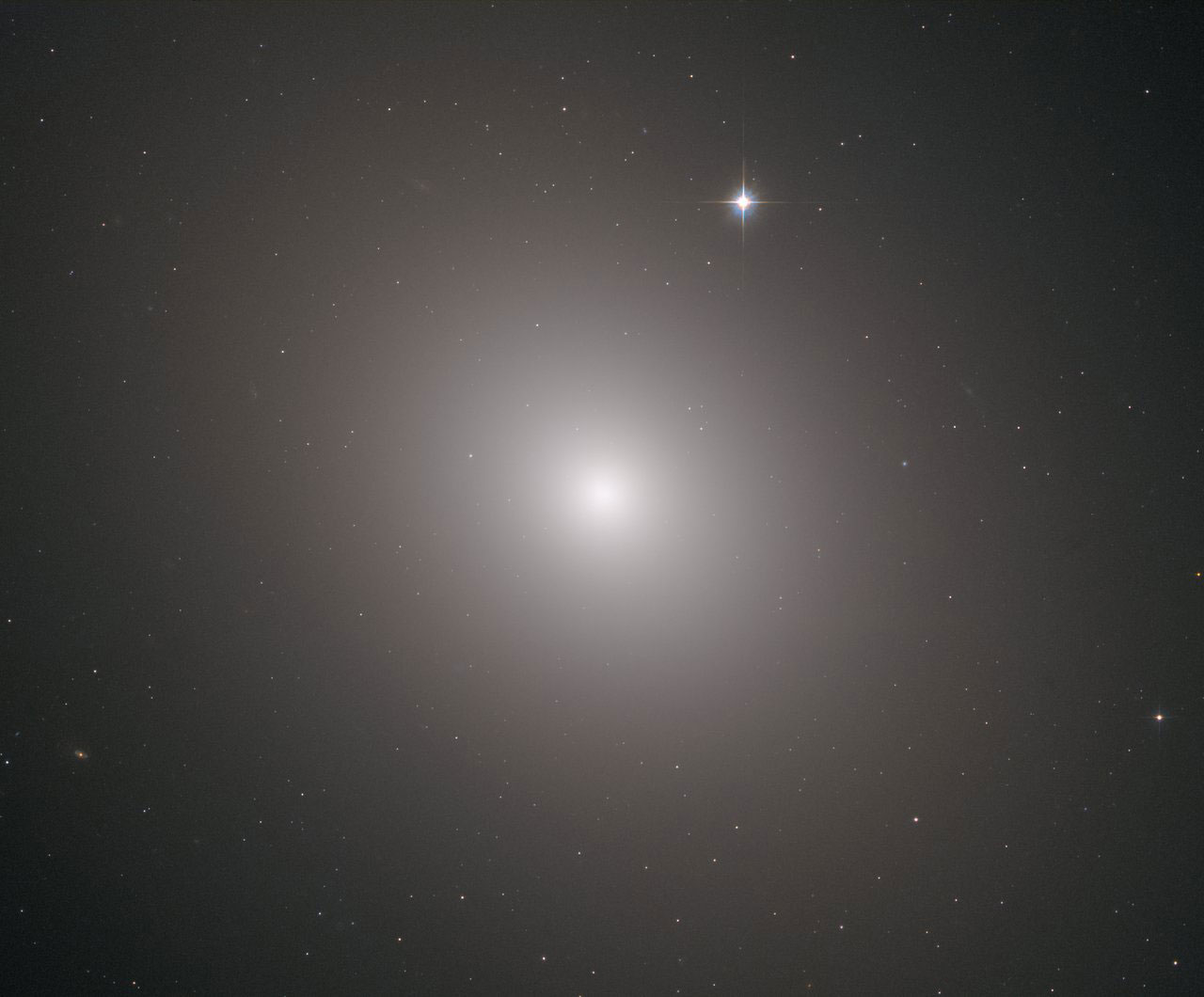
    Hubble Space Telescope image of Messier 49, a giant elliptical galaxy filled with an incredible 200 billion stars. Credit: ESA/Hubble & NASA, J. Blakenslee, P Cote et al.

    This fuzzy orb of light is a giant elliptical galaxy containing an incredible 200 billion stars. Unlike spiral galaxies, which have a well-defined structure and boast picturesque spiral arms, elliptical galaxies appear fairly smooth and featureless. This is likely why this galaxy, named Messier 49, was discovered by French astronomer Charles Messier in 1771. At a distance of 56 million light-years, and measuring 157,000 light-years across, M49 was the first member of the Virgo Cluster of galaxies to be discovered, and it is more luminous than any other galaxy at its distance or nearer.

    Elliptical galaxies tend to contain a larger portion of older stars than spiral galaxies and also lack young blue stars. Messier 49 itself is very yellow, which indicates that the stars within it are mostly older and redder than the Sun. In fact, the last major episode of star formation was about six billion years ago — before the Sun was even born!

    Messier 49 is also rich in globular clusters; it hosts about 6000, a number that dwarfs the 150 found in and around the Milky Way. On average, these clusters are 10 billion years old. Messier 49 is also known to host a supermassive black hole at its center with the mass of more than 500 million Suns, identifiable by the X-rays pouring out from the heart of the galaxy (as this Hubble image comprises infrared observations, these X-rays are not visible here).

    Never miss a breakthrough: Join the SciTechDaily newsletter.
    Follow us on Google and Google News.

    Astronomy Hubble Space Telescope Popular
    Share. Facebook Twitter Pinterest LinkedIn Email Reddit

    Related Articles

    Astronomers Puzzled by Dark Storm’s U-Turn on Neptune, Appearance of New Dark Spot

    Rings of Relativity: A Truly Strange and Very Rare Phenomenon

    Hubble Discovers a Strange Exoplanet That Resembles the Long-Sought “Planet Nine”

    Ethereal Orange Glow Radiates From Heart of Stellar Forge

    Hubble Captures Unprecedented Fading of Stingray Nebula – “This Is Very, Very Dramatic, and Very Weird”

    Hubble Space Telescope Explains Oddball Galaxy’s Missing Dark Matter

    ULLYSES: Hubble Embarks on Largest Observing Program of Its Career

    Hubble Spots a Gorgeous Waterfall of Stars

    Hubble Spots Giant Space “Pumpkin” [Video]

    2 Comments

    1. danR on March 20, 2019 9:15 am

      Is that surrounding glow/halo comprised of the stars themselves, or is that ionized gas or glowing dust. Or a bit of all three. Or what? Or is the brighter central part the stars? If that glow is the stars, is there any (accessible) high res shots that actually can resolve some of them, at least the brighter ones?

      Reply
    2. Caine on March 20, 2019 3:18 pm

      That is so beautiful..

      Reply
    Leave A Reply Cancel Reply

    • Facebook
    • Twitter
    • Pinterest
    • YouTube

    Don't Miss a Discovery

    Subscribe for the Latest in Science & Tech!

    Trending News

    Long COVID Brain Scans Reveal Damage to Dopamine Neurons

    Scientists Warn a Silent Oxygen Crisis Is Spreading Through Earth’s Waters

    James Webb Telescope Discovers Hidden Giant Planet in Famous Star System

    Scientists Build the First 3D Cloak That Makes Objects Invisible To Heat

    Common Food Additive Linked To Gut Inflammation

    Black Hole Collisions May Follow a Surprisingly Simple Rule

    The Eye Has a Hidden Cleanup System and Scientists Just Discovered It

    The Truth About Vikings Is More Complicated Than Museums Admit

    Follow SciTechDaily
    • Facebook
    • Twitter
    • YouTube
    • Pinterest
    • Newsletter
    • RSS
    SciTech News
    • Biology News
    • Chemistry News
    • Earth News
    • Health News
    • Physics News
    • Science News
    • Space News
    • Technology News
    Recent Posts
    • NASA Astronaut Comes Home After 3,856 Orbits of Earth
    • A Rare and Deadly Cancer May Have an Unexpected New Vulnerability
    • Sleep Disorders Don’t Just Exhaust You. New Research Shows They Change Your Brain
    • THC-CBD Treatment Dramatically Reduces Agitation in Dementia Trial
    • Rare 8,000-Year-Old Rock Shelter Captures a Turning Point in Human History
    Copyright © 1998 - 2026 SciTechDaily. All Rights Reserved.
    • Science News
    • About
    • Contact
    • Editorial Board
    • Privacy Policy
    • Terms of Use

    Type above and press Enter to search. Press Esc to cancel.