
Close Menu
    Facebook X (Twitter) Instagram
    SciTechDaily
    • Biology
    • Chemistry
    • Earth
    • Health
    • Physics
    • Science
    • Space
    • Technology
    Facebook X (Twitter) Pinterest YouTube RSS
    SciTechDaily
    Home»Space»Mission-Critical Upgrade: International Space Station Computer Gets a Heart Transplant
    Space

    Mission-Critical Upgrade: International Space Station Computer Gets a Heart Transplant

    By European Space AgencyDecember 29, 20192 Comments5 Mins Read
    Facebook Twitter Pinterest Telegram LinkedIn WhatsApp Email Reddit
    Share
    Facebook Twitter LinkedIn Pinterest Telegram Email Reddit
    Space Station Office
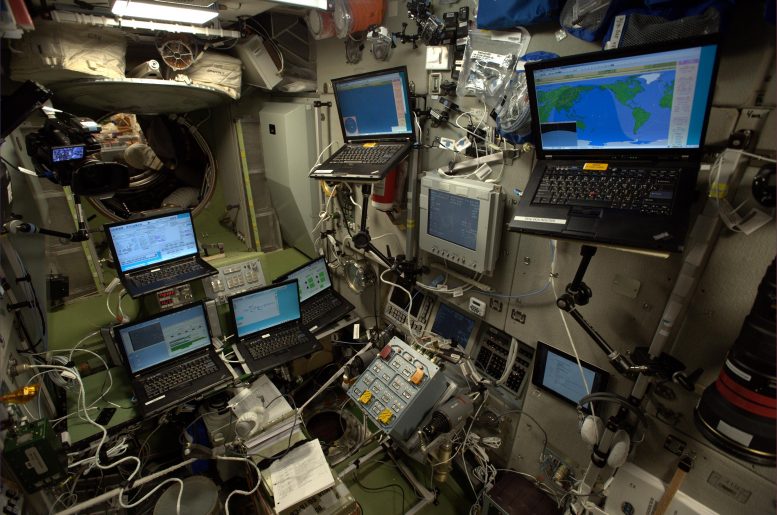
    The setup in the Russian Zvezda module on the International Space Station shortly before the docking of Europe’s Automated Transfer Vehicle Georges Lemaître (ATV-5). Credit: ESA/NASA

    The Space Station has grown to the size of a football field and space agencies are looking to extend its lifetime until 2030. European-built computers have quietly been keeping this orbital outpost on track and in the right position, running in the background since 2000.

    The Data Management System (DMS) computers in the Russian Zvezda module were built over 20 years ago by what is now Airbus. Two fault-tolerant computers collect data and provide navigation, communications, and operations for the Russian segment.
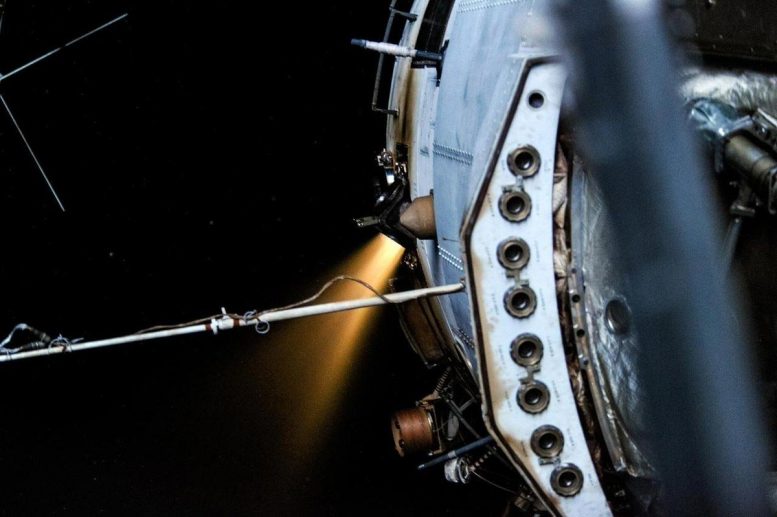
    Zvezda Burning Its Engines to Adjust the Space Station’s Orbit
    Zvezda burning its engines to adjust the Space Station’s orbit. The International Space Station adjusted its orbit to create the right conditions to welcome Luca’s Soyuz and the cargo vehicle and later this month the Progress MS-12 supply spacecraft. Credit: ESA

    These are required for International Space Station operations, and a sudden breakdown could lead to catastrophic consequences. To ensure continuity three units work in parallel with two active and one standby to take over if one fails. A fourth computer is kept as spare that is used as soon as one of the computers in active duty has problems.

    Mission-critical upgrade

    More fault-tolerant computers were built for a Russian module soon to be launched to the International Space Station, the Multipurpose Laboratory Module. The new computers exhausted the spare parts kept aside for ground repairs and the production of new computers.
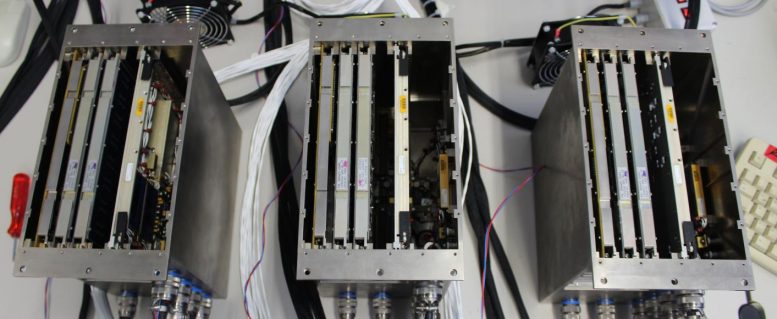
    Data Management System (DMS) Computers
    Data Management System (DMS) Computers. Credit: ESA

    After years of operations, engineers noticed that most of the failures on the ground and on-orbit computers occurred in memory modules on one of the printed circuit boards of the computers. Each time, a failed computer was removed, returned to the ground for repairs and then re-launched, with a long turn-around and impact on logistics. In addition, it soon became clear that this approach was not sustainable due to the lack of parts.

    Following extensive technical discussions and testing on Earth, engineers proved that a new printed circuit board, with the same form and function but built using modern and available components, could be the solution.
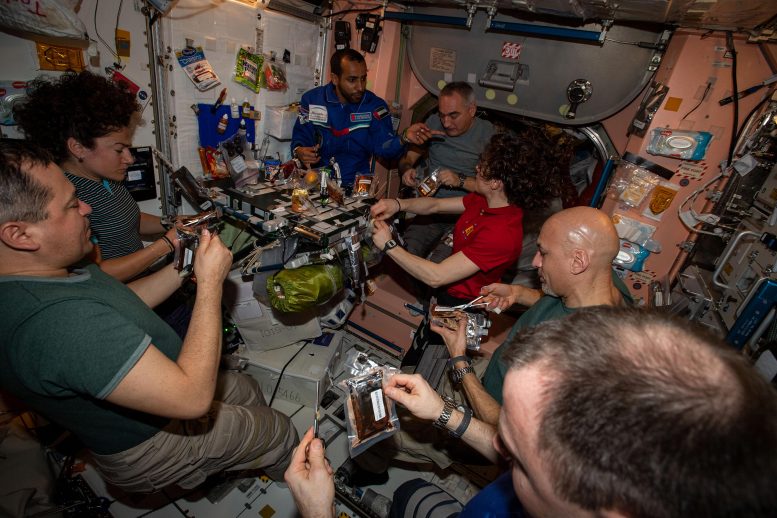
    Inside Zvezda Module
    When Earth is so far away, it helps to have friends nearby. The usual six-astronaut crew of the International Space Station welcomed three more and a cargo vehicle in September 2019, making for a full house on the orbital outpost. This image was taken of the team gathered for a celebratory dinner in the Russian Zvezda module, the food preparation area of the Space Station. Credit: NASA

    Teams in Russia and Europe considered upgrading the computer boards directly by an astronaut on the Space Station in weightlessness – the equivalent of open-heart surgery on Earth! This was no easy task to demonstrate, considering the computers were not designed for maintenance on orbit and the units were closed with small screws, sometimes even glued in place.
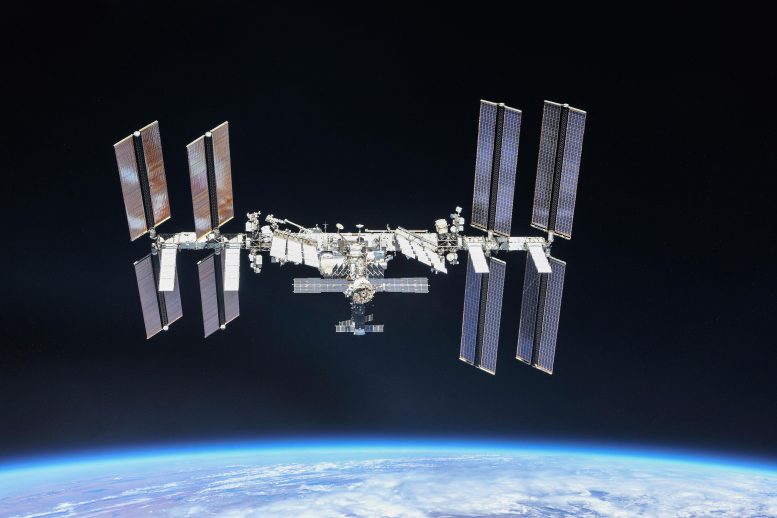
    International Space Station in 2018
    The International Space Station photographed by Expedition 56 crew members from a Soyuz spacecraft after undocking. NASA astronauts Andrew Feustel and Ricky Arnold and Roscosmos cosmonaut Oleg Artemyev flew around of the orbiting laboratory to take pictures of the station before returning home after spending 197 days in space. The Station celebrated the 20th anniversary of the launch of the first element Zarya in November 2018. Credit: Roscosmos/NASA

    Much like preparing for a spacewalk, engineers and Russian cosmonauts practiced and demonstrated the process on Earth to ensure the operations were feasible and could be performed in space without risk.

    Convinced that this approach would work new computer boards were ordered in 2015 and sent to the Space Station in 2018.

    Space transplant

    Waiting for the new mainboards to reach the Space Station, a failed computer was kept on-orbit. When the new parts and trained astronauts arrived teams decided to use a failed unit as a test case.
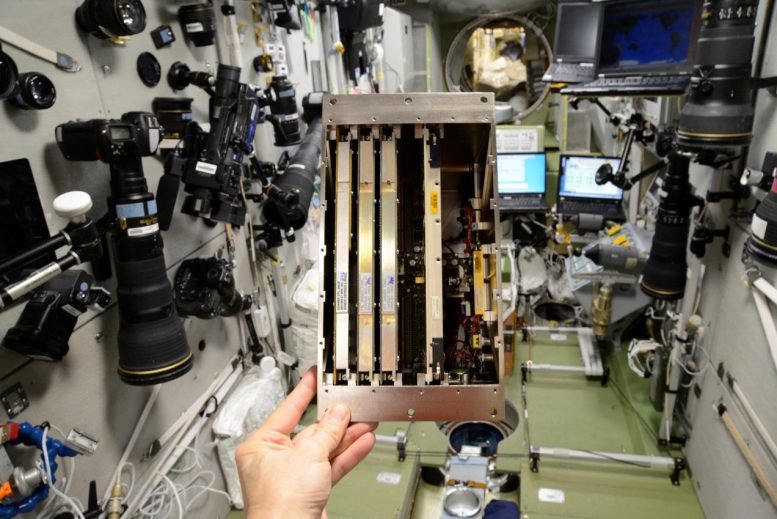
    Data Management System Space Upgrade
    The Data Management System (DMS) computers in the Russian Zvezda module were built over 20 years ago by what is now Airbus. Two fault-tolerant computers collect data and provide navigation, communications and operations for the Russian segment. Credit: Roscosmos

    In January 2019 the older board was replaced with the new stock. At that time cosmonauts confirmed that the computer had survived the operation but were not yet certain that it was fully fit. Crew time in space is scarce and the teams planned to wait for the next failure before installing the computer that had undergone a heart transplant and fully check it. Last month one of the old computers had problems and so it was removed and replaced with the new unit.

    All is now confirmed to be working properly, with great satisfaction to the personnel at RSC-Energia, Airbus and ESA. This solution requires less costly transport to Earth orbit as only the boards need to be swapped instead of the whole units – the repair time is now reduced from six months to a few days.

    Future missions

    This kind of behind-the-scenes work is the type that does not get much attention unless something goes wrong, but the new approach is needed as humans explore farther into our Solar System, starting on the Gateway, where supplies from Earth are not readily available.
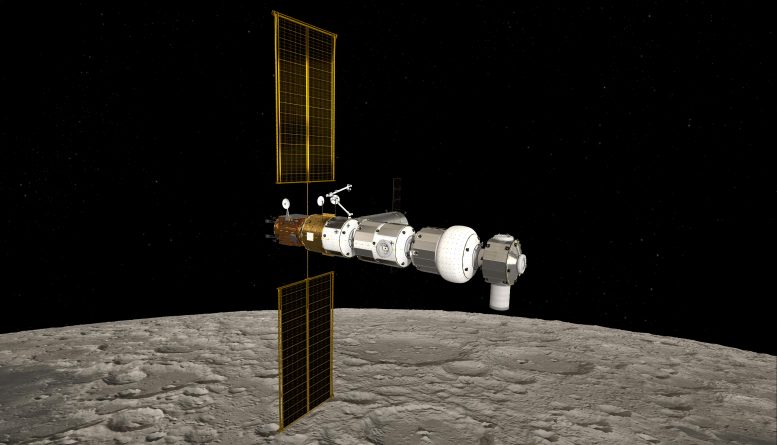
    Gateway and Moon
    Artist’s impression of the Gateway over the Moon. The Gateway is the next structure to be launched by the partners of the International Space Station. Credit:
    ESA/NASA/ATG Medialab

    Maintenance on the International Space Station demonstrates the experience and design knowledge needed to support future missions while ensuring more sustainable operations – a win-win situation.

    Never miss a breakthrough: Join the SciTechDaily newsletter.
    Follow us on Google and Google News.

    European Space Agency International Space Station Popular
    Share. Facebook Twitter Pinterest LinkedIn Email Reddit

    Related Articles

    From Star Trek to the Lab: The Real Challenge of Fungi in Hypergravity

    Peek-a-Boo Moon: Astronaut on Space Station Captures Spectacular Photos of the Lunar Eclipse

    Splashdown! NASA SpaceX Crew-3 Astronauts Safely Return to Earth

    Stunning View of Comet NEOWISE Over Madrid As Space Station Streaks Past

    Clean Space Initiative to Target Orbital Debris

    Herschel Image of the Vela C Region

    Researchers Discover First Intermediate-Mass Black Hole

    ESA’s Vega Rocket Has Launched on Its Maiden Voyage, Carries 9 Satellites

    ESA’s Hershel Space Telescope Captures Incredible Views of Eagle Nebula

    2 Comments

    1. Rick Hunter on October 26, 2020 5:55 am

      I assume that this computer is a “triple modular redundant” design where two computers really do the work with a third checking the other two? We worked on these kinds of systems at Tandem Computers Inc. where I worked as an analyst for years.

      Reply
    2. maksum on June 30, 2021 3:37 am

      kiro” oleh sawangan opo wae nek kono apo enek seng iso pok kabarne kambi aku iki nek iso tulung kabarne sak cepete yho tak enteni wiwit sore iki yen ono seng okeh mesisan lek ngabarno mbi awak..ku yhowes matursuwon

      Reply
    Leave A Reply Cancel Reply

    • Facebook
    • Twitter
    • Pinterest
    • YouTube

    Don't Miss a Discovery

    Subscribe for the Latest in Science & Tech!

    Trending News

    Breakthrough Bowel Cancer Trial Leaves Patients Cancer-Free for Nearly 3 Years

    Natural Compound Shows Powerful Potential Against Rheumatoid Arthritis

    100,000-Year-Old Neanderthal Fossils in Poland Reveal Unexpected Genetic Connections

    Simple “Gut Reset” May Prevent Weight Gain After Ozempic or Wegovy

    2.8 Days to Disaster: Scientists Warn Low Earth Orbit Could Suddenly Collapse

    Common Food Compound Shows Surprising Power Against Superbugs

    5 Simple Ways To Remember More and Forget Less

    The Atomic Gap That Could Cost the Semiconductor Industry Billions

    Follow SciTechDaily
    • Facebook
    • Twitter
    • YouTube
    • Pinterest
    • Newsletter
    • RSS
    SciTech News
    • Biology News
    • Chemistry News
    • Earth News
    • Health News
    • Physics News
    • Science News
    • Space News
    • Technology News
    Recent Posts
    • After 37 Years, the World’s Longest-Running Soil Warming Experiment Uncovers a Startling Climate Secret
    • NASA Satellite Captures First-Ever High-Res View of Massive Pacific Tsunami
    • ADHD Isn’t Just a Deficit: Study Reveals Powerful Hidden Strengths
    • Scientists Uncover “Astonishing” Hidden Property of Light
    • Scientists Discover Stem Cells That Could Regrow Teeth and Bone
    Copyright © 1998 - 2026 SciTechDaily. All Rights Reserved.
    • Science News
    • About
    • Contact
    • Editorial Board
    • Privacy Policy
    • Terms of Use

    Type above and press Enter to search. Press Esc to cancel.