
Close Menu
    Facebook X (Twitter) Instagram
    SciTechDaily
    • Biology
    • Chemistry
    • Earth
    • Health
    • Physics
    • Science
    • Space
    • Technology
    Facebook X (Twitter) Pinterest YouTube RSS
    SciTechDaily
    Home»Chemistry»A Profound Leap Forward: Pushing the Limits of 2D Supramolecules
    Chemistry

    A Profound Leap Forward: Pushing the Limits of 2D Supramolecules

    By University of South Florida (USF Innovation)April 17, 2020No Comments3 Mins Read
    Facebook Twitter Pinterest Telegram LinkedIn WhatsApp Email Reddit
    Share
    Facebook Twitter LinkedIn Pinterest Telegram Email Reddit
    2D Supramolecule
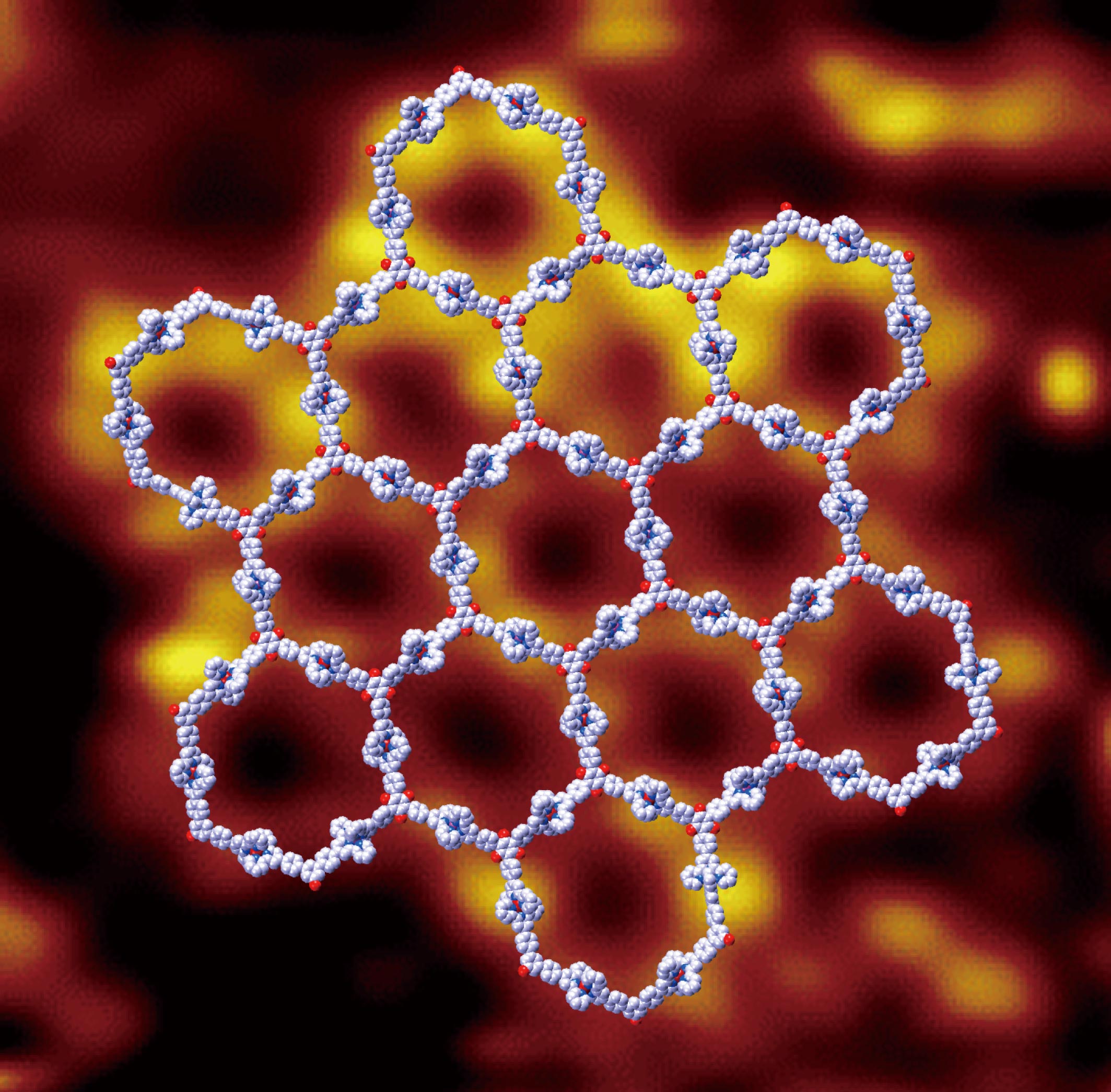
    A scanning tunneling microscopy image of the USF-developed supramolecular grid with a molecular modelling overlay. Credit: University of South Florida

    Scientists at the University of South Florida have reached a new milestone in the development of two-dimensional supramolecules – the building blocks that make areas of nanotechnology and nanomaterial advancement possible.

    Since the 2004 discovery of graphene, the world’s thinnest (one atom thick) and strongest (200 times stronger than steel) material, researchers have been working to further develop similar nanomaterials for industrial, pharmaceutical and other commercial uses. Thanks to its conductive properties and strength, graphene can be used in microelectronics to fortify mechanical materials and has recently enabled precise 3D imaging of nanoparticles.

    While work to develop new supramolecules capable of further applications has seen some success, those molecular formations are either small – less than 10 nanometers in size – or arbitrarily assemble, limiting their potential use. But now, new research published in Nature Chemistry, outlines a profound leap forward in supramolecular progress.

    “Our research team has been able to overcome one of the major supramolecular obstacles, developing a well-defined supramolecular structure that pushes the 20-nanometer scale,” said Xiaopeng Li, an associate professor in the USF Department of Chemistry and the study’s lead researcher. “It’s essentially a world record for this area of chemistry.”

    Li, along with his USF research team, collaborated with Saw Wai Hia’s team at the Argonne National Laboratory and Ohio University, as well as several other U.S. and international research institutes on this effort.

    Supramolecules are large molecular structures made up of individual molecules. Unlike traditional chemistry, which focuses on covalent bonds between atoms, supramolecular chemistry studies the noncovalent interactions between molecules themselves. Many times, these interactions lead to molecular self-assembly, naturally forming complex structures capable of performing a variety of functions.

    In this latest study, the team was able to build a 20-nm-wide metallo-supramolecular hexagonal grid by combining intra- and intermolecular self-assembly processes. Li says the success of this work will advance further understanding of the design principles governing these molecular formations and could one day lead to the development of new materials with yet-to-be-discovered functions and properties.

    Reference: “Intra- and intermolecular self-assembly of a 20-nm-wide supramolecular hexagonal grid” by Zhe Zhang, Yiming Li, Bo Song, Yuan Zhang, Xin Jiang, Ming Wang, Ryan Trumbleson, Changlin Liu, Pingshan Wang, Xin-Qi Hao, Tomas Rojas, Anh T. Ngo, Jonathan L. Sessler, George R. Newkome, Saw Wai Hla and Xiaopeng Li, 13 April 2020, Nature Chemistry.
    DOI: 10.1038/s41557-020-0454-z

    Never miss a breakthrough: Join the SciTechDaily newsletter.
    Follow us on Google and Google News.

    2D Materials Materials Science Nanotechnology University of South Florida
    Share. Facebook Twitter Pinterest LinkedIn Email Reddit

    Related Articles

    Thomas Edison May Have Created a Miracle Material Before Physics Knew It Existed

    Revolutionary Solid Lubricant Slashes Friction With Nanoscale Precision

    Nano-Chainmail Unveiled: Revolutionary Material for Lightweight, Tough Protection

    White Graphene: The One-Atom Wonder Driving Greener Energy and Faster Tech

    Measuring the “Wettability” of Graphene and Other 2D Materials at the Molecular Level

    Discovery of “Magic” Chemical That Makes Perfect Edges in 2D-Materials

    Chemists Achieve Breakthrough in the Synthesis of Graphene Nanoribbons

    “Patterned Regrowth” May Lead to Graphene-Based Circuits

    Scientists Examine Platinum-Based Catalyst Design

    Leave A Reply Cancel Reply

    • Facebook
    • Twitter
    • Pinterest
    • YouTube

    Don't Miss a Discovery

    Subscribe for the Latest in Science & Tech!

    Trending News

    Artificial Sweeteners May Harm Future Generations, Study Suggests

    Splashdown! NASA Artemis II Returns From Record-Breaking Moon Mission

    What If Consciousness Exists Beyond Your Brain

    Scientists Finally Crack the 100-Million-Year Evolutionary Mystery of Squid and Cuttlefish

    Beyond “Safe Levels”: Study Challenges What We Know About Pesticides and Cancer

    Researchers Have Found a Dietary Compound That Increases Longevity

    Scientists Baffled by Bizarre “Living Fossil” From 275 Million Years Ago

    Your IQ at 23 Could Predict Your Wealth at 27, Study Finds

    Follow SciTechDaily
    • Facebook
    • Twitter
    • YouTube
    • Pinterest
    • Newsletter
    • RSS
    SciTech News
    • Biology News
    • Chemistry News
    • Earth News
    • Health News
    • Physics News
    • Science News
    • Space News
    • Technology News
    Recent Posts
    • What if Dark Matter Has Two Forms? Bold New Hypothesis Could Explain a Cosmic Mystery
    • Researchers Expose Hidden Chemistry of “Ore-Forming” Elements in Biology
    • Geologists Reveal the Americas Collided Earlier Than We Thought
    • 20x Difference: Study Reveals True Source of Airborne Microplastics
    • Scientists Uncover Hidden Force Powering Yellowstone’s Supervolcano
    Copyright © 1998 - 2026 SciTechDaily. All Rights Reserved.
    • Science News
    • About
    • Contact
    • Editorial Board
    • Privacy Policy
    • Terms of Use

    Type above and press Enter to search. Press Esc to cancel.