
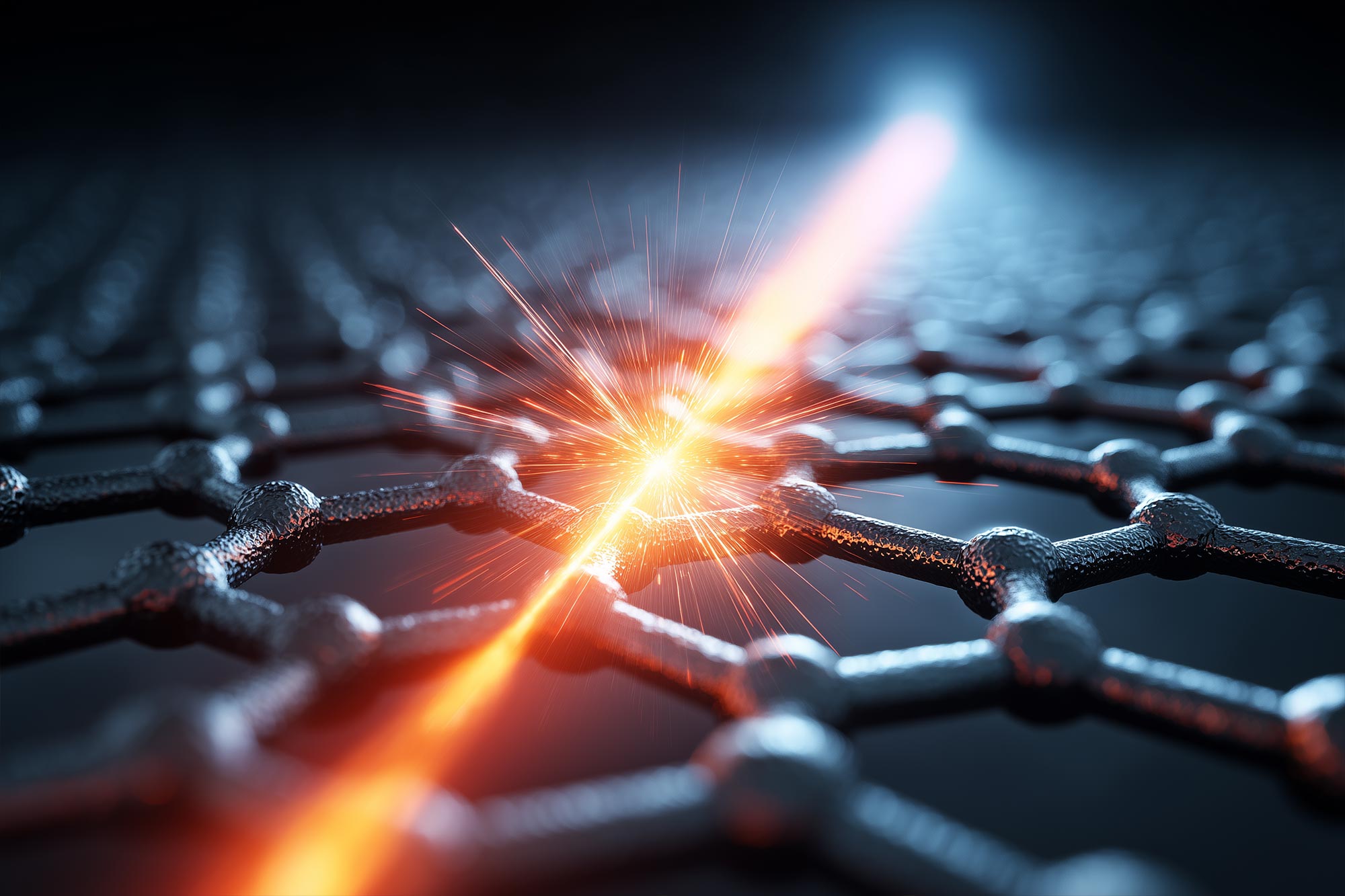
A modern materials study suggests that Thomas Edison’s early light bulb experiments may have unknowingly produced graphene decades before the material was formally theorized or isolated.
Thomas Edison never heard the word “graphene,” yet researchers at Rice University think his work may still brush up against it. In a recent paper from chemist James Tour’s lab, the team points to graphene as an unexpected thread connecting Edison to Konstantin Novoselov and Andre Geim, the 2010 Nobel Prize in Physics winners who isolated and studied the material.
Edison died nearly two decades before physicist P.R. Wallace proposed that graphene might exist, and almost 80 years before the Nobel committee recognized its experimental discovery.
Graphene is a one-atom-thick form of carbon that is both transparent and remarkably strong, with growing importance in modern devices such as semiconductors. The Rice researchers focus on a variant called turbostratic graphene, which can form when a resistive carbon material is hit with an electrical voltage and heated extremely quickly to about 2,000 to 3,000 degrees Celsius.
A 19th-Century Precursor to Flash Joule Heating
Today, that rapid electrical heating approach is known as flash Joule heating. In 1879, Edison could create similar conditions in a far more familiar way: by switching on one of his newly patented light bulbs. Early incandescent designs often relied on carbon filaments, including Japanese bamboo, rather than tungsten.
When current flowed, the filament heated rapidly and produced light, and under the right circumstances, it may have done more than glow. It may have briefly entered the temperature range where graphene can emerge.
“I was developing ways to mass produce graphene with readily available and affordable materials,” explains Lucas Eddy, first author on the paper and a former Rice graduate student in Tour’s lab. “I was looking at everything from arc welders, which were more efficient than anything I’d ever built, to lightning struck trees, which were complete dead ends.” But then, as his lab mate put it, he had a light bulb moment. “I was trying to figure out the smallest, easiest piece of equipment you could use for flash Joule heating, and I remembered that early light bulbs often used carbon-based filaments.”

Edison’s bulbs were not chosen for nostalgia. His patented design could drive a carbon filament to roughly 2,000 degrees Celsius, a temperature range considered essential for the kind of rapid carbon transformations the team wanted to test. Another practical advantage was documentation: Edison’s 1879 patent offered Eddy a detailed reference point for rebuilding the setup as closely as possible.
Recreating a Historic Experiment
Finding a truly comparable bulb took trial and error. Eddy initially bought Edison style bulbs advertised as having “carbon” filaments, only to discover the filaments were actually tungsten.
“You can’t fool a chemist,” laughs Eddy. “But I finally found a small art store in New York City selling artisan Edison-style light bulbs.” The artisan light bulbs were exactly like Edison’s, down to the Japanese bamboo filaments. Even the diameters of the filaments were close with Eddy’s filaments measuring only 5 micrometers larger than Edison’s.
Just like Edison, Eddy attached the light bulb to a 110-volt DC electricity source. He flipped the switch on for only 20 seconds. Longer periods of heating, he explains, can result in graphite forming rather than graphene.
When the filament was examined under an optical microscope, its appearance had clearly changed. The carbon had shifted from a dull dark gray to what Eddy described as a “lustrous silver.” A transformation had likely occurred, but to what?
To characterize the change, Eddy reached for a technique developed in the 1930s: Raman spectroscopy. This technique uses lasers to identify the substances through their atomic signatures, like reading a barcode. Advances over the last century allow it to do so with rather extreme precision. The spectroscopy confirmed what Eddy had hoped — parts of the filament had turned into turbostratic graphene. Edison, in his quest to develop a practical light bulb that could be used in everyday life, may just have produced a substance that is quickly becoming key to the technology-dependent 21st century.
Revisiting the Past With Modern Tools
Of course, there is no way to know what really happened with Edison’s long-ago experiment. Even if the original light bulb Edison used was available to analyze, any graphene produced likely would have turned to graphite during its first 13-hour test.
“To reproduce what Thomas Edison did, with the tools and knowledge we have now, is very exciting,” said Tour, the T.T. and W.F. Chao Professor of Chemistry and corresponding author on the paper. “Finding that he could have produced graphene inspires curiosity about what other information lies buried in historical experiments. What questions would our scientific forefathers ask if they could join us in the lab today? What questions can we answer when we revisit their work through a modern lens?”
Reference: “Evidence for Graphene Formation in Thomas Edison’s 1879 Carbon Filament Experiments” by Lucas Eddy, Chi Hun Choi, Justin Sharp, Carter Kittrell, Yimo Han and James M. Tour, 6 January 2026, ACS Nano.
DOI: 10.1021/acsnano.5c12759
The research was supported by the Air Force Office of Scientific Research (FA9550-22-1-0526, J.M.T.), the U.S. Army Engineer Research and Development Center (W912HZ-21-2-0050 and W912HZ-24-2-0027, J.M.T.), and the Welch Foundation (C-2065-20210327, Y.H.) The content in this press release is solely the responsibility of the authors and does not necessarily represent the official views of funding organizations and institutions.
Never miss a breakthrough: Join the SciTechDaily newsletter.
Follow us on Google and Google News.