
Close Menu
    Facebook X (Twitter) Instagram
    SciTechDaily
    • Biology
    • Chemistry
    • Earth
    • Health
    • Physics
    • Science
    • Space
    • Technology
    Facebook X (Twitter) Pinterest YouTube RSS
    SciTechDaily
    Home»Science»Graphene Quantum Dots Outperform Platinum in Fuel Cells
    Science

    Graphene Quantum Dots Outperform Platinum in Fuel Cells

    By Mike Williams, Rice UniversityOctober 1, 20141 Comment3 Mins Read
    Facebook Twitter Pinterest Telegram LinkedIn WhatsApp Email Reddit
    Share
    Facebook Twitter LinkedIn Pinterest Telegram Email Reddit
    Graphene Quantum Dots Form Catalyst Capable of Replacing Platinum in Fuel Cells
    Rice University scientists combined graphene quantum dots, graphene oxide, nitrogen, and boron into a catalyst capable of replacing platinum in fuel cells at a fraction of the cost. Credit: Tour Group/Rice University

    Researchers at Rice University have developed a cheap hybrid catalyst made from graphene quantum dots that outperforms platinum catalysts for certain reactions within fuel cells.

    Graphene quantum dots created at Rice University grab onto graphene platelets like barnacles attach themselves to the hull of a boat. But these dots enhance the properties of the mothership, making them better than platinum catalysts for certain reactions within fuel cells.

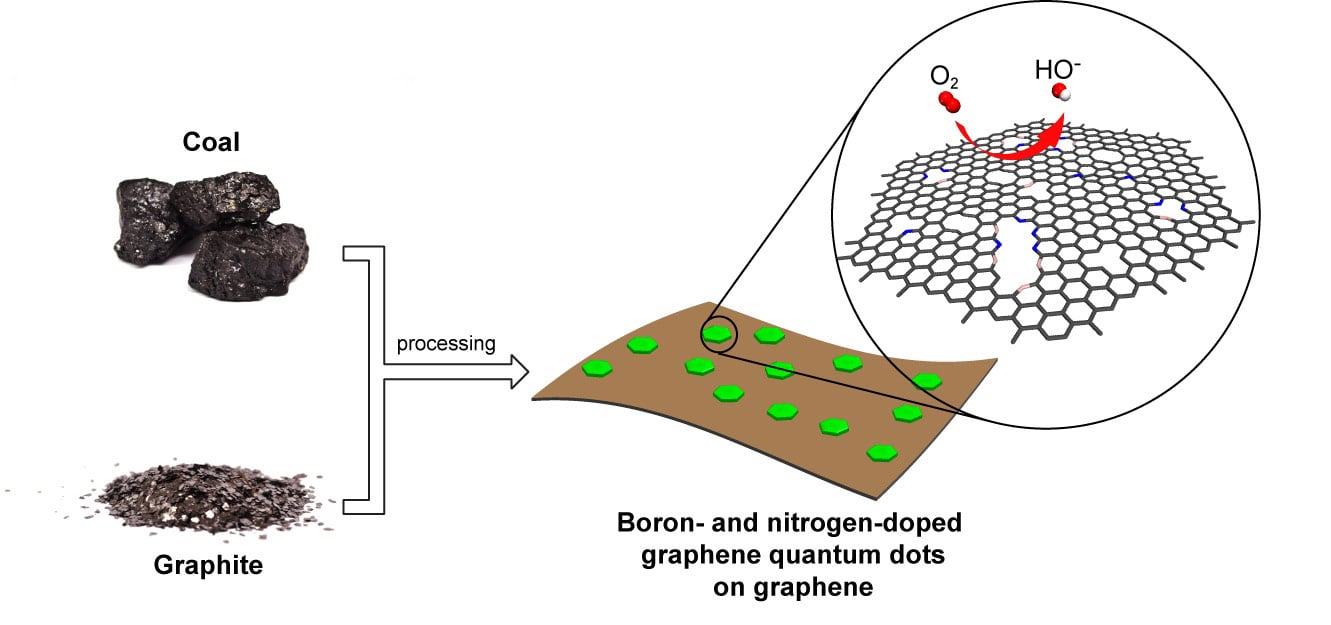
    The Rice lab of chemist James Tour created dots known as GQDs from coal last year and have now combined these nanoscale dots with microscopic sheets of graphene, the one-atom-thick form of carbon, to create a hybrid that could greatly cut the cost of generating energy with fuel cells.

    The research is the subject of a new paper in the American Chemical Society journal ACS Nano.

    The lab discovered boiling down a solution of GQDs and graphene oxide sheets (exfoliated from common graphite) and combined them into self-assembling nanoscale platelets that could then be treated with nitrogen and boron. The hybrid material combined the advantages of each component: an abundance of edges where chemical reactions take place and excellent conductivity between GQDs provided by the graphene base. The boron and nitrogen collectively add more catalytically active sites to the material than either element would add alone.

    “The GQDs add to the system an enormous amount of edge, which permits the chemistry of oxygen reduction, one of the two needed reactions for operation in a fuel cell,” Tour said. “The graphene provides the conductive matrix required. So it’s a superb hybridization.”

    The Tour lab’s material outperformed commercial platinum/carbon hybrids commonly found in fuel cells. The material showed an oxygen reduction reaction of about 15 millivolts more in positive onset potential – the start of the reaction – and 70 percent larger current density than platinum-based catalysts.

    The materials required to make the flake-like hybrids are much cheaper, too, Tour said. “The efficiency is better than platinum in terms of oxygen reduction, permitting one to sidestep the most prohibitive hurdle in fuel-cell generation — the cost of the precious metal,” he said.

    Rice graduate student Huilong Fei is the paper’s lead author. Co-authors are graduate students Ruquan Ye, Gonglan Ye, Yongji Gong, Zhiwei Peng, and Errol Samuel; research technician Xiujun Fan; and Pulickel Ajayan, the Benjamin M. and Mary Greenwood Anderson Professor in Mechanical Engineering and Materials Science and of chemistry and chair of the Department of Materials Science and NanoEngineering, all of Rice.

    Tour is the T.T. and W.F. Chao Chair in Chemistry as well as a professor of materials science and nanoengineering and of computer science.

    The Office of Naval Research Multidisciplinary University Research Initiative (MURI) program, the Air Force Office of Scientific Research, and its MURI program supported the research.

    Reference: “Boron- and Nitrogen-Doped Graphene Quantum Dots/Graphene Hybrid Nanoplatelets as Efficient Electrocatalysts for Oxygen Reduction” by Huilong Fei, Ruquan Ye, Gonglan Ye, Yongji Gong, Zhiwei Peng, Xiujun Fan, Errol L. G. Samuel, Pulickel M. Ajayan and James M. Tour, 24 September 2014, ACS Nano.
    DOI: 10.1021/nn504637y


    Never miss a breakthrough: Join the SciTechDaily newsletter.
    Follow us on Google and Google News.

    Fuel-cell Technology Graphene Materials Science Nanotechnology Quantum Dots Rice University
    Share. Facebook Twitter Pinterest LinkedIn Email Reddit

    Related Articles

    Scientists Toughening Graphene by Integrating Carbon Nanotubes

    Rice Scientists Make Polymers with Light-Triggered Nanoparticles

    Graphene Oxide Layers Deform Evenly Under Gentle Strain

    New Graphene Based Catalyst Shows Promise for Clean, Inexpensive Hydrogen Production

    Pillared Graphene Structures Gain Strength, Toughness and Ductility

    3D Graphene Aerogel Catalyst Shows Promise for Fuel Cells

    Microbullets Demonstrate Graphene’s Energy Absorbing Strength

    Graphene Nanoribbon Film Keeps Glass Ice-Free

    Graphene is Transparent to Water

    1 Comment

    1. kamir bouchareb st on February 26, 2025 12:41 pm

      THANK YOU

      Reply
    Leave A Reply Cancel Reply

    • Facebook
    • Twitter
    • Pinterest
    • YouTube

    Don't Miss a Discovery

    Subscribe for the Latest in Science & Tech!

    Trending News

    Scientists Call for a Complete Rethink of Alzheimer’s Treatment

    Scientists Identify Molecular Switch That Lets Exercise Reverse Muscle Aging

    Why Your Most Vivid Dreams Might Be the Key to Deep, Restful Sleep

    A Bright Star Hid a Massive Secret for 50 Years: Mystery of Gamma Cassiopeiae Finally Solved

    Scientists Identify Protein That Slows Key Effects of Aging

    Revolutionary Submarine Mysteriously Disappears Without a Trace – Scientists Are Now Preparing for a Bold Return

    Why Drinking More Water Isn’t Enough To Stop Kidney Stones

    New Study Reveals Surprising Effect of Drinking Coffee at Night

    Follow SciTechDaily
    • Facebook
    • Twitter
    • YouTube
    • Pinterest
    • Newsletter
    • RSS
    SciTech News
    • Biology News
    • Chemistry News
    • Earth News
    • Health News
    • Physics News
    • Science News
    • Space News
    • Technology News
    Recent Posts
    • Scientists Create Tiny “Nanolaser” That Could Revolutionize Future Computers
    • Mystery Deepens: Astrophysicists Say Dark Matter May Not Be One Thing
    • Life Without a Sun? Scientists Say It May Thrive on Rogue Planet Moons
    • Your BMI Might Be Wrong: Study Finds Millions Are Misclassified
    • More Than Half of U.S. College Students Are Lonely, Major Study Reveals
    Copyright © 1998 - 2026 SciTechDaily. All Rights Reserved.
    • Science News
    • About
    • Contact
    • Editorial Board
    • Privacy Policy
    • Terms of Use

    Type above and press Enter to search. Press Esc to cancel.