
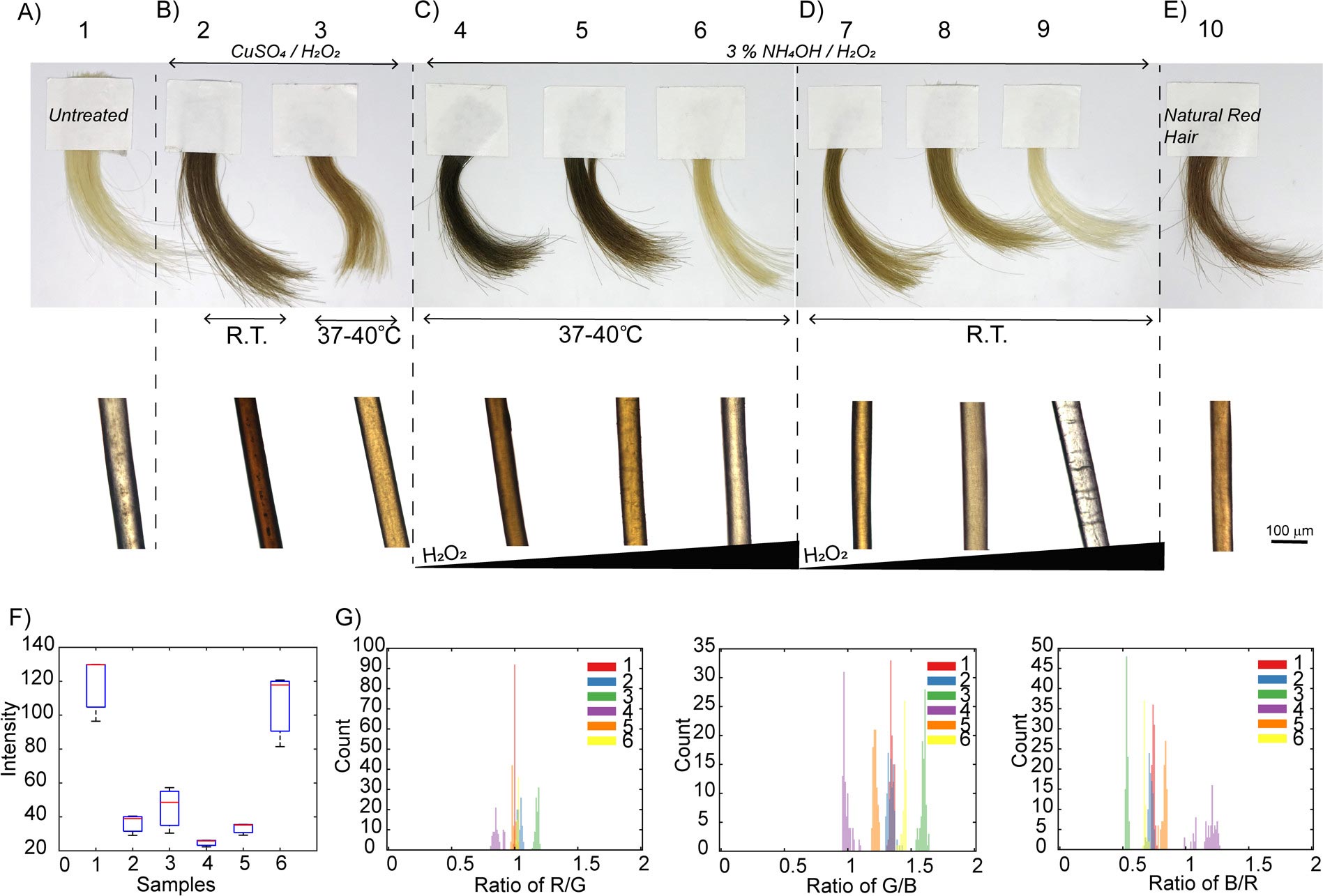
Natural-looking color mimics human hair pigmentation.
With the coronavirus pandemic temporarily shuttering hair salons, many clients are appreciating — and missing — using hair dye to cover up grays or touch up roots. Whether done at a salon or at home, frequent coloring, however, can damage hair and might pose health risks from potentially cancer-causing dye components.
Now Northwestern University researchers have developed a new hair dye process that is much milder than traditional hair dyes. The dye uses synthetic melanin to mimic natural human hair pigmentation.
“We have worked with melanin for several years, focused on how we can capture some of its properties that naturally arise in biology. For example, as a pigment and a color element in all kinds of organisms,” said Northwestern’s Nathan Gianneschi, who led the research. “In this study, our postdoctoral fellow Claudia Battistella wondered whether we could use a synthetic process to make a melanin coating on hair, that would mimic the appearance of real, melanized hair in the full array of natural hair colors. Such an approach, if done under mild conditions, could be an alternative to other kinds of hair dyes, avoiding some of the toxicity or allergies associated with those chemicals.”
The research was published on April 29, 2020, in the journal ACS Central Science.
Gianneschi is the Jacob and Rosalind Cohn Professor of Chemistry in Northwestern’s Weinberg College of Arts and Sciences and associate director of the International Institute of Nanotechnology. Battistella is the paper’s first author.
Melanin is a group of natural pigments that give hair and skin their varied colors. With aging, melanin disappears from hair fibers, leading to color loss and graying. Most permanent hair dyes use ammonia, hydrogen peroxide, small-molecule dyes and other ingredients to penetrate the cuticle of the hair and deposit coloring. Along with being damaging to hair, these harsh substances could cause allergic reactions or other health problems in colorists and their clients.
Recently, scientists have explored using synthetic melanin to color human hair, but the process required relatively high concentrations of potentially toxic heavy metals, such as copper and iron, and strong oxidants. Gianneschi’s team aimed to find a gentler, safer way to get long-lasting, natural-looking hair color with synthetic melanin.
The researchers tested different dyeing conditions for depositing synthetic melanin on hair and found that they could substitute mild heat and a small amount of ammonium hydroxide for the heavy metals and strong oxidants used in prior methods. They could produce darker hues by increasing the concentration of ammonium hydroxide, or red and gold shades by adding a small amount of hydrogen peroxide.
Overall, the conditions were similar to, or milder than, those used in commercially available hair dyes. And the natural-looking colors deposited on the hair surface, rather than penetrating the cuticle, which is less likely to cause damage. The colored layer persisted for at least 18 washes.
Reference: “Mimicking Natural Human Hair Pigmentation with Synthetic Melanin” by Claudia Battistella, Naneki C. McCallum, Karthikeyan Gnanasekaran, Xuhao Zhou, Valeria Caponetti, Marco Montalti and Nathan C. Gianneschi, 29 April 2020, ACS Central Science.
DOI: 10.1021/acscentsci.0c00068
Gianneschi is a member of the Chemistry of Life Processes Institute, Simpson Querrey Institute and Robert H. Lurie Comprehensive Cancer Center. He also is a professor of biomedical engineering and materials science and engineering in the McCormick School of Engineering.
The study, “Mimicking natural human hair pigmentation with synthetic melanin,” was supported by the Air Force Office of Scientific Research (award number FA-9550-18-1-0142) and the Swiss National Science Foundation.
Never miss a breakthrough: Join the SciTechDaily newsletter.
Follow us on Google and Google News.
1 Comment
Melanin actually adds strength to bird feathers. So, would hair become noticeably stiffer after melanin is infused into it?