
Close Menu
    Facebook X (Twitter) Instagram
    SciTechDaily
    • Biology
    • Chemistry
    • Earth
    • Health
    • Physics
    • Science
    • Space
    • Technology
    Facebook X (Twitter) Pinterest YouTube RSS
    SciTechDaily
    Home»Space»Hubble Views Planetary Nebula NGC 7026
    Space

    Hubble Views Planetary Nebula NGC 7026

    By NASAJune 4, 2012No Comments2 Mins Read
    Facebook Twitter Pinterest Telegram LinkedIn WhatsApp Email Reddit
    Share
    Facebook Twitter LinkedIn Pinterest Telegram Email Reddit
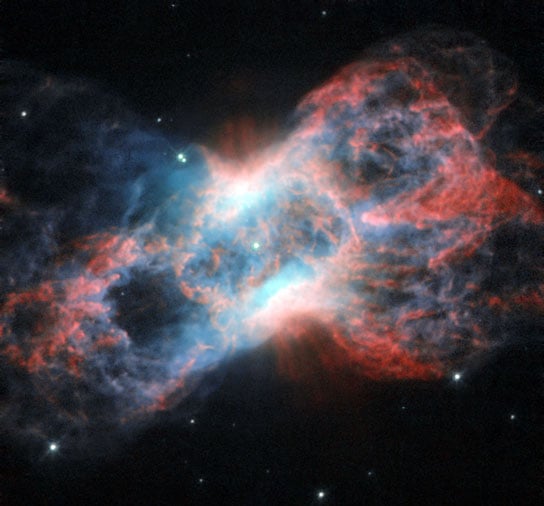
    image from the NASA/ESA Hubble Space Telescope shows NGC 7026
    Hubble Space Telescope image of planetary nebula NGC 7026. Credit: ESA/Hubble & NASA

    A new image from the Hubble Space Telescope shows the butterfly-shaped cloud of glowing gas and dust that is the wreckage of a star similar to the Sun.

    This image from the NASA/ESA Hubble Space Telescope shows NGC 7026, a planetary nebula. Located just beyond the tip of the tail of the constellation of Cygnus (The Swan), this butterfly-shaped cloud of glowing gas and dust is the wreckage of a star similar to the Sun.

    Planetary nebulae, despite their name, have nothing to do with planets. They are in fact a relatively short-lived phenomenon that occurs at the end of the life of mid-sized stars. As a star’s source of nuclear fuel runs out, its outer layers are puffed out, leaving only the hot core of the star behind. As the gaseous envelope heats up, the atoms in it are excited, and it lights up like a fluorescent sign.

    Fluorescent lights on Earth get their bright colors from the gases they are filled with. Neon signs, famously, produce a bright red color, while ultraviolet lights (black lights) typically contain mercury. The same goes for nebulae: their vivid colors are produced by the mix of gases present in them.

    This image of NGC 7026 shows starlight in green, light from glowing nitrogen gas in red, and light from oxygen in blue (in reality, this appears green, but the color in this image has been shifted to increase the contrast).

    As well as visible light, NGC 7026 emits X-ray radiation, and has been studied by ESA’s XMM-Newton space telescope. X-rays are a result of the extremely high temperatures of the gas in NGC 7026.

    This image was produced by the Wide Field and Planetary Camera 2 aboard the Hubble Space Telescope. The image is 35 by 35 arcseconds.

    A version of this image was entered into the Hubble’s Hidden Treasures Competition by contestant Linda Morgan-O’Connor. Hidden Treasures is an initiative to invite astronomy enthusiasts to search the Hubble archive for stunning images that have never been seen by the general public.

    Never miss a breakthrough: Join the SciTechDaily newsletter.
    Follow us on Google and Google News.

    Hubble Space Telescope NASA Nebula Stars
    Share. Facebook Twitter Pinterest LinkedIn Email Reddit

    Related Articles

    Hubble Views Planetary Nebula IC 289

    Looking Inside a Stellar Cloud

    Panoramic View of 30 Doradus – The Brightest Star-Forming Region in Our Galactic Neighborhood

    Hubble Captures New Image of Messier 9

    Stars of the Antlia Dwarf Galaxy

    New Images of Orion Nebula Show Young Stars Hidden in Gas and Dust Clouds

    Researchers Discover First Intermediate-Mass Black Hole

    ESA’s Hershel Space Telescope Captures Incredible Views of Eagle Nebula

    Hubble Observes Rare Blue Stars in Andromeda’s Core

    Leave A Reply Cancel Reply

    • Facebook
    • Twitter
    • Pinterest
    • YouTube

    Don't Miss a Discovery

    Subscribe for the Latest in Science & Tech!

    Trending News

    Researchers Warn Widely Prescribed Blood Pressure Drugs Could Be Harming Diabetic Kidneys

    James Webb Spots Something Strange Between Day and Night on an Alien Planet

    How Ancient People Moved a 6-Ton Stone 700 Kilometers to Stonehenge

    The Unexpected Gut Health Risk of Cutting Out Sugar

    Popular Weight-Loss Drugs Like Ozempic Linked to Lower Breast Cancer Risk

    AI Learned the Rules of the Universe and That Became a Problem

    Scientists Found a Hidden Brain Signal That Predicts Social Behavior

    Even GPT-5 Failed This Human Attention Test

    Follow SciTechDaily
    • Facebook
    • Twitter
    • YouTube
    • Pinterest
    • Newsletter
    • RSS
    SciTech News
    • Biology News
    • Chemistry News
    • Earth News
    • Health News
    • Physics News
    • Science News
    • Space News
    • Technology News
    Recent Posts
    • Scientists Say a New Universe Could Form Inside a Dying Star
    • Climate Models May Be Wrong About How Trees Store Carbon
    • Scientists Discovered a Fly That Sheds Its Wings and Sacrifices Its Sight
    • Researchers Capture the First Atomic-Level Images of a Critical Human DNA Repair Enzyme
    • Scientists Just Discovered a Cellular Survival System That Was Never Supposed To Exist
    Copyright © 1998 - 2026 SciTechDaily. All Rights Reserved.
    • Science News
    • About
    • Contact
    • Editorial Board
    • Privacy Policy
    • Terms of Use

    Type above and press Enter to search. Press Esc to cancel.