
Close Menu
    Facebook X (Twitter) Instagram
    SciTechDaily
    • Biology
    • Chemistry
    • Earth
    • Health
    • Physics
    • Science
    • Space
    • Technology
    Facebook X (Twitter) Pinterest YouTube RSS
    SciTechDaily
    Home»Space»Hubble Captures a Breathtaking Light Show From a Powerful Protostellar Jet
    Space

    Hubble Captures a Breathtaking Light Show From a Powerful Protostellar Jet

    By ESA/HubbleOctober 1, 2023No Comments3 Mins Read
    Facebook Twitter Pinterest Telegram LinkedIn WhatsApp Email Reddit
    Share
    Facebook Twitter LinkedIn Pinterest Telegram Email Reddit
    Hubble G35.2-0.7N
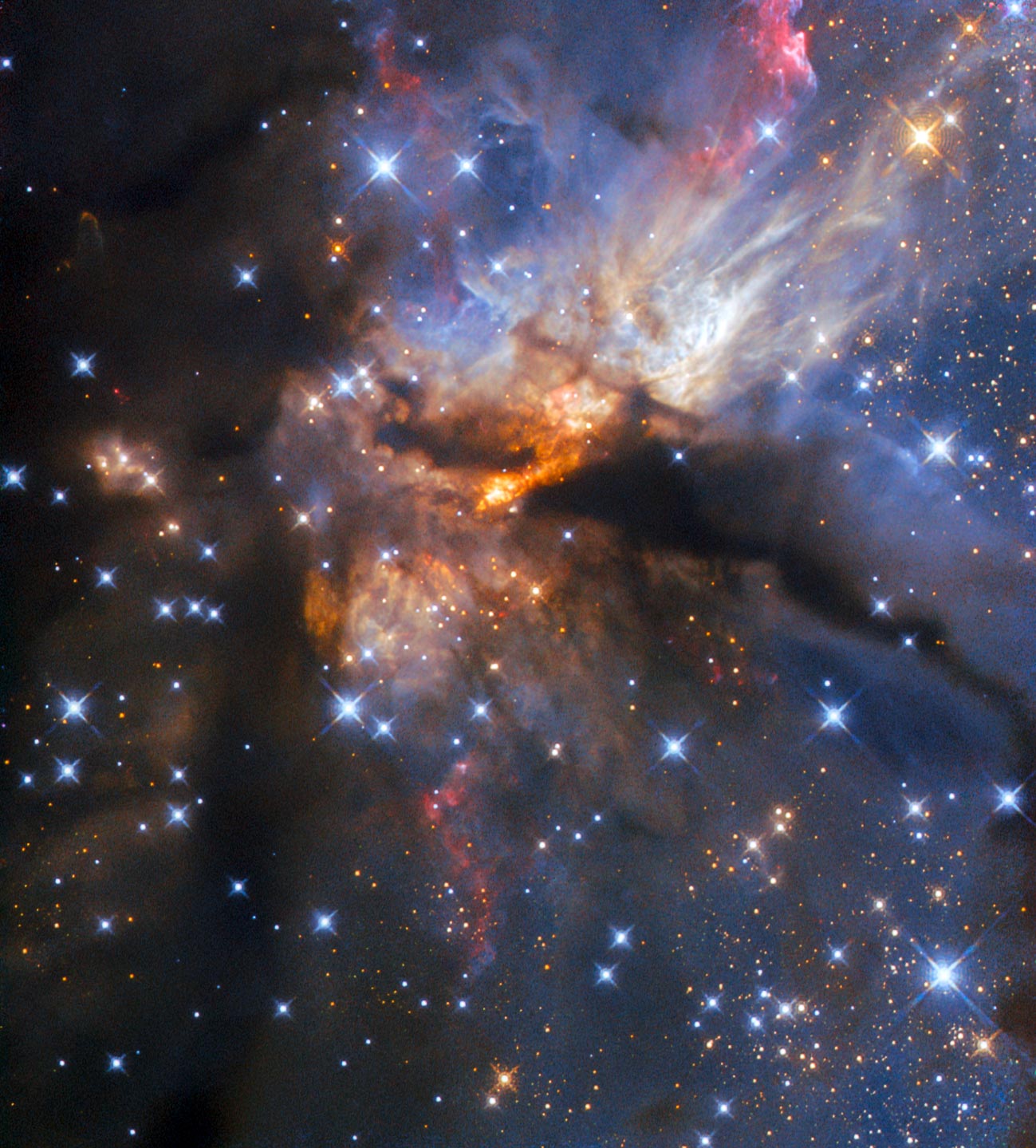
    The Hubble Space Telescope captured this spectacular image of G35.2-0.7N, a region known for its high-mass star formation. Located approximately 7200 light-years from Earth in the Aquila constellation, this area houses at least one B-type star. This star emits a powerful protostellar jet, which can be observed as a radiant display in the image.  Credit: ESA/Hubble & NASA, R. Fedriani, J. Tan

    Hubble’s image of G35.2-0.7N reveals a massive protostar ejecting a jet, providing insights into high-mass star formation and ionization processes.

    This breathtaking image from the Hubble Space Telescope shows a region called G35.2-0.7N, which is known as a hotbed of high-mass star formation. The kind of stars that form here are so massive that they will end their lives as destructive supernovae. However, even as they form they greatly impact their surroundings. At least one B-type star — the second most massive type — lurks within the region pictured here, and a powerful protostellar jet that it is launching towards us is the source of the spectacular light show.

    Taken with the Wide Field Camera 3 (WFC3), which is mounted on the NASA/ESA Hubble Space Telescope, this image captures the region G35.2-0.7N which lies approximately 7200 light-years from Earth in the constellation Aquila.

    This beautiful picture was assembled using data that were collected primarily for very specific research purposes, as are many of the Hubble Pictures of the Week. The research conducted using these data included measuring the extent of ionization in the jets being blasted out of the protostar buried within G35.2-0.7N. Ionization is a process by which atoms or molecules become charged, often because they are in such a high-energy environment that they have lost some of their electrons (the tiny negatively charged particles that orbit nuclei in atoms and molecules).

    Protostellar jets are enormous collimated beams of matter that are ejected from protostars. Collimated simply means that the matter is ejected in parallel (column-like) streams, which in turn means that the jets do not spread out much, but extend out very far in relatively straight lines.

    The visual result of the ejected matter is the glorious display visible in this image. Much of the nebula is dark, with light being blocked from Hubble’s view by the rich dust clouds that produce these massive stars.

    Near the very center, the location of the star and the jet of material it is emitting can be seen. The small, bright orange streak there is a cavity in the dust carved out by the ferocity of the jet as it streams toward us. By breaking through its dusty cocoon, the jet reveals light from the protostar, but there is still so much dust that the light is “reddened” to a fiery orange. The massive protostar lies at the very lower-left tip of this cavity.

    Never miss a breakthrough: Join the SciTechDaily newsletter.
    Follow us on Google and Google News.

    Astronomy European Space Agency Hubble Space Telescope
    Share. Facebook Twitter Pinterest LinkedIn Email Reddit

    Related Articles

    A Diamond Necklace of Cosmic Proportions

    Hubble Snaps a Stunning Close-Up of a Magnificent Spiral Galaxy

    Extraordinary Hubble Image: Light Bends From the Beyond

    Hubble Space Telescope Sees Volcanic Activity Reforming the Atmosphere on a Rocky Exoplanet

    Hubble Spies a Luminous Heart With Dark Tendrils

    Spectacular Return to the Veil Nebula

    Hubble Spots a Peculiar Sight: Unusual Spiral Galaxy With a Heavy Arm

    A Flash of Life: Hubble Spies an Unusual Planetary Nebula

    Through the Cosmic Clouds: Hubble Spots a Beautiful Stellar Nursery

    Leave A Reply Cancel Reply

    • Facebook
    • Twitter
    • Pinterest
    • YouTube

    Don't Miss a Discovery

    Subscribe for the Latest in Science & Tech!

    Trending News

    Stanford Scientists Discover a Remarkable Way To Rescue Dying Corals in Just Seven Weeks

    0 to 15 MPH in a Single Swipe: New Research Reveals How Ancient Giant Sea Monsters Ambushed Their Prey

    Late-Night Snacking Could Be Putting Your Liver at Risk

    40 Years of Superconductor Science Just Got Turned Upside Down by a Stunning Discovery

    A 50-Year-Old Mystery: Scientists Discover What May Have Killed Brazil’s Frogs

    Scientists Discover Exercise Changes the Body in Ways We Never Fully Understood

    Scientists Restore Memory in Mice With Alzheimer’s by Boosting a Single Brain Protein

    Scientists Create “Super Ice” That’s 10 Times Stronger and Rivals Concrete in Strength

    Follow SciTechDaily
    • Facebook
    • Twitter
    • YouTube
    • Pinterest
    • Newsletter
    • RSS
    SciTech News
    • Biology News
    • Chemistry News
    • Earth News
    • Health News
    • Physics News
    • Science News
    • Space News
    • Technology News
    Recent Posts
    • Scientists Studied 865 Humpback Whales and Found They Grow Faster Than Expected
    • Physicists Use Light To Unlock a Crystal’s Hidden Electrical Powers
    • Archaeologists May Have Just Discovered the World’s Oldest Shipwreck
    • Dementia Will Cost America a Staggering $818 Billion This Year
    • Popular Sleep Supplement Could Come With an Unexpected Catch, Scientists Warn
    Copyright © 1998 - 2026 SciTechDaily. All Rights Reserved.
    • Science News
    • About
    • Contact
    • Editorial Board
    • Privacy Policy
    • Terms of Use

    Type above and press Enter to search. Press Esc to cancel.