
Close Menu
    Facebook X (Twitter) Instagram
    SciTechDaily
    • Biology
    • Chemistry
    • Earth
    • Health
    • Physics
    • Science
    • Space
    • Technology
    Facebook X (Twitter) Pinterest YouTube RSS
    SciTechDaily
    Home»Space»Hubble Space Telescope: Calling on a Galactic Neighbor
    Space

    Hubble Space Telescope: Calling on a Galactic Neighbor

    By ESA/HubbleJanuary 8, 20232 Comments2 Mins Read
    Facebook Twitter Pinterest Telegram LinkedIn WhatsApp Email Reddit
    Share
    Facebook Twitter LinkedIn Pinterest Telegram Email Reddit
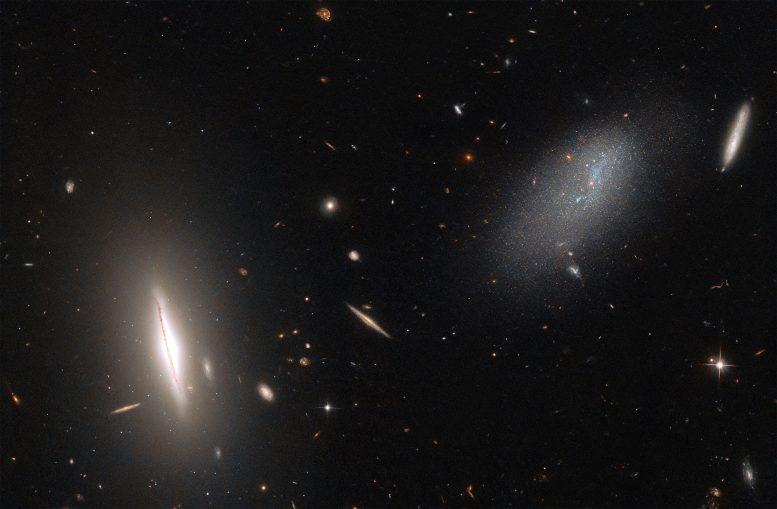
    Galaxy LEDA 48062
    Hubble Space Telescope image of galaxy LEDA 48062 in the constellation Perseus. Credit: ESA/Hubble & NASA, R. Tully

    This image from the NASA/ESA Hubble Space Telescope features the galaxy LEDA 48062 in the constellation Perseus. LEDA 48062 is the faint, sparse, amorphous galaxy on the right side of this image, and it is accompanied by a more sharply defined neighbor on the left, the large, disc-like lenticular galaxy UGC 8603. A smattering of more distant galaxies also litter the background, and a handful of foreground stars are also visible throughout the image.

    Have you ever wondered why the stars in Hubble images are surrounded by four sharp points? These are called diffraction spikes, and are created when starlight diffracts — or spreads around — the support structures inside reflecting telescopes like Hubble. The four spikes are due to the four thin vanes supporting Hubble’s secondary mirror and are only noticeable for bright objects like stars where a lot of light is concentrated on one spot. Darker, more spread-out objects like the galaxies LEDA 48062 and UGC 8603 do not possess visible diffraction spikes.

    Hubble recently spent some time with our galactic neighbors. LEDA 48062 is only around 30 million light-years from the Milky Way, and was therefore included in the observing campaign Every Known Nearby Galaxy. The aim of this campaign was to observe precisely that: every known galaxy within 10 megaparsecs (around 33 million light-years) of the Milky Way. By getting to know our galactic neighbors, astronomers can determine what types of stars reside in various galaxies and also map out the local structure of the Universe.

    Never miss a breakthrough: Join the SciTechDaily newsletter.
    Follow us on Google and Google News.

    Astronomy European Space Agency Hubble Space Telescope
    Share. Facebook Twitter Pinterest LinkedIn Email Reddit

    Related Articles

    A Diamond Necklace of Cosmic Proportions

    Hubble Snaps a Stunning Close-Up of a Magnificent Spiral Galaxy

    Extraordinary Hubble Image: Light Bends From the Beyond

    Hubble Space Telescope Sees Volcanic Activity Reforming the Atmosphere on a Rocky Exoplanet

    Hubble Spies a Luminous Heart With Dark Tendrils

    Spectacular Return to the Veil Nebula

    Hubble Spots a Peculiar Sight: Unusual Spiral Galaxy With a Heavy Arm

    A Flash of Life: Hubble Spies an Unusual Planetary Nebula

    Through the Cosmic Clouds: Hubble Spots a Beautiful Stellar Nursery

    2 Comments

    1. Jojo on January 8, 2023 10:51 pm

      “LEDA 48062 is only around 30 million light-years from the Milky Way”
      ——–
      Only??? What is amazing is the amount of light being put out by galaxies that enable the millions or billions of light years away to be captured as an image. Imagine if the energy output from a galaxy could be captured and channeled into a useful project!

      Reply
    2. Austin Hook on January 10, 2023 12:11 am

      I keep wondering why spikes on bright stars, in images from billion dollar telescopes, are not filtered out by some algorithm that computes the effect and subtracts it from the image.

      Reply
    Leave A Reply Cancel Reply

    • Facebook
    • Twitter
    • Pinterest
    • YouTube

    Don't Miss a Discovery

    Subscribe for the Latest in Science & Tech!

    Trending News

    Walking for Just 20 Minutes Caused an Immediate Change in the Gut

    Scientists Have Uncovered Previously Hidden Microbial Activity on Human Skin

    Stacked Mummies Reveal 700 Years of Changing Burial Rituals in Ancient Egypt

    Scientists Discover a Butterfly That Barely Seems To Age

    Astronomers Detect a Faint Hydrogen Signal From Billions of Light-Years Away

    Fighting Fire With Fire Could Save Giant Sequoias

    Scientists Just Found a Hidden Factor That Could Trigger an Atlantic Ocean Collapse

    Scientists Find a Berry Compound That Helps Muscle Cells Burn Fat

    Follow SciTechDaily
    • Facebook
    • Twitter
    • YouTube
    • Pinterest
    • Newsletter
    • RSS
    SciTech News
    • Biology News
    • Chemistry News
    • Earth News
    • Health News
    • Physics News
    • Science News
    • Space News
    • Technology News
    Recent Posts
    • This Simple Walking Habit May Have Helped Humans Conquer the World
    • Scientists Discover a Key Reason Why the Aging Eye Struggles To Regrow Lost Neurons
    • New Study Reveals a Major Shift Behind Rising ADHD and Autism Diagnoses
    • New Treatment Cuts “Bad” Cholesterol in Half for a Full Year
    • Scientists Discover Trees Have a Hidden “Muscle” That Helps Them Straighten Themselves
    Copyright © 1998 - 2026 SciTechDaily. All Rights Reserved.
    • Science News
    • About
    • Contact
    • Editorial Board
    • Privacy Policy
    • Terms of Use

    Type above and press Enter to search. Press Esc to cancel.