
Close Menu
    Facebook X (Twitter) Instagram
    SciTechDaily
    • Biology
    • Chemistry
    • Earth
    • Health
    • Physics
    • Science
    • Space
    • Technology
    Facebook X (Twitter) Pinterest YouTube RSS
    SciTechDaily
    Home»Technology»A Benchmark for Single-Electron Quantum Circuits
    Technology

    A Benchmark for Single-Electron Quantum Circuits

    By Physikalisch-Technische Bundesanstalt (PTB)January 26, 2021No Comments3 Mins Read
    Facebook Twitter Pinterest Telegram LinkedIn WhatsApp Email Reddit
    Share
    Facebook Twitter LinkedIn Pinterest Telegram Email Reddit
    Counting Statistics Error Signal
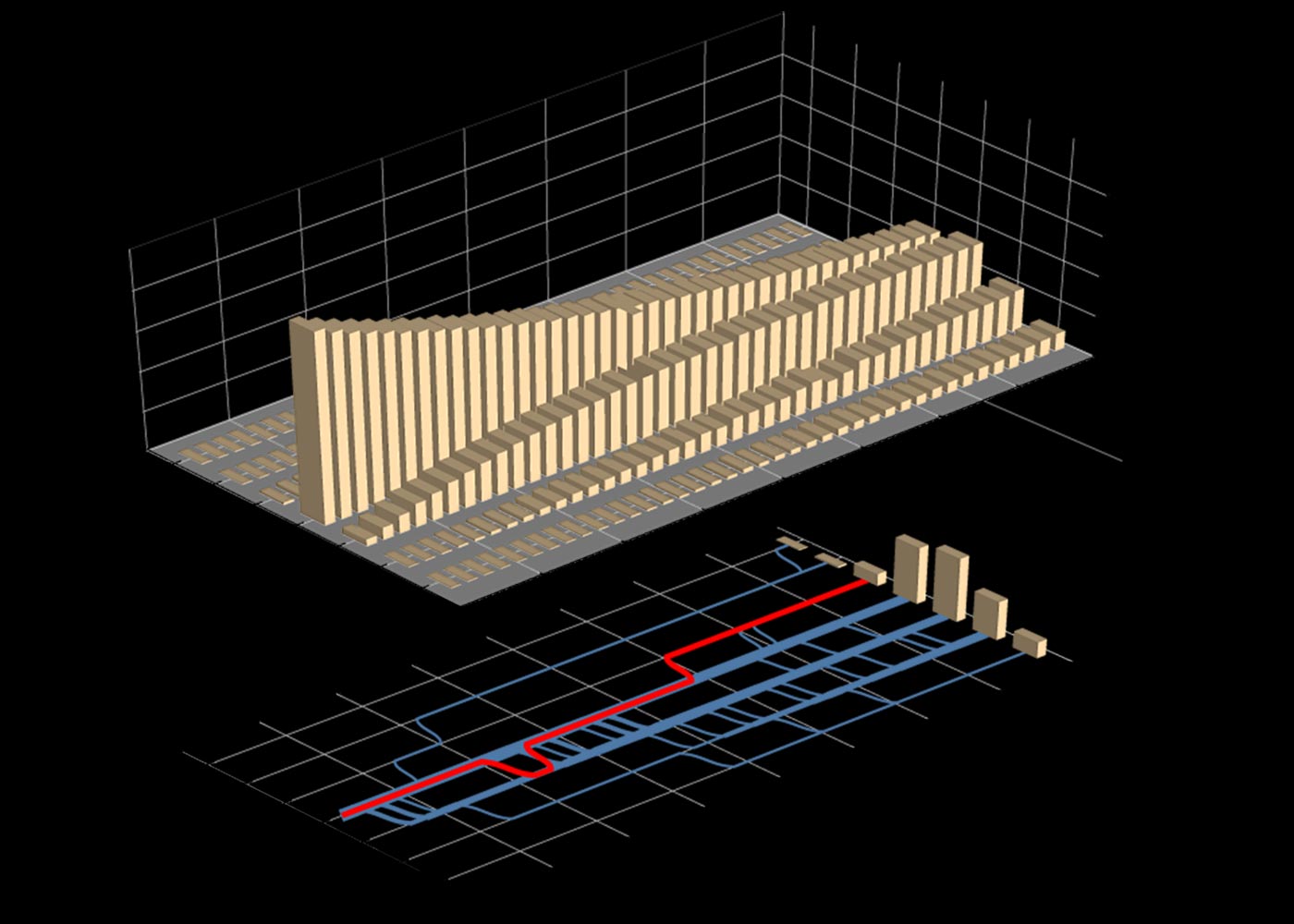
    Top: Counting statistics (ptx) of an error signal (x) recorded by a single-charge detector, shown as a function of the number of repetitions (t) of the transfer operation; these repetitions were performed by the single-electron circuit. Bottom: Simulation of the underlying “random walks” (blue lines) based on this measurement signal. Here, the width of the line shows how frequently a step takes place. The red line exemplifies a single path of the error signal. Credit: Ubbelohde

    A new methodology for an abstract and universal description of the fidelity of quantum circuits.

    Manipulating individual electrons with the goal of employing quantum effects offers new possibilities and greater precision in electronics. However, these single-electron circuits are governed by the laws of quantum mechanics, meaning that deviations from error-free operation still occur – albeit (in the best possible scenario) only very rarely. Thus, insights into both the physical origin and metrological aspects of this fundamental uncertainty are crucial for the further development of quantum circuitry. To this end, scientists from the Physikalisch-Technische Bundesanstalt (PTB) and the University of Latvia have collaborated to develop a statistical testing methodology. Their results have been published in the journal Nature Communications.

    Single-electron circuits are already used as electric-current quantum standards and in quantum-computer prototypes. In these miniaturized quantum circuits, interactions and noise impede the investigation of the fundamental uncertainties, and measuring them is a challenge, even for the metrological precision of the measurement apparatus.

    In the field of quantum computers, a testing procedure also referred to as a “benchmark” is frequently used in which the operating principle and fidelity of the entire circuit are evaluated via the accumulation of errors following a sequence of operations. Based on this principle, researchers from PTB and the University of Latvia have now developed a benchmark for single-electron circuits. Here, the circuit’s fidelity is described by the random steps of an error signal recorded by an integrated sensor while the circuit repeatedly executes an operation. The statistical analysis of this “random walk” can be used to identify the rare but unavoidable errors when individual quantum particles are manipulated.

    Tracking Errors Through a Quantum Random Walk

    By means of this “random-walk benchmark”, the transfer of individual electrons was investigated in a circuit consisting of single-electron pumps developed at PTB as primary standards for realizing the ampere, an SI base unit. In this experiment, sensitive detectors record the error signal with single-electron resolution. The statistical analysis made possible by counting individual particles not only shows fundamental limitations of the circuit’s fidelity induced by external noise and temporal correlations but also provides a robust measure of assessing errors in applied quantum metrology.

    The methodology developed within the scope of this work provides a rigorous mathematical foundation for validating quantum standards of electrical quantities and opens new paths for the development of integrated complex quantum systems.

    Reference: “A random-walk benchmark for single-electron circuits” by David Reifert, Martins Kokainis, Andris Ambainis, Vyacheslavs Kashcheyevs and Niels Ubbelohde, 12 January 2021, Nature Communications.
    DOI: 10.1038/s41467-020-20554-w

    Never miss a breakthrough: Join the SciTechDaily newsletter.
    Follow us on Google and Google News.

    Electromagnetics Physikalisch-Technische Bundesanstalt Quantum Computing Quantum Physics
    Share. Facebook Twitter Pinterest LinkedIn Email Reddit

    Related Articles

    USC Study Validates Large-Scale Quantum Chip

    A New Model of a Quantum Computer

    Physicists Use Cloud of Rubidium Atoms as Optical Memory Device

    Quantum Computing Continues to Move Forward

    New Spin Technique Moves Quantum Computers a Step Closer

    Yale Physicists Observe Quantum Information While Preserving Its Integrity

    Photon Devices Could Outperform Traditional Computers

    Samarium Hexoboride Behaves Like a Topological Insulator

    Electronic Read-Out of the Quantum State of an Atom

    Leave A Reply Cancel Reply

    • Facebook
    • Twitter
    • Pinterest
    • YouTube

    Don't Miss a Discovery

    Subscribe for the Latest in Science & Tech!

    Trending News

    Your Blood Pressure Reading Could Be Wrong Because of One Simple Mistake

    Astronomers Stunned by Ancient Galaxy With No Spin

    Physicists May Be on the Verge of Discovering “New Physics” at CERN

    Scientists Solve 320-Million-Year Mystery of Reptile Skin Armor

    Scientists Say This Daily Walking Habit May Be the Secret to Keeping Weight Off After Dieting

    New Therapy Rewires the Brain To Restore Joy in Depression Patients

    Giant Squid Detected off Western Australia in Stunning Deep-Sea Discovery

    Popular Sugar-Free Sweetener Linked to Liver Disease, Study Warns

    Follow SciTechDaily
    • Facebook
    • Twitter
    • YouTube
    • Pinterest
    • Newsletter
    • RSS
    SciTech News
    • Biology News
    • Chemistry News
    • Earth News
    • Health News
    • Physics News
    • Science News
    • Space News
    • Technology News
    Recent Posts
    • Scientists Revive Ancient Chemistry Trick To Engineer Next-Generation Glass
    • Scientists Use AI To Supercharge Ultrafast Laser Simulations by More Than 250x
    • Scientists Just Found a Surprising Way To Destroy “Forever Chemicals”
    • Popular Supplement Ingredient Linked to Shorter Lifespan in Men
    • Scientists May Have Found a Way To Repair Nerve Damage in Multiple Sclerosis
    Copyright © 1998 - 2026 SciTechDaily. All Rights Reserved.
    • Science News
    • About
    • Contact
    • Editorial Board
    • Privacy Policy
    • Terms of Use

    Type above and press Enter to search. Press Esc to cancel.