
Close Menu
    Facebook X (Twitter) Instagram
    SciTechDaily
    • Biology
    • Chemistry
    • Earth
    • Health
    • Physics
    • Science
    • Space
    • Technology
    Facebook X (Twitter) Pinterest YouTube RSS
    SciTechDaily
    Home»Chemistry»A Boron-Radical Approach: Mild Ammonia Synthesis From Nitrogen
    Chemistry

    A Boron-Radical Approach: Mild Ammonia Synthesis From Nitrogen

    By WileyDecember 28, 2022No Comments3 Mins Read
    Facebook Twitter Pinterest Telegram LinkedIn WhatsApp Email Reddit
    Share
    Facebook Twitter LinkedIn Pinterest Telegram Email Reddit
    Abstract Chemistry Concept Image
    A team of researchers has published a new method for obtaining ammonia in the journal Angewandte Chemie. This method, which uses reactive boron compounds to convert atmospheric nitrogen to ammonium chloride with the addition of an acid, is much milder than the traditional Haber-Bosch process and does not require the use of energy-intensive hydrogen gas or metals. This conversion can be carried out in solution at room temperature, making it a more environmentally friendly and efficient alternative for producing ammonia.

    Using Boron Radicals To Convert Nitrogen to Ammonia in Solution

    Ammonia is obtained industrially using the Haber–Bosch process, which requires a lot of energy and hydrogen gas. A much milder approach has now been reported by a team of researchers in the journal Angewandte Chemie. According to this research, reactive boron compounds can efficiently target atmospheric nitrogen and convert it to ammonium chloride after the addition of an acid. This conversion takes place in solution, at room temperature, and without the need for metals or hydrogen gas.

    Nitrogen makes up 77% of the air we breathe, and so, in theory, it is virtually infinitely available for ammonia synthesis. However, in practice, it only reacts extremely slowly with other elements. In the Haber–Bosch process, which was developed over 100 years ago, metal catalysts accelerate this sluggish reaction. They activate the nitrogen which is then reacted with hydrogen under high pressure and temperature, giving ammonia.
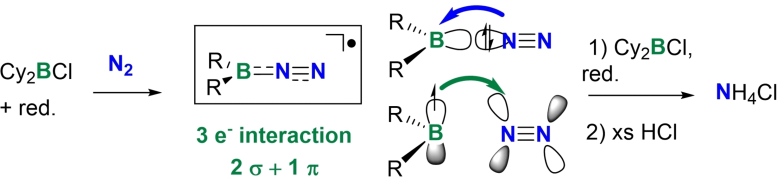
    Mild Ammonia Synthesis
    Credit: © Wiley-VCH, Angewandte Chemie

    Ammonia is used industrially for producing nitrate fertilizers. It can also be used as a hydrogen store when hydrogen is used as a source of energy. To date, microbiological methods for nitrogen fixation have been the predominant milder alternative proposed for the Haber–Bosch process. However, exploiting bacteria for biotechnological ammonia production is still quite inefficient.

    Boron-Centered Radicals: A Breakthrough in Ammonia Synthesis

    A team of researchers headed by Nicolas Mézailles of the Université Paul Sabatier, CNRS, in Toulouse, France, have now discovered that reactive boron compounds can very efficiently target and activate molecular nitrogen. The team explained their initial thinking: “We reasoned that the use of high-energy radicals might provide a kinetically and thermodynamically favorable pathway to nitrogen functionalization.”

    The team’s theoretical calculations then highlighted boron-centered radicals as suitable candidates. The researchers produced these boron-centered radicals by adding a strong reducing agent to organic boron halides. The resulting substances converted molecular nitrogen at room temperature to borylamines, which in turn reacted with aqueous acid to give ammonium chloride.

    Mézailles and the team have now described a novel approach to nitrogen fixation in solution using radical compounds. The researchers observed that the boron-centered radicals they produced efficiently broke down the stable triple bond in molecular nitrogen, making it possible to functionalize molecular nitrogen under mild conditions. This radical-based approach opens up further possibilities for ammonia production without having to rely on fossil-based raw materials.

    Reference: “Ammonia Synthesis at Room Temperature and Atmospheric Pressure from N2: A Boron-Radical Approach” by Dr. Soukaina Bennaamane, Barbara Rialland, Lhoussain Khrouz, Dr. Marie Fustier-Boutignon, Dr. Christophe Bucher, Dr. Eric Clot and Dr. Nicolas Mézailles, 27 October 2022, Angewandte Chemie International Edition.
    DOI: 10.1002/anie.202209102

    Dr. Nicolas Mézailles is a CNRS Research Director (UMR 5069, “Laboratoire Hétérochimie Fondamentale et Appliquée”) at the Université Paul Sabatier, Toulouse, and a Professor at the École Polytechnique, Palaiseau, France. His research team studies the synthesis and reactivity of high-energy species, ranging from metal complexes to main group high-energy compounds. He has co-founded a startup company Swan-H aiming to industrialize this discovery.

    Never miss a breakthrough: Join the SciTechDaily newsletter.
    Follow us on Google and Google News.

    Ammonia Green Energy Hydrogen Wiley
    Share. Facebook Twitter Pinterest LinkedIn Email Reddit

    Related Articles

    Harnessing Hydrogen in a Safe, Easy, and Affordable Way for a Decarbonized Future

    Advanced New Catalysts for More Efficient Clean Hydrogen Production

    New Electrocatalyst Produces Liquid Fuels From Carbon Dioxide

    Technological Breakthrough Allows Seamless Conversion of Ammonia to Green Hydrogen

    Speeding Toward Improved Hydrogen Fuel Production With a New Nanomaterial

    Clean Energy Breakthrough: Scientists Improve Light-Driven Water-Splitting to Produce Hydrogen

    Energy Industry Game-Changer: Using Rust and Organic Waste to Produce Hydrogen Fuel

    Efficient Seawater Desalination and Hydrogen Production Possible With New Catalyst

    Post-Lithium Technology: High-Energy-Density Next-Generation Rechargeable Batteries

    Leave A Reply Cancel Reply

    • Facebook
    • Twitter
    • Pinterest
    • YouTube

    Don't Miss a Discovery

    Subscribe for the Latest in Science & Tech!

    Trending News

    AI Could Detect Early Signs of Alzheimer’s in Under a Minute – Far Before Traditional Tests

    What if Dark Matter Has Two Forms? Bold New Hypothesis Could Explain a Cosmic Mystery

    This Metal Melts in Your Hand – and Scientists Just Discovered Something Strange

    Beef vs. Chicken: Surprising Results From New Prediabetes Study

    Alzheimer’s Breakthrough: Scientists Discover Key Protein May Prevent Toxic Protein Clumps in the Brain

    Quantum Reality Gets Stranger: Physicists Put a Lump of Metal in Two Places at Once

    Scientists May Have Found the Key to Jupiter and Saturn’s Moon Mystery

    Scientists Uncover Brain Changes That Link Pain to Depression

    Follow SciTechDaily
    • Facebook
    • Twitter
    • YouTube
    • Pinterest
    • Newsletter
    • RSS
    SciTech News
    • Biology News
    • Chemistry News
    • Earth News
    • Health News
    • Physics News
    • Science News
    • Space News
    • Technology News
    Recent Posts
    • Students Found an Ancient Star That Shouldn’t Be in the Milky Way
    • Astronomers Solve 50-Year Mystery and Reveal Hidden Culprit Behind Strange X-Ray Emissions
    • One of the Universe’s Largest Stars May Be Getting Ready To Explode
    • Scientists Discover Enzyme That Could Supercharge Ozempic-Like Weight Loss Drugs
    • Asthma and Depression Don’t Mix the Way Scientists Expected
    Copyright © 1998 - 2026 SciTechDaily. All Rights Reserved.
    • Science News
    • About
    • Contact
    • Editorial Board
    • Privacy Policy
    • Terms of Use

    Type above and press Enter to search. Press Esc to cancel.