

As the largest planet in our Solar System, Jupiter’s grandeur is visible to the naked eye and through simple telescopes, showing its moons and surface storms.
Jupiter is truly the giant of our solar system, earning its title as the “king of planets.” Its massive size and reflective, banded cloud tops make it one of the brightest and easiest objects to spot in the night sky. Jupiter also boasts moons as large as planets; for example, Ganymede, its largest moon, is bigger than Mercury. Remarkably, with a simple telescope or even binoculars, you can observe Jupiter and its moons, much like Galileo did over 400 years ago.
Jupiter’s Massive Scale and Influence
Jupiter’s immense size is staggering. Eleven Earths could line up across its diameter, and it would take more than 1,300 Earth-sized planets to fill its volume — yet even that wouldn’t fully match its capacity!
Beyond its sheer size, Jupiter’s dominance comes from its incredible mass. Combine the mass of all the other planets in the solar system, and Jupiter would still outweigh them two to one. This immense gravitational force influences countless comets and asteroids, shaping their orbits. It can hurl these objects toward the inner solar system or capture them in its own gravitational grip.
One dramatic example occurred in 1994 when fragments of Comet Shoemaker-Levy 9 collided with Jupiter’s atmosphere. The impacts created massive fireballs and dark spots on the planet’s surface, visible to both NASA’s Galileo probe and telescopes on Earth, demonstrating the sheer power of this gas giant.

Observing Jupiter and Its Moons
Jupiter is easy to observe at night with our unaided eyes, as well-documented by the ancient astronomers who carefully recorded its slow movements from night to night. It can be one of the brightest objects in our nighttime skies, bested only by the Moon, Venus, and occasionally Mars, when the red planet is at opposition.
That’s impressive for a planet that, at its closest to Earth, is still over 365 million miles (587 million km) away. It’s even more impressive that the giant world remains very bright to Earthbound observers at its furthest distance: 600 million miles (968 million km)!
While the King of Planets has a coterie of 95 known moons, only the four large moons that Galileo originally observed in 1610 – Io, Europa, Ganymede, and Calisto – can be easily observed by Earth-based observers with very modest equipment. These are called, appropriately enough, the Galilean moons.
Most telescopes will show the moons as faint star-like objects neatly lined up close to bright Jupiter. Most binoculars will show at least one or two moons orbiting the planet. Small telescopes will show all four of the Galilean moons if they are all visible, but sometimes they can pass behind or in front of Jupiter or even each other. Telescopes will also show details like Jupiter’s cloud bands and, if powerful enough, large storms like its famous Great Red Spot, and the shadows of the Galilean moons passing between the Sun and Jupiter.
Sketching the positions of Jupiter’s moons during the course of an evening – and night to night – can be a rewarding project! You can download an activity guide from the Astronomical Society of the Pacific.
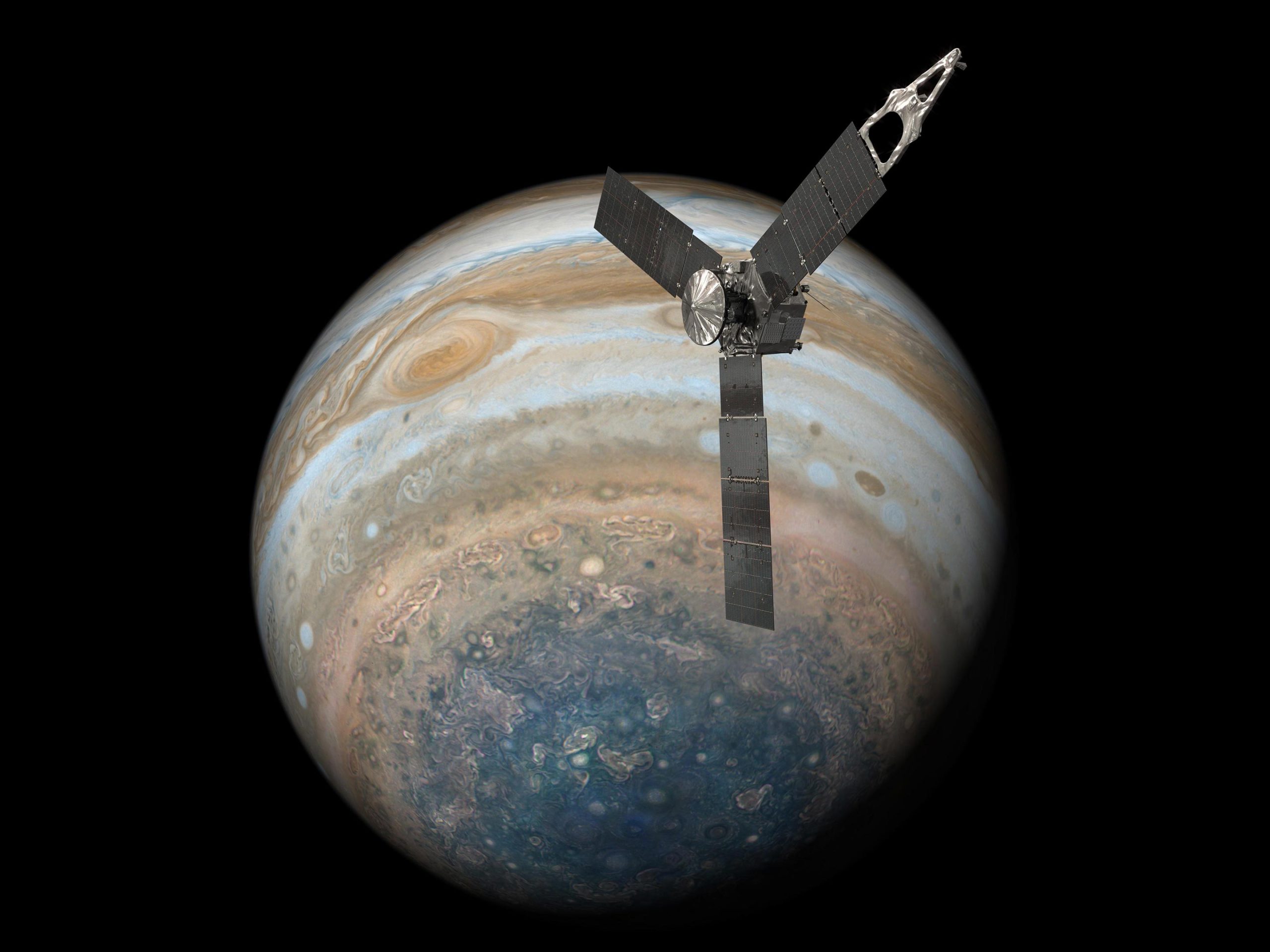
Exploring Jupiter: The Juno Mission
Now in its eighth year, NASA’s Juno mission is one of just nine spacecraft to have visited this impressive world. Juno entered Jupiter’s orbit in 2016 to begin its initial mission to study this giant world’s mysterious interior. The years have proven Juno’s mission a success, with data from the probe revolutionizing our understanding of this gassy world’s guts.
Juno’s mission has since been extended to include the study of its large moons, and since 2021 the plucky probe, increasingly battered by Jupiter’s powerful radiation belts, has made close flybys of the icy moons Ganymede and Europa, along with volcanic Io. What else will we potentially learn in 2030 with the Europa Clipper mission?
Never miss a breakthrough: Join the SciTechDaily newsletter.
Follow us on Google and Google News.