
Close Menu
    Facebook X (Twitter) Instagram
    SciTechDaily
    • Biology
    • Chemistry
    • Earth
    • Health
    • Physics
    • Science
    • Space
    • Technology
    Facebook X (Twitter) Pinterest YouTube RSS
    SciTechDaily
    Home»Biology»A Child’s Unique Brain Activity Reveals Their Memory Ability
    Biology

    A Child’s Unique Brain Activity Reveals Their Memory Ability

    By Society for NeuroscienceMay 25, 2020No Comments2 Mins Read
    Facebook Twitter Pinterest Telegram LinkedIn WhatsApp Email Reddit
    Share
    Facebook Twitter LinkedIn Pinterest Telegram Email Reddit
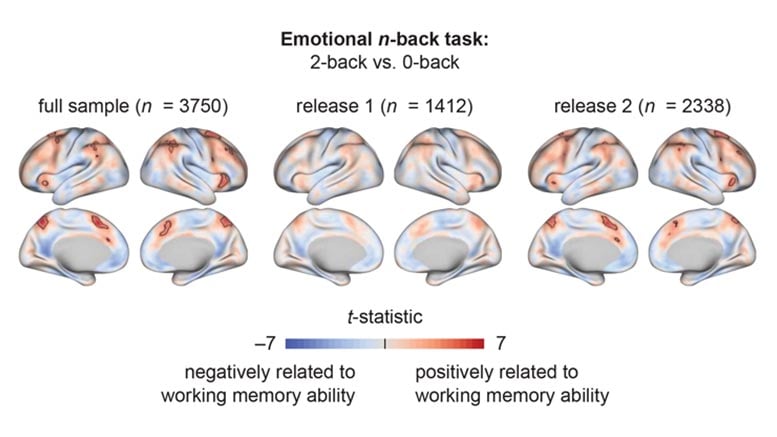
    Frontoparietal Brain Activation
    Frontoparietal activation reflects individual working memory abilities. Credit: Rosenberg et al., JNeurosci 2020

    Brain network activity predicts working memory abilities during development.

    A child’s unique brain activity reveals how good their memories are, according to research recently published in JNeurosci.

    When you scramble to remember a phone number as you enter it into your phone, you rely on your working memory to keep the number at the front of your mind. Briefly holding and manipulating information relies on the activity of the frontoparietal network, a group of brain regions coined the “cognition core.” Working memory performance changes throughout development, but can an individual’s memory facility be determined based on brain activity?

    Rosenberg et al. analyzed fMRI data from the Adolescent Brain Cognitive Development (ABCD) data set, a repository of scans and behavioral tests from over 11,000 children aged nine and ten. Children with better working memory performed better on a range of cognitive, language, and problem-solving tasks. Activity in the frontoparietal network during a memory task reflected the individual working memory capabilities of the children, with an activity pattern unique to working memory. The ABCD data set will reexamine the children for ten years, allowing future studies to explore how the neural signature of working memory evolves across development.

    Reference: “Behavioral and neural signatures of working memory in childhood” by Monica D. Rosenberg, Steven A. Martinez, Kristina M. Rapuano, May I. Conley, Alexandra O. Cohen, M. Daniela Cornejo, Donald J. Hagler Jr., Wesley J. Meredith, Kevin M. Anderson, Tor D. Wager, Eric Feczko, Eric Earl, Damien A. Fair, Deanna M. Barch, Richard Watts and B. J. Casey, 25 May 2020, JNeurosci.
    DOI: 10.1523/JNEUROSCI.2841-19.2020

    Never miss a breakthrough: Join the SciTechDaily newsletter.
    Follow us on Google and Google News.

    Brain Neuroscience Society for Neuroscience
    Share. Facebook Twitter Pinterest LinkedIn Email Reddit

    Related Articles

    Drug (Cocaine, Methamphetamine, or Nicotine) Withdrawal Morphs Brain Communication Networks in Mice

    The Brain Networks Underlying Imagination – Separate Subnetworks Construct and Evaluate Imagined Scenarios

    Deep Inside the Brain: Neuroscientists Discover the Missing Piece of the Brain’s Multitasking Network

    Scientists Uncover Brain Mechanism That May Explain Why Sleep Helps You Learn

    Adult-Born Neurons Grow More Than Their Counterparts From Infancy – May Even Have Unique Functions

    Feeling Disconnected? Loneliness Alters Your Brain’s Social Network

    Unlocking the Neuroscience of How Experiencing Traumatic Stress Leads to Aggression

    Researchers Discover How Stress Restructures the Brain

    Functional Magnetic Resonance Imaging Shows How the Brain Repurposes Unused Regions

    Leave A Reply Cancel Reply

    • Facebook
    • Twitter
    • Pinterest
    • YouTube

    Don't Miss a Discovery

    Subscribe for the Latest in Science & Tech!

    Trending News

    Invisible Black Holes Could Be Triggering Supernovae

    Scientists Discover the First Contagious Cancer in a Freshwater Animal

    THC-CBD Treatment Dramatically Reduces Agitation in Dementia Trial

    Scientists Say Love Follows Mathematical Patterns

    “Zombie Cells” Reveal a Hidden Weakness That Could Help Fight Aging

    Alien Signals May Be Hiding in a Radio Band SETI Has Barely Explored

    Earth’s Hidden Thermostat Has Regulated Climate for 60 Million Years

    This 518-Million-Year-Old Creature Reveals How Spiders Got Their Bite

    Follow SciTechDaily
    • Facebook
    • Twitter
    • YouTube
    • Pinterest
    • Newsletter
    • RSS
    SciTech News
    • Biology News
    • Chemistry News
    • Earth News
    • Health News
    • Physics News
    • Science News
    • Space News
    • Technology News
    Recent Posts
    • Tiny Divers Challenge a Major Theory About Ocean Insects
    • More Than 1,500 Ships Could Carry a Marine Crisis Around the World
    • New Compound Could Help Aging Muscles Repair Themselves
    • Exercise Helps Hip Arthritis but the Relief May Be Hard to Notice
    • Rare Bourbon Virus Confirmed in New York for the First Time
    Copyright © 1998 - 2026 SciTechDaily. All Rights Reserved.
    • Science News
    • About
    • Contact
    • Editorial Board
    • Privacy Policy
    • Terms of Use

    Type above and press Enter to search. Press Esc to cancel.