
Close Menu
    Facebook X (Twitter) Instagram
    SciTechDaily
    • Biology
    • Chemistry
    • Earth
    • Health
    • Physics
    • Science
    • Space
    • Technology
    Facebook X (Twitter) Pinterest YouTube RSS
    SciTechDaily
    Home»Space»A Closer Look at Interacting Galaxies
    Space

    A Closer Look at Interacting Galaxies

    By Harvard Smithsonian Center for AstrophysicsOctober 5, 2012No Comments3 Mins Read
    Facebook Twitter Pinterest Telegram LinkedIn WhatsApp Email Reddit
    Share
    Facebook Twitter LinkedIn Pinterest Telegram Email Reddit
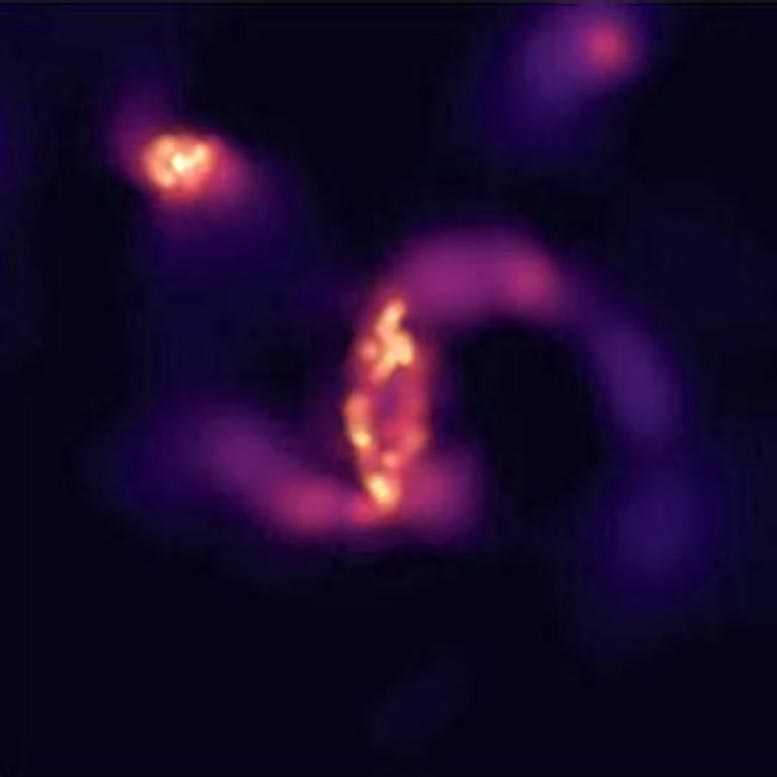
    Interacting Galaxies Computer Simulation Snapshot
    A computer simulation of two colliding galaxies seen here at one early evolutionary stage, showing some of the twists and warps that typically develop and introduce misalignments between a host galaxy and its black hole nucleus. Credit: Hopkins 2012

    Scientists look at how galaxy collisions can distort the shapes of the galaxies involved, including the shapes and orientations of the regions around their central black holes, helping shed light on how infalling gas in a galaxy can efficiently feed its black hole, and whether light from the nuclear region is likely to be obscured by viewing through the galaxy’s disk of material.

    Almost thirty years ago the Infrared Astronomy Satellite, IRAS, discovered that the universe contained many fabulously luminous galaxies, some of them more than a thousand times brighter than our own galaxy, but which are practically invisible at optical wavelengths. The reason for their optical dimness is that their bright light comes not from stars, which can be seen in the visible, but from dust that is warmed by bursts of star formation to temperatures of about 70 kelvin (about 200 degrees below zero Celsius) where infrared radiation predominates. Luminous galaxies not only shed light on how galaxies evolve and form stars, they act as lanterns that can be seen across cosmological distances, thereby helping scientists study the relatively early universe.

    The IRAS galaxies are luminous because they contain so much of this warm dust. Astronomers suspect that most of them have been involved in collisional encounters that stimulated vigorous star formation, as gravitational effects induce interstellar gas to condense into stars. The issue for astronomers is how to confirm and refine these general conclusions. CfA astronomers have an active research effort that uses computer simulations of interacting galaxies to calculate the luminosity of these systems, to uncover how their luminosity evolves with time, and to determine the specific contribution of starburst activity to the infrared emission.

    A new paper by Harvard Smithsonian Center for Astrophysics (CfA) astronomers Lars Hernquist and Chris Hayward and two of their colleagues looks carefully at the ways in which galaxy collisions can distort the shapes of the galaxies involved, including the shapes and orientations of the regions around their central black holes. They compare the orientation of the nuclei (as measured by disks and outflowing jets) with the large-scale orientations of the host galaxies.

    In their computer simulations, they report finding only weak correlations between these alignments. It turns out that misalignments can easily be introduced as giant clumps of material fall into the region of the black hole and alter its spin, or more gradually as twists develop and evolve in the gas of the spinning galaxy. Their conclusion is in excellent agreement with the observational data, namely, that there is a poor correlation between the orientation of the spin axis of a host galaxy and of its black hole nucleus.

    The results will help shed light on a range of related issues, including how infalling gas in a galaxy can efficiently feed its black hole, and whether light from the nuclear region is likely to be obscured by viewing through the galaxy’s disk of material.

    Never miss a breakthrough: Join the SciTechDaily newsletter.
    Follow us on Google and Google News.

    Astronomy Galaxy Evolution Harvard-Smithsonian Center for Astrophysics
    Share. Facebook Twitter Pinterest LinkedIn Email Reddit

    Related Articles

    Astronomers Just Reconstructed a Galaxy’s 12-Billion-Year History

    Chandra Reveals Shock Heated Gas in Colliding Galaxies

    12 Billion Year Old Explosion Illuminates a Galaxy from the Dark Ages

    The First Systematic Analysis of the Energy Distribution of Interacting Galaxies

    New Computer Simulations Help Reveal How Spiral Galaxies Get Their Arms

    Researchers Study Early Galaxies and Their Specific Properties

    Centaurus a Hides a Gaseous Spiral at Its Core

    Arepo Software Helps Simulate the Birth and Evolution of Galaxies

    Using Infrared Images from Hubble & Spitzer, Scientists Discover 25 Distant Galaxies

    Leave A Reply Cancel Reply

    • Facebook
    • Twitter
    • Pinterest
    • YouTube

    Don't Miss a Discovery

    Subscribe for the Latest in Science & Tech!

    Trending News

    The Universe Is Expanding Too Fast and Scientists Can’t Explain Why

    “Like Liquid Metal”: Scientists Create Strange Shape-Shifting Material

    Early Warning Signals of Esophageal Cancer May Be Hiding in Plain Sight

    Common Blood Pressure Drug Shows Surprising Power Against Deadly Antibiotic-Resistant Superbug

    Scientists Uncover Dangerous Connection Between Serotonin and Heart Valve Disease

    Scientists Discover a “Protector” Protein That Could Help Reverse Hair Loss

    Bone-Strengthening Discovery Could Reverse Osteoporosis

    Scientists Uncover Hidden Trigger Behind Stem Cell Aging

    Follow SciTechDaily
    • Facebook
    • Twitter
    • YouTube
    • Pinterest
    • Newsletter
    • RSS
    SciTech News
    • Biology News
    • Chemistry News
    • Earth News
    • Health News
    • Physics News
    • Science News
    • Space News
    • Technology News
    Recent Posts
    • Scientists Overcome Major Quantum Bottleneck, Potentially Transforming Teleportation and Computing
    • Quantum Physics’ Strangest Problem May Hold the Key to Time Itself
    • Scientists Create “Liquid Gears” That Spin Without Touching
    • The Simple Habit That Could Help Prevent Cancer
    • Forgotten Medicinal Plant Shows Promise in Fighting Dangerous Superbugs
    Copyright © 1998 - 2026 SciTechDaily. All Rights Reserved.
    • Science News
    • About
    • Contact
    • Editorial Board
    • Privacy Policy
    • Terms of Use

    Type above and press Enter to search. Press Esc to cancel.