
Astronomers using the James Webb Space Telescope have discovered the most distant quiescent galaxy ever seen – one that had already stopped forming stars just 700 million years after the Big Bang.
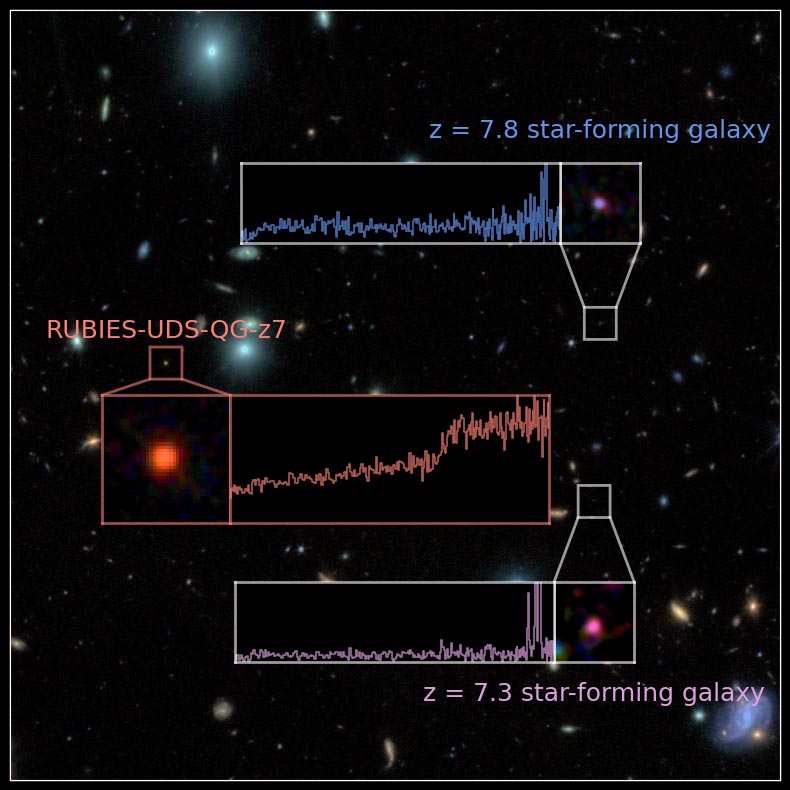
This challenges existing models of galaxy evolution, which can’t explain how such massive, “red and dead” galaxies could form so early. The galaxy, named RUBIES-UDS-QG-z7, packs over 10 billion solar masses into a space only 650 light-years across, suggesting the dense cores of today’s giant elliptical galaxies may have formed shockingly early.
How Galaxies Grow and Then Die
In the early Universe, galaxies grew by pulling in gas from the surrounding intergalactic medium and turning that gas into new stars. As a galaxy’s mass increased, it could attract gas more efficiently, fueling even faster star formation. But this growth doesn’t go on forever. Eventually, galaxies undergo a process called ‘‘quenching,’’ where they stop forming stars and effectively stop growing.
Key factors in theoretical models may need to be revisited.
Today, astronomers see that about half of the galaxies in the nearby Universe are no longer forming stars. These are known as quiescent, quenched, or “red and dead” galaxies. They appear red because they’ve run out of young, hot, blue stars, leaving behind only older, cooler, reddish stars.
The Mystery Behind Galaxy Quenching
Quiescent galaxies are especially common among the most massive galaxies, which often have an elliptical shape. These galaxies usually take a long time to form, first building up large stellar populations before star formation shuts down. However, what actually causes galaxies to quench remains one of the biggest open questions in astrophysics.
“Finding the first examples of massive quiescent galaxies (MQGs) in the early Universe is critical as it sheds light on their possible formation mechanisms,” says Pascal Oesch, associate professor in the Department of Astronomy at the UNIGE Facutly of Science and co-author of the paper. The hunt for such systems has thus been a major goal of astronomers for years.
Observations at Odds with Theories
With advancing technology, particularly near-infrared spectroscopy, astronomers have confirmed massive quiescent galaxies (MQGs) at increasingly earlier cosmic times. Their inferred abundance has been challenging to reconcile with theoretical models of galaxy formation, which predict that such systems should take longer to form. With the James Webb space telescope (JWST), this tension has been pushed to a redshift of 5 (1.2 billion years after the Big Bang), where several MQGs have been confirmed in recent years. The new study led by UNIGE reveals that these galaxies formed even earlier and more rapidly than previously thought.
In JWST Cycle 2, the wide-area program RUBIES (the Red Unknowns: Bright Infrared Extragalactic Survey), one of the largest European-led programs for extragalactic research using the NIRSpec instrument, has obtained spectroscopic observations of several thousand galaxies, including hundreds of newly discovered sources from early JWST imaging data.
The Most Distant “Dead” Galaxy Yet
Among these novel spectra, scientists identified the most distant MQG found to date, with a spectroscopic redshift of 7.29, just ~700 million years after the Big Bang. The NIRSpec/PRISM spectrum reveals a surprisingly old stellar population in such a young Universe. Detailed modeling of the spectrum and imaging data shows that the galaxy formed a stellar mass of more than 10 billion (1010) solar masses within the first 600 million years after the Big Bang, before rapidly ceasing star formation, thus confirming its quiescent nature.
“The discovery of this galaxy, named RUBIES-UDS-QG-z7, implies that massive quiescent galaxies in the first billion years of the Universe are more than 100 times more abundant than predicted by any model to date,” says Andrea Weibel, PhD student in the Department of Astronomy at the UNIGE Faculty of science and first author of the paper. This, in turn, suggests that key factors in theoretical models (e.g., the effects of stellar winds, and the strength of outflows powered by star formation and massive black holes) may need to be revisited. Galaxies died much earlier than these models can predict.
Ancient Cores of Today’s Giants
Finally, the small physical size of RUBIES-UDS-QG-z7, measured at just ~650 light-years, implies a high stellar mass density comparable to the highest central densities observed in quiescent galaxies at slightly lower redshifts (z ~2–5). These galaxies are likely to evolve into the cores of the oldest and most massive elliptical galaxies in the local Universe.
“The discovery of RUBIES-UDS-QG-z7 provides the first strong evidence that the centers of some nearby massive ellipticals may have already been in place since the first few hundred million years of the Universe,” concludes Anna de Graaff, principal investigator of the RUBIES program, postdoctoral researcher at the Max Planck Institute for Astronomy in Heidelberg and second author of the paper.
Reference: “RUBIES Reveals a Massive Quiescent Galaxy at z = 7.3” by Andrea Weibel, Anna de Graaff, David J. Setton, Tim B. Miller, Pascal A. Oesch, Gabriel Brammer, Claudia D. P. Lagos, Katherine E. Whitaker, Christina C. Williams, Josephine F.W. Baggen, Rachel Bezanson, Leindert A. Boogaard, Nikko J. Cleri, Jenny E. Greene, Michaela Hirschmann, Raphael E. Hviding, Adarsh Kuruvanthodi, Ivo Labbé, Joel Leja, Michael V. Maseda, Jorryt Matthee, Ian McConachie, Rohan P. Naidu, Guido Roberts-Borsani, Daniel Schaerer, Katherine A. Suess, Francesco Valentino, Pieter van Dokkum and Bingjie Wang, 1 April 2025, The Astrophysical Journal.
DOI: 10.3847/1538-4357/adab7a
Never miss a breakthrough: Join the SciTechDaily newsletter.
Follow us on Google and Google News.
2 Comments
There was never a Big Bang. The Universe has existed forever and will never cease to exist.
The universe will end when it falls into the lowest energy pit.