
Close Menu
    Facebook X (Twitter) Instagram
    SciTechDaily
    • Biology
    • Chemistry
    • Earth
    • Health
    • Physics
    • Science
    • Space
    • Technology
    Facebook X (Twitter) Pinterest YouTube RSS
    SciTechDaily
    Home»Space»A Galaxy Far, Far, Away: Cosmic Colossi and Their Origins
    Space

    A Galaxy Far, Far, Away: Cosmic Colossi and Their Origins

    By National Radio Astronomy ObservatoryFebruary 21, 2022No Comments3 Mins Read
    Facebook Twitter Pinterest Telegram LinkedIn WhatsApp Email Reddit
    Share
    Facebook Twitter LinkedIn Pinterest Telegram Email Reddit
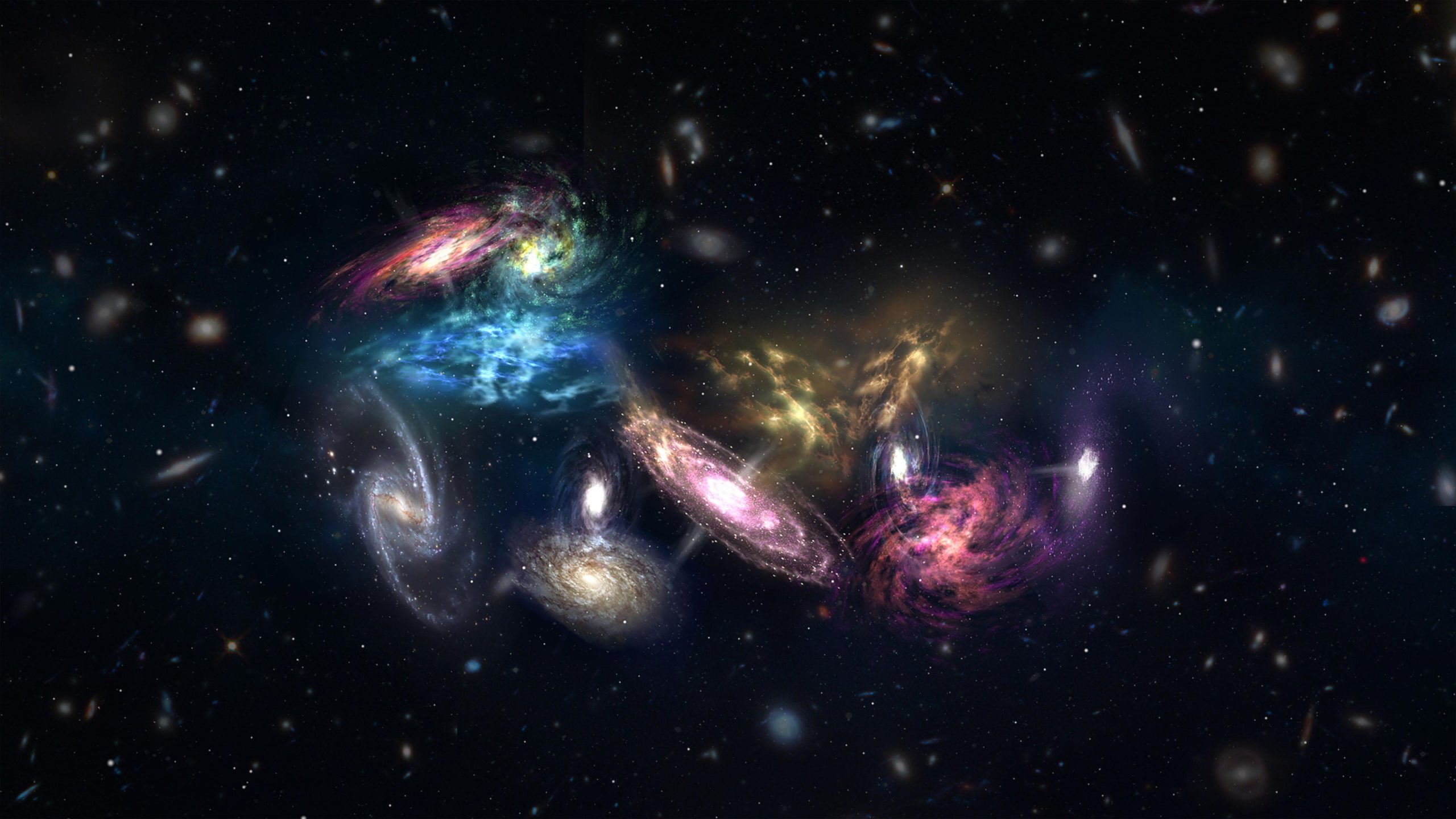
    14 Galaxies Detected by ALMA
    Artist’s impression of the 14 galaxies detected by ALMA as they appear in the very early, very distant universe. These galaxies are in the process of merging and will eventually form the core of a massive galaxy cluster. Credit: NRAO

    Astronomers have long wondered how galaxies form and evolve. The Next Generation Very Large Array (ngVLA) will address these questions by studying cold gas in galaxies, which fuels star formation. The ngVLA will provide detailed maps of gas in galaxies and transform our understanding of cosmic history.

    A century ago two prominent astronomers held a debate at the Smithsonian Museum of Natural History. The topic concerned the nature of the faint spiral nebulae seen in the night sky—are they galaxies that each contain billions of stars like our own Milky Way, or are they found within the Milky Way itself? The answer to this question would have profound implications for the size of our universe. We now know that these nebulae are indeed separate galaxies, but we still don’t fully understand how they form and evolve. It is a question the Next Generation Very Large Array (ngVLA) will help us understand. The ngVLA will study galaxy evolution by comparing how the fuel available for making stars matches up with the rate at which they are formed throughout the history of the cosmos.

    Stars are born in stellar nurseries swaddled in enormous clouds of gas. The coldest, densest clouds of gas collapse under gravity, until enough material is pulled together in one spot to form a star, or multiple stars, in several parts of the cloud. But nature provides challenges to star formation. For example, powerful jets can shoot out during the process of star formation and push back on the collapsing gas clouds against gravity. Furthermore, baby stars themselves emit hot radiation that can act to evaporate the surrounding gas. Understanding the fine-tuned balance between these different competing phenomena in galaxies is a major goal of the ngVLA, primarily by looking at the cold gas itself rather than the end product of the whole process. This will be important for scientists to evaluate if their models of the star formation process correctly describe what happens in reality inside our cosmic neighbors, and in the universe beyond.

    Tracing the cold gas content of galaxies throughout cosmic history is key to understanding how the stars and planetary systems we find in galaxies today were originally made, and thus, how galaxy evolution takes place. This evolution began only a few hundred million years after the Big Bang (i.e., more than 13 billion years ago) when galaxies first formed. In a single day of observations, the ngVLA will find tens to hundreds of galaxies in the early Universe based on the emission from the star-forming gas within them, while at the same time mapping the distribution and motion of the gas down to the size scales of individual star-forming clouds. Enabled by broad support in the US and from the worldwide astronomical community, these studies will transform our understanding of galaxy formation and evolution across cosmic history in the coming decade.

    Never miss a breakthrough: Join the SciTechDaily newsletter.
    Follow us on Google and Google News.

    Astronomy Astrophysics National Radio Astronomy Observatory
    Share. Facebook Twitter Pinterest LinkedIn Email Reddit

    Related Articles

    Stellar Collision Triggers Supernova Explosion – “This Is the First Time We’ve Actually Seen Such an Event”

    Gas Re-Accretion Observed in Dying Galaxies for the First Time

    Surprising Insights Into Star Formation From Unprecedented Survey of the “Nurseries” Where Stars Are Born

    Mind the Gap: Direct Link Uncovered Between Protoplanetary Disk Structures and Giant Exoplanets

    Young Chaotic Star System Reveals Secrets of Planet Formation

    Astronomers Discover Jets from Massive Protostars Might be Very Different from Lower-Mass Systems

    Map of the Nearby Universe Created by Cosmic Cartographers Reveals the Diversity of Star-Forming Galaxies

    Cosmic Lens Reveals Faint Radio Galaxy More Than 8 Billion Light-Years From Earth

    New Clues About Early Universe From Black Hole Powered Cosmic Jet 13 Billion Light-Years From Earth

    Leave A Reply Cancel Reply

    • Facebook
    • Twitter
    • Pinterest
    • YouTube

    Don't Miss a Discovery

    Subscribe for the Latest in Science & Tech!

    Trending News

    Scientists Recreate a Nuclear Fireball and Uncover Fallout’s Hidden Chemistry

    These Tiny Gut Particles Could Be Accelerating Aging Throughout the Body

    Doctors Changed One Thing and Weight Gain Stopped

    Magnetic Fields May Solve a Longstanding Binary Star Mystery

    The Probiotic Breakthrough for Natural Anxiety Relief and Better Mental Health

    Animal vs. Plant Protein: Scientists Found a Surprising Nutritional Difference

    According to Scientists, This Simple Dietary Change Is Linked to Lower Depression Scores

    Researchers Discover a Hidden Vitamin D Problem That Persists Year-Round

    Follow SciTechDaily
    • Facebook
    • Twitter
    • YouTube
    • Pinterest
    • Newsletter
    • RSS
    SciTech News
    • Biology News
    • Chemistry News
    • Earth News
    • Health News
    • Physics News
    • Science News
    • Space News
    • Technology News
    Recent Posts
    • Mini Brain Organoids Expose Hidden Biological Differences in Alzheimer’s Disease
    • Scientists Recommend Doing This To Reduce Anxiety During Pregnancy
    • Scientists Reveal What Happened When 12 People Were Trapped Together in Antarctica for 10 Months
    • Buried for 1.7 Billion Years: These Ancient Fossils May Rewrite the Story of Complex Life
    • NASA Spots Giant Ocean Swell Signaling a Potential El Niño Comeback
    Copyright © 1998 - 2026 SciTechDaily. All Rights Reserved.
    • Science News
    • About
    • Contact
    • Editorial Board
    • Privacy Policy
    • Terms of Use

    Type above and press Enter to search. Press Esc to cancel.