
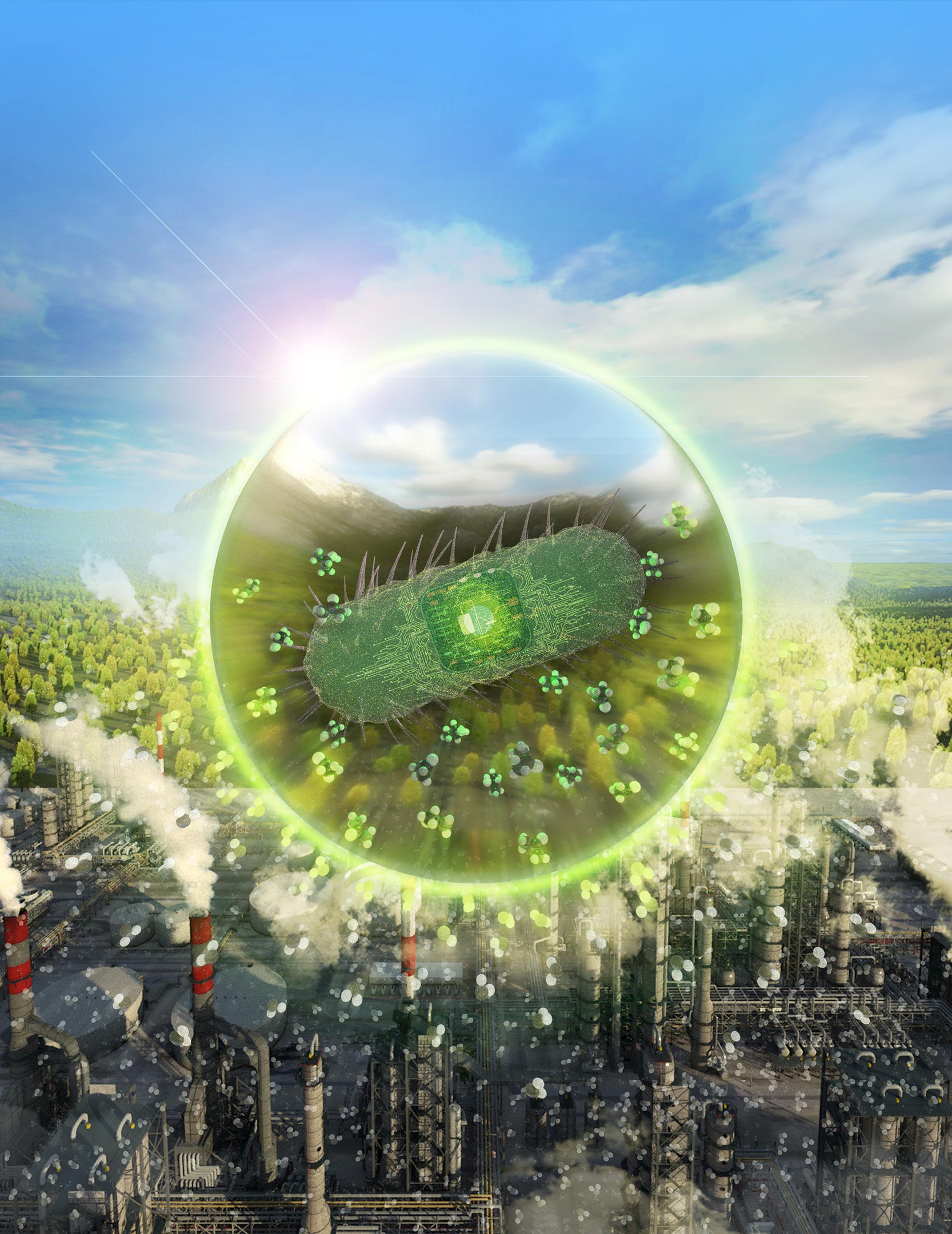
Engineered Bacteria Upcycle Carbon Waste Into Valuable Chemicals
Bacteria are known for breaking down lactose to make yogurt and sugar to make beer. Now researchers led by Northwestern University and LanzaTech have harnessed bacteria to break down waste carbon dioxide (CO2) to make valuable industrial chemicals.
In a new pilot study, the researchers selected, engineered, and optimized a bacteria strain and then successfully demonstrated its ability to convert CO2 into acetone and isopropanol (IPA).
Not only does this new gas fermentation process remove greenhouse gases from the atmosphere, but it also avoids using fossil fuels, which are typically needed to generate acetone and IPA. After performing life-cycle analysis, the team found the carbon-negative platform could reduce greenhouse gas emissions by 160% as compared to conventional processes, if widely adopted.
The study will be published today (February 21, 2022) in the journal Nature Biotechnology.
Addressing the Climate Crisis through Biological Engineering
“The accelerating climate crisis, combined with rapid population growth, pose some of the most urgent challenges to humankind, all linked to the unabated release and accumulation of CO2 across the entire biosphere,” said Northwestern’s Michael Jewett, co-senior author of the study. “By harnessing our capacity to partner with biology to make what is needed, where and when it is needed, on a sustainable and renewable basis, we can begin to take advantage of the available CO2 to transform the bioeconomy.”
Jewett is the Walter P. Murphy Professor of Chemical and Biological Engineering at Northwestern’s McCormick School of Engineering and director of the Center for Synthetic Biology. He co-led the study with Michael Koepke and Ching Leang, both researchers at LanzaTech.
Necessary industrial bulk and platform chemicals, acetone, and IPA are found nearly everywhere, with a combined global market topping $10 billion. Widely used as a disinfectant and antiseptic, IPA is the basis for one of the two World Health Organization-recommended sanitizer formulas, which are highly effective in killing the SARS-CoV-2 virus. And acetone is a solvent for many plastics and synthetic fibers, thinning polyester resin, cleaning tools, and nail polish remover.
While these chemicals are incredibly useful, they are generated from fossil resources, leading to climate-warming CO2 emissions.
Engineering CO2 Conversion with Synthetic Biology
To manufacture these chemicals more sustainably, the researchers developed a new gas fermentation process. They started with Clostridium autoethanogenum, an anaerobic bacterium engineered at LanzaTech. Then, the researchers used synthetic biology tools to reprogram the bacterium to ferment CO2 to make acetone and IPA.
“These innovations, led by cell-free strategies that guided both strain engineering and optimization of pathway enzymes, accelerated time to production by more than a year,” Jewett said.
The Northwestern and LanzaTech teams believe the developed strains and fermentation process will translate to industrial scale. The approach also could potentially be applied to create streamlined processes for generating other valuable chemicals.
“This discovery is a major step forward in avoiding a climate catastrophe,” said Jennifer Holmgren, LanzaTech CEO. “Today, most of our commodity chemicals are derived exclusively from new fossil resources such as oil, natural gas or coal. Acetone and IPA are two examples with a combined global market of $10 billion. The acetone and IPA pathways developed will accelerate the development of other new products by closing the carbon cycle for their use in multiple industries.”
Reference: “Carbon-negative, scaled-up production of acetone and isopropanol by gas fermentation” by Fungmin Eric Liew, Robert Nogle, Tanus Abdalla, Blake J. Rasor, Christina Canter, Rasmus O. Jensen, Lan Wang, Jonathan Strutz, Payal Chirania, Sashini De Tissera, Alexander P. Mueller, Zhenhua Ruan, Allan Gao, Loan Tran, Nancy L. Engle, Jason C. Bromley, James Daniell, Robert Conrado, Timothy J. Tschaplinski, Richard J. Giannone, Robert L. Hettich, Ashty S. Karim, Séan D. Simpson, Steven D. Brown, Ching Leang, Michael C. Jewett and Michael Köpke, 21 February 2022, Nature Biotechnology.
DOI: 10.1038/s41587-021-01195-w
Jewett is a member of the Chemistry of Life Processes Institute, Simpson Querrey Institute for BioNanotechnology and the Robert H. Lurie Comprehensive Cancer Center of Northwestern University.
The study, “Carbon-negative, scaled-up production of acetone and isopropanol by gas fermentation,” was supported by the U.S. Department of Energy (DOE) Bioenergy Technologies Office (award numbers DE-EE0007566 and CRADA/NFE-16-06364), DOE Office of Science, Biological and Environmental Research Division, Genomic Science Program (award numbers DE-SC0018249 and FWP ERKP903), the David and Lucile Packard Foundation and the Camille Dreyfus Teacher-Scholar Program.
Never miss a breakthrough: Join the SciTechDaily newsletter.
Follow us on Google and Google News.
3 Comments
“This discovery is a major step forward in avoiding a climate catastrophe,”
Unless this “technology” can operate without fossils fuels for transportation of the people and materials needed … and can be scaled up to sequester the billions of tons of CO2 needed to affect the climate, it remains another interesting academic exercise.
Bacterial production of ethanol and diesel fuel was attempted a few years ago, but the cost was uncompetitive at $100/barrel equivalent. The inputs were captured CO2 and sunlight. This new process will also live or die based on the final product cost relative to the fossil-based versions.
Open Access too! What besides CO2 they feed the 🦠 and how they make bactericide in gruntlement is left to reading on a bigger screen. Can this be golden (carbon negative downbore fermentation) mining?