
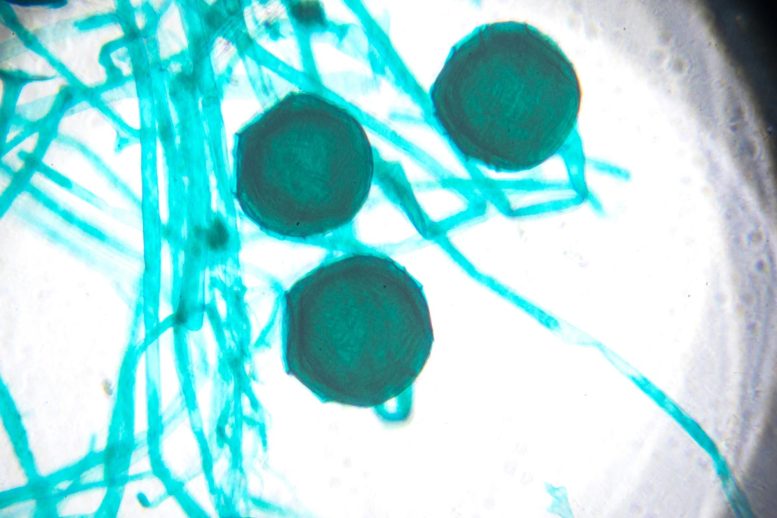
The fungus Rhizopus teams up with Ralstonia bacteria to defend itself against predators in the soil, and this partnership also helps Rhizopus evade the human immune system. Disrupting this alliance could lead to better treatments for infections like mucormycosis.
New research discovered that the fungus Rhizopus fights back against soil predators and human immune cells by partnering with a bacteria called Ralstonia in a two-way partnership.
The microscopic world resembles our world in some surprising ways. The environment around us is inhabited by microbes living in complex communities — some friendly and some not so friendly. Microbes compete with each other for resources and must also hide from or fight predators. One example of this is the fungus Rhizopus, which grows in the soil and on spoiled food and is the cause of “black fungus” outbreaks in covid patients.
The Partnership Between Rhizopus and Ralstonia
In the soil, its predator is the amoeba Dictyostelium, a single-celled microbe that can move through the soil and engulf Rhizopus, devouring it for nutrients. Scientists from the universities of Exeter and Birmingham found Rhizopus fights back against this predator by partnering with a bacteria called Ralstonia in a two-way partnership. By living inside Rhizopus, Ralstonia hides from the predator. In return, Ralstonia makes a toxin that Rhizopus can use to neutralize the predator, preventing it from feeding on the pair.
Why does this matter to human disease? Our immune cells are very much like the predator Dictyostelium: They seek out, engulf, and destroy foreign microbes that enter our bodies, protecting us from infection. This means that Rhizopus and Ralstonia can use the same strategy to avoid predators in the soil to evade our own immune systems. By learning to fight off predators in the soil, Rhizopus has also learned how to cause disease in humans.
Disrupting the Partnership to Combat Disease
This work showed that when its partnership with Ralstonia is disrupted, animals infected with Rhizopus are able to survive this devastating disease. The hope is that by better understanding the ecology and strategies for survival that Rhizopus and other pathogens use in their normal environments, we will be better prepared to combat these microbes when they cause human disease.
“This work is really important because while its been known that fungal-bacterial partnerships in the soil impact plant disease for many years, this is the first example of a bacterial-fungal partnership contributing to mucormycosis in humans. We hope this will help us develop better strategies for treating this devastating disease,” says Dr. Elizabeth Ballou, one of the Principal Investigators for this project.
This work was led by Dr. Herbert Itabangi, who was a joint student between Dr. Elizabeth Ballou (Exeter) and Dr. Kerstin Voelz (Birmingham). Dr. Itabangi was funded by a Wellcome Trust Strategic Award (led by Prof Neil Gow while at Aberdeen). Dr. Itabangi’s discovery is a key step forward in our understanding of the “black fungus” that causes mucormycosis and was responsible for nearly 40,000 deaths in 2021 as part of the COVID-19 pandemic.
Reference: “A bacterial endosymbiont of the fungus Rhizopus microsporus drives phagocyte evasion and opportunistic virulence” by Herbert Itabangi, Poppy C.S. Sephton-Clark, Diana P. Tamayo, Xin Zhou, Georgina P. Starling, Zamzam Mahamoud, Ignacio Insua, Mark Probert, Joao Correia, Patrick J. Moynihan, Teclegiorgis Gebremariam, Yiyou Gu, Ashraf S. Ibrahim, Gordon D. Brown, Jason S. King, Elizabeth R. Ballou and Kerstin Voelz, 7 February 2022, Current Biology.
DOI: 10.1016/j.cub.2022.01.028
Never miss a breakthrough: Join the SciTechDaily newsletter.
Follow us on Google and Google News.