

Close Menu
    Facebook X (Twitter) Instagram
    SciTechDaily
    • Biology
    • Chemistry
    • Earth
    • Health
    • Physics
    • Science
    • Space
    • Technology
    Facebook X (Twitter) Pinterest YouTube RSS
    SciTechDaily
    Home»Health»Treatment in Early Life Prevents Autism Symptoms From Developing in Mice
    Health

    Treatment in Early Life Prevents Autism Symptoms From Developing in Mice

    By Society for NeuroscienceFebruary 21, 2022No Comments2 Mins Read
    Facebook Twitter Pinterest Telegram LinkedIn WhatsApp Email Reddit
    Share
    Facebook Twitter LinkedIn Pinterest Telegram Email Reddit
    Autism Help Concept
    Timing is key when treating developmental disorders.

    Identifying the window of development could reveal ideal time to intervene in autism.

    Timing is key when treating developmental disorders. Blocking an overactive signaling pathway during the first five weeks of life prevents autism symptoms from ever developing in mice, according to new research published in JNeurosci.

    The brain develops capabilities, like language, during specific spans of time called critical periods. The symptoms of disorders like autism arise during a set critical period; administering a targeted intervention only during the critical period could prevent the disorder from ever taking shape without the burden of a life-long treatment.
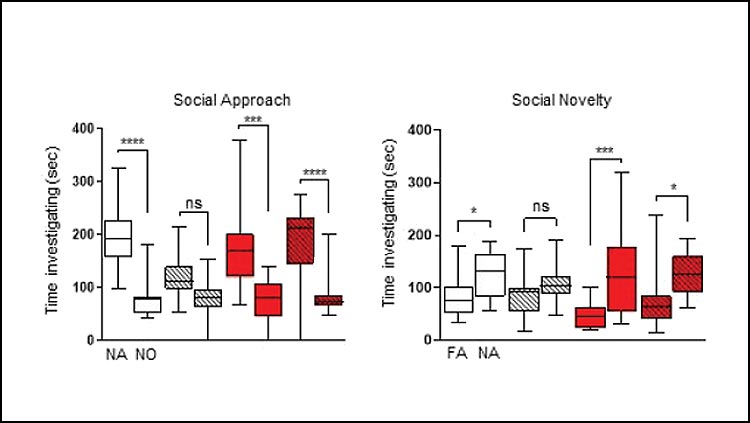
    Early Life Treatment Prevents Autism Symptoms From Developing in Mice
    Treatment with rapamycin for 4 weeks prevents the onset of social deficits in three-chamber social approach (left) and social novelty (right) testing. Credit: Gibson et al., JNeurosci 2021

    Gibson et al. compared intervention timing in a genetic mouse model of Tuberous Sclerosis Complex (TSC), a neurodevelopmental disorder with high rates of autism spectrum disorder. The research team administered the drug rapamycin to inhibit mTOR signaling, a pathway that is overactive in people and animals with TSC. After four weeks of treatment starting at one week of life, mutant mice displayed normal social behaviors and normal activity in cerebellar Purkinje neurons, even after four weeks without treatment. These results raise the possibility that treatment covering critical periods of development could prevent autism symptoms from ever manifesting. As TSC is often diagnosed in utero in humans, defining these critical periods may provide an opportunity to prevent development of autism behaviors.

    Reference: “A Critical Period for Development of Cerebellar-Mediated Autism-Relevant Social Behavior” by Jennifer M. Gibson, Cleone P. Howland, Chongyu Ren, Cyrena Howland, Alexandra Vernino and Peter T. Tsai, 21 February 2022, JNeurosci.
    DOI: 10.1523/JNEUROSCI.1230-21.2021

    Never miss a breakthrough: Join the SciTechDaily newsletter.
    Follow us on Google and Google News.

    Autism Spectrum Disorder Brain Neuroscience Society for Neuroscience
    Share. Facebook Twitter Pinterest LinkedIn Email Reddit

    Related Articles

    Groundbreaking Experimental Compound Displays Effectiveness in Treating Symptoms of Autism and Alzheimer’s Disease

    Physical Activity May Improve Alzheimer’s Disease by Lowering Brain Inflammation

    Antibiotics in Early Life Could Lead to Brain Disorders

    Some Brain Disorders – Such As Autism and Schizophrenia – Exhibit Similar Circuit Malfunctions

    Imaging the Twilight Zone: The Brain Network Driving Changes in Consciousness

    Lactation Changes Electrical Signaling in Mom’s Brain – But It’s Reversible

    Brain Waves of Sleeping Sheep Maaay Offer Clues to Human Brain Disease

    New Research Shows the Brain May Need Iron for Healthy Cognitive Development

    New Way to Treat Hypersensitivity to Noise and Other Neurological Disorders

    Leave A Reply Cancel Reply

    • Facebook
    • Twitter
    • Pinterest
    • YouTube

    Don't Miss a Discovery

    Subscribe for the Latest in Science & Tech!

    Trending News

    On the Brink of Extinction, These Giant Sea Turtles Are Doing Something Unexpected

    Coffee May Be Changing Your Gut in Ways Scientists Are Only Beginning To Understand

    Scientists Uncover Why a Common Nutrient Can Be Dangerous for Blood Vessels

    Mysterious Radio Signals From 5,000 Light-Years Away Lead Scientists to a Surprising Discovery

    New FDA-Approved Pill Lowers High Blood Pressure and May Slow Kidney Disease

    Scientists Just Challenged a Decades-Old Belief About How Cells Work

    Scientists Uncover a Natural Molecule That Makes Muscles Stronger and More Resistant to Fatigue

    Scientists Find That Mice, Not Deer, Hold a Major Clue to Lyme Disease Risk

    Follow SciTechDaily
    • Facebook
    • Twitter
    • YouTube
    • Pinterest
    • Newsletter
    • RSS
    SciTech News
    • Biology News
    • Chemistry News
    • Earth News
    • Health News
    • Physics News
    • Science News
    • Space News
    • Technology News
    Recent Posts
    • A 72-Year-Old Invention Could Be the Key to Unlocking More Powerful Quantum Computers
    • This 3D-Printed Robot Runs, Swims, and Climbs Without Any Electronics
    • Researchers Just Sent an Unblockable Message Through a Solid Wall Using Gravity
    • A 360-Year-Old Manuscript Reveals Galileo May Have Built a Telescope Far Ahead of Its Time
    • Scientists Discover That Young Chimpanzees May Develop Accents Just Like Humans
    Copyright © 1998 - 2026 SciTechDaily. All Rights Reserved.
    • Science News
    • About
    • Contact
    • Editorial Board
    • Privacy Policy
    • Terms of Use

    Type above and press Enter to search. Press Esc to cancel.