
Close Menu
    Facebook X (Twitter) Instagram
    SciTechDaily
    • Biology
    • Chemistry
    • Earth
    • Health
    • Physics
    • Science
    • Space
    • Technology
    Facebook X (Twitter) Pinterest YouTube RSS
    SciTechDaily
    Home»Space»A Giant Planet Microlensing Event
    Space

    A Giant Planet Microlensing Event

    By Harvard-Smithsonian Center for AstrophysicsJuly 26, 2022No Comments4 Mins Read
    Facebook Twitter Pinterest Telegram LinkedIn WhatsApp Email Reddit
    Share
    Facebook Twitter LinkedIn Pinterest Telegram Email Reddit
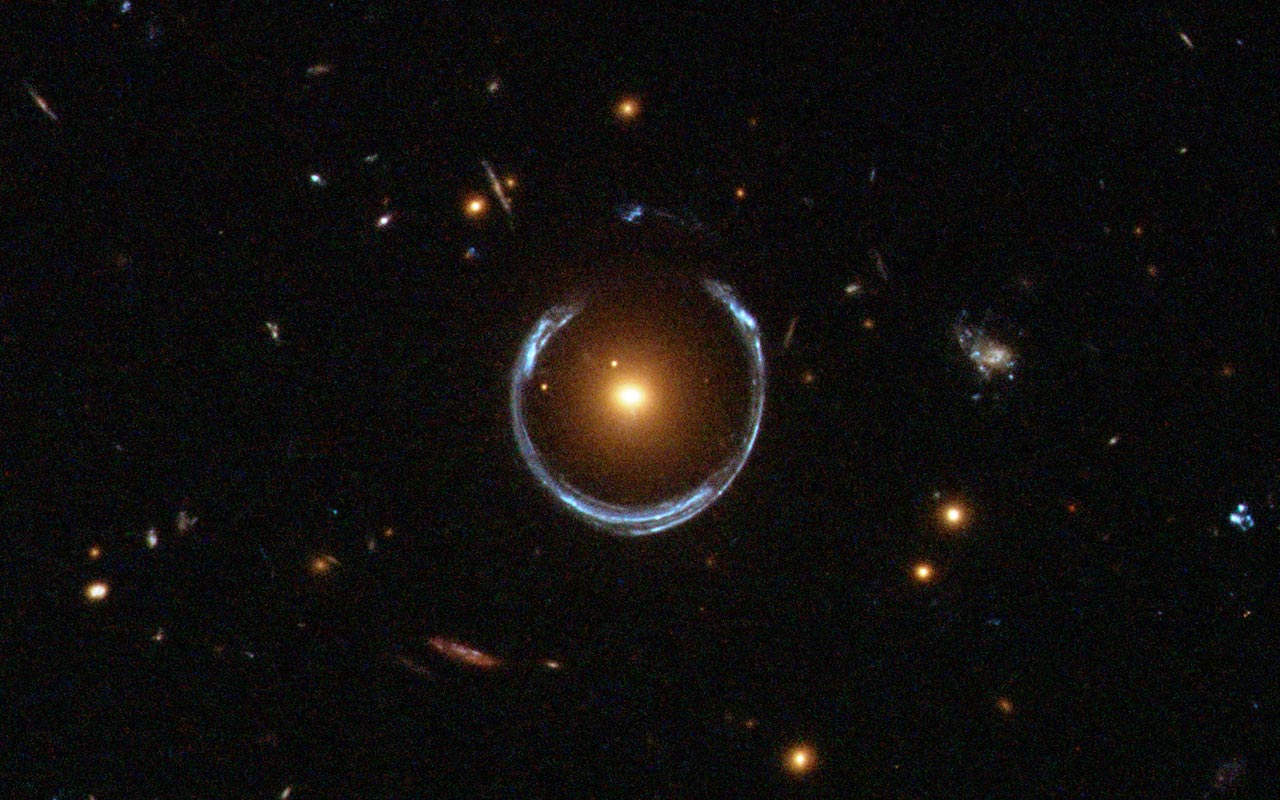
    Giant Planet Microlensing Event
    A Hubble image of a red galaxy acting as a gravitational lens for a more distant blue galaxy, bending its light into an arc. Exoplanets can be detected via a similar effect, gravitational microlensing, when a foreground star and its orbiting planet fortuitously pass across a background star in the sky, creating bright flashes. Astronomers have spotted a new microlensed, Jupiter-sized exoplanet around an M dwarf star, and use the result to help decide between competing planet formation scenarios. Credit: ESA/Hubble and NAS

    Microlensing reveals planets around faint stars, including a giant planet near an M dwarf, supporting an alternative planet formation theory.

    Over 5,000 exoplanets have been detected to date, with more than 90% of them found by using the transit or radial velocity techniques. Of the other 10%, 105 were found using the microlensing method which takes advantage of the fact that the path of a light beam is bent by the presence of a massive body. The gravitational force of the body acts like a lens (a “gravitational lens”) to distort the image of an object seen behind it. When a massive object fortuitously passes in front of a star, it acts as a gravitational lens and thus its motion across the sky causes the background star to appear to brighten briefly. When the foreground object is a star hosting a planet, both bodies can produce brightening events as they pass in front of the star, and the flashes as seen from Earth can be modeled to determine their masses and separation.

    Two significant advantages are offered by the microlensing method over more common exoplanet detection techniques. First, the brightness of the microlensing effect does not depend on the brightness of the moving body, only on its mass, which makes it possible to spot faint, low-mass M dwarf stars. The second advantage is that the microlensing planet may orbit its star at a large distance, even many astronomical units. (Since normal exoplanet techniques, like transiting, require multiple detections over many orbital periods, exoplanets with large orbits take years to complete their cycle and so far the vast majority of all measured exoplanets have orbits smaller than one astronomical unit.) As a result of their large orbits, the detected giant planets around microlensing host stars are usually far enough away to reside beyond the “snow line,” the distance at which surface water would freeze.

    Harvard-Smithsonian Center for Astrophysics (CfA) astronomer Jennifer Yee collaborates with a team of astronomers from the OGLE project (Optical Gravitational Lensing Experiment), which discovered the microlensing event OGLE-2017-BLG-1049. The analysis was led by her colleagues in the Korea Microlensing Telescope Network.

    Planet Formation and M Dwarfs

    They modeled the brightening events using some probable assumptions, and concluded that the host star is an M dwarf with a mass of about 0.55 solar masses; the planet has a mass of about 5.5 Jupiter-masses and orbits at a distance of 3.9 astronomical units. These results have direct implications for models of planet formation. Fifty-four of the known microlensed exoplanets are giants around M dwarfs, like this new one, suggesting that planets are common around M dwarfs.

    In the core accretion model of planet formation, however, in which planets gradually assemble from smaller rocks, very few planets are expected to be found around M dwarf stars. The result appears instead to support the alternative disk instability model in which a rotating disk fragments into clumps that form planets, and it predicts that many planets exist around M dwarf stars.

    Reference: “OGLE-2017-BLG-1049: Another Giant Planet Microlensing Event” Yun Hak Kim, Sun-Ju Chung, A. Udalski, Ian A. Bond, Youn Kil Jung, Andrew Gould, Michael D. Albrow, Cheongho Han, Kyu-Ha Hwang, Yoon-Hyun Ryu, In-Gu Shin, Yossi Shvartzvald, Jennifer C. Yee, Weicheng Zang, Sang-Mok Cha, Dong-Jin Kim, Hyoun-Woo Kim, Seung-Lee Kim, Chung-Uk Lee and Dong-Joo Lee, 31 December 2020, Journal of the Korean Astronomical Society.
    DOI: 10.5303/JKAS.2020.53.6.161

    Never miss a breakthrough: Join the SciTechDaily newsletter.
    Follow us on Google and Google News.

    Astronomy Astrophysics Exoplanet Harvard-Smithsonian Center for Astrophysics
    Share. Facebook Twitter Pinterest LinkedIn Email Reddit

    Related Articles

    Never-Before-Seen Molecule: Webb Reveals a “Hot Saturn” Exoplanet Atmosphere

    Astronomers Uncover New Evidence of Baby Planet in the Making

    Finding Exoplanets in Debris Disks

    Astronomers May Have Discovered the First Extragalactic Planet

    Stellar Winds, Magnetic Activity, and Evaporating Exoplanet Atmospheres

    Astrophysicists Spot an Exoplanet With the Potential To Form Moons

    How Habitable Are Planets That Orbit Red Dwarfs – The Most Common Type of Stars in the Galaxy?

    Four Exoplanets – Including a Super-Earth Planet – Discovered by High School Students

    Astronomers Discover First Cloudless, Jupiter-Like Planet – “Smoking Gun Evidence”

    Leave A Reply Cancel Reply

    • Facebook
    • Twitter
    • Pinterest
    • YouTube

    Don't Miss a Discovery

    Subscribe for the Latest in Science & Tech!

    Trending News

    AI Could Detect Early Signs of Alzheimer’s in Under a Minute – Far Before Traditional Tests

    What if Dark Matter Has Two Forms? Bold New Hypothesis Could Explain a Cosmic Mystery

    This Metal Melts in Your Hand – and Scientists Just Discovered Something Strange

    Beef vs. Chicken: Surprising Results From New Prediabetes Study

    Alzheimer’s Breakthrough: Scientists Discover Key Protein May Prevent Toxic Protein Clumps in the Brain

    Quantum Reality Gets Stranger: Physicists Put a Lump of Metal in Two Places at Once

    Scientists May Have Found the Key to Jupiter and Saturn’s Moon Mystery

    Scientists Uncover Brain Changes That Link Pain to Depression

    Follow SciTechDaily
    • Facebook
    • Twitter
    • YouTube
    • Pinterest
    • Newsletter
    • RSS
    SciTech News
    • Biology News
    • Chemistry News
    • Earth News
    • Health News
    • Physics News
    • Science News
    • Space News
    • Technology News
    Recent Posts
    • Popular Sweetener Linked to DNA Damage – “It’s Something You Should Not Be Eating”
    • Ancient “Rock” Microbes May Reveal How Complex Life Began
    • Hidden “Trade Winds” Inside Cells Could Explain Cancer Spread
    • Humans Owe Their Eyes to a Tiny One-Eyed “Cyclops”
    • Researchers Capture Quantum Interference in One of Nature’s Rarest Atoms
    Copyright © 1998 - 2026 SciTechDaily. All Rights Reserved.
    • Science News
    • About
    • Contact
    • Editorial Board
    • Privacy Policy
    • Terms of Use

    Type above and press Enter to search. Press Esc to cancel.