

The Grand Ethiopian Renaissance Dam will increase energy generation and development in Ethiopia, but it may have unwanted consequences for other Nile River users.
About half of the citizens of Ethiopia have access to electricity, a lower percentage than in most other African countries and a far lower percentage than in most other countries throughout the world. To address this, the Ethiopian government began constructing a dam on the Blue Nile in 2011 that will rank as Africa’s largest hydroelectric dam when completed in 2023.
With three spillways and 13 turbines, the concrete structure will rise 145 meters (475 feet) and create a reservoir that will cover 1,874 square kilometers (724 square miles) of land, an area about the size of Houston, Texas. Called the Grand Ethiopian Renaissance Dam (GERD), it is expected to more than double Ethiopia’s electricity output.
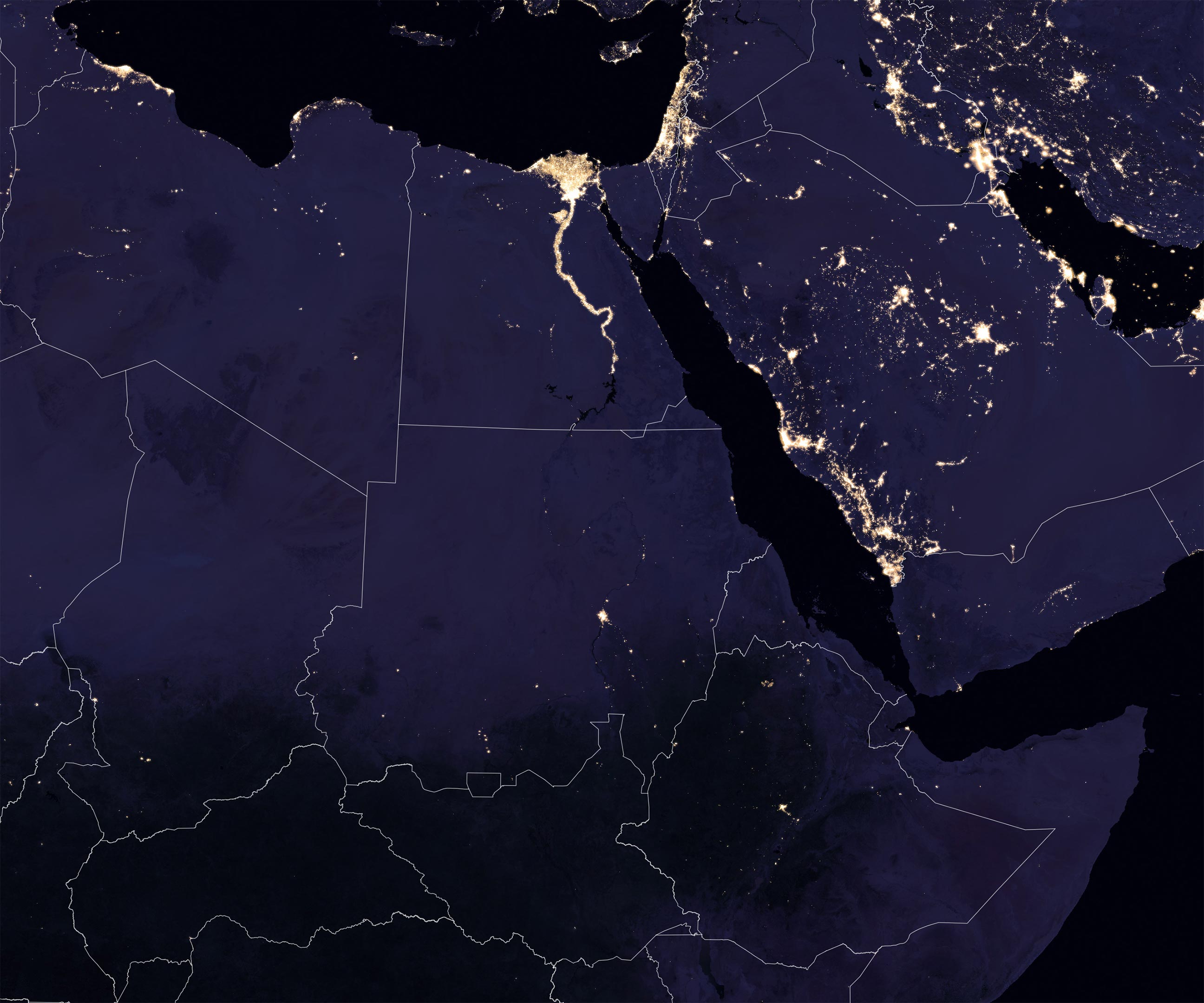
If it works as planned, GERD will usher in a new era and help brighten the mostly dark landscape that appears in nighttime images of Ethiopia. (In the Suomi-NPP satellite composite above, note the contrast between the darkness of Ethiopia and the bright trail of light along the Nile River in Egypt, where World Bank data indicates that 100 percent of the population has access to electricity.) In addition to generating electricity, GERD should temper destructive seasonal floods in Sudan, boost food supplies in Ethiopia by providing reliable irrigation water, and extend the lifespan of other dams downstream on the Nile by trapping sediment.
Downstream Concerns for Egypt and Sudan
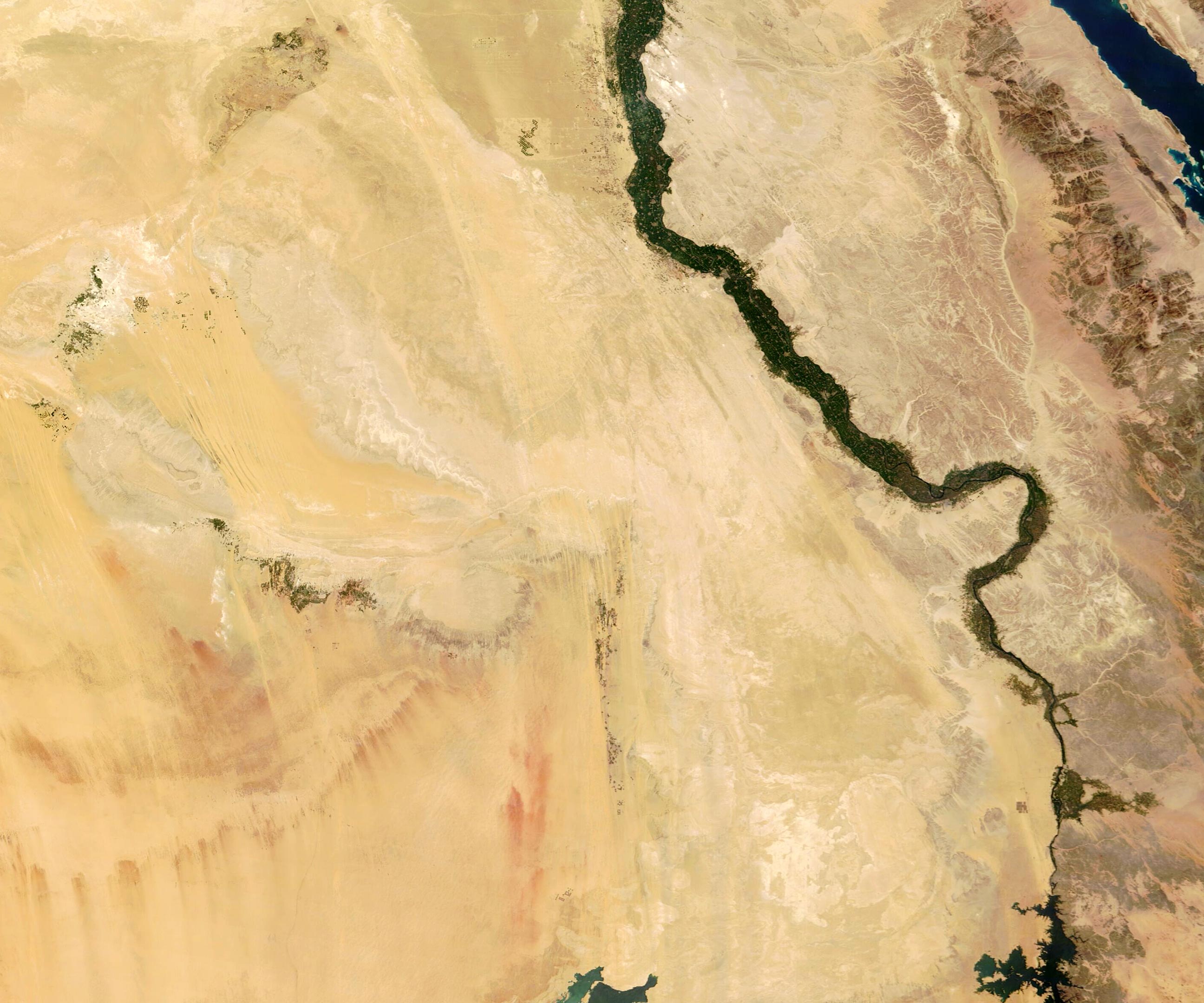
However, by changing the river’s hydrology, the dam may have an impact on millions of people who live and farm downstream in Egypt and parts of Sudan and use the Nile’s water. The natural-color image of the Nile’s Great Bend shown below underscores how much the people of Egypt depend on the Nile: 95 percent of Egypt’s farmland is found within a narrow zone near the riverbanks.
After 10 years of construction, GERD is almost complete. In 2020, water managers started filling the reservoir, a process that could take from a few years to a decade depending on weather conditions and how much of the Blue Nile’s flow the dam managers hold back. Ethiopia has an incentive to fill the reservoir quickly to start generating power and start paying for the $5 billion dollar project. However, rapid filling could significantly reduce the water downstream since the Blue Nile provides 60 percent of the water that flows into the Nile.
GERD’s Impacts and Water Levels
“While the dam will certainly have positive effects in regards to flood control and hydroelectric power, there are important unanswered questions about how quickly the reservoir should be filled, and how it will be managed long term,” said Essam Heggy, a NASA Jet Propulsion Laboratory scientist who recently coauthored a study analyzing the potential hydrological and economic consequences of filling the dam at various rates.
“Filling the reservoir too quickly—in less than seven years—could lead to measurable water shortages downstream that impact food production, especially if the initial filling occurs under drought conditions,” said Heggy. His research indicates that rapid filling of the reservoir could lead to severe economic losses, though he notes that expanding groundwater extraction, adjusting the operation of Egypt’s Aswan High Dam, and cultivating crops that require less water could help offset some of the impact.
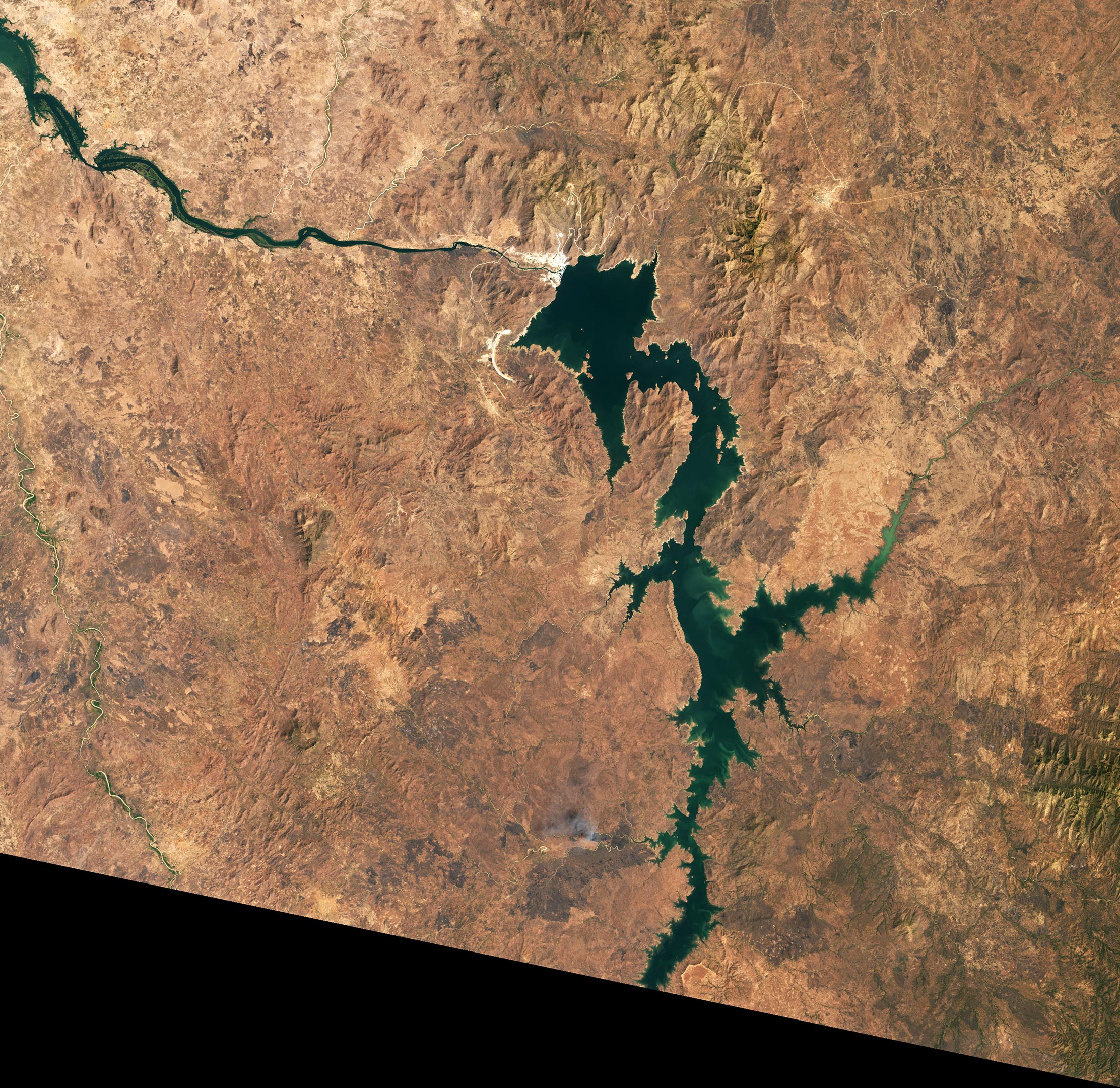
Egypt, Ethiopia, and Sudan have not agreed on a timetable for filling the reservoir or a plan for how the dam will be managed. Meanwhile, remote sensing scientists have used satellites to help track developments at GERD. Satellites offers one of the best ways to monitor developments because the data are free, transparent, and available to all.
As of February 2022, one team led by University of Virginia researchers estimated that the GERD reservoir was less than 15 percent full based on satellite observations. “By combining cloud-penetrating radar observations from the European Space Agency’s Sentinel-1 satellite with a NASA digital elevation model of the terrain, we are able to estimate the change of the volume of water in the reservoir,” explained Prakrut Kansara, the lead author of a study published in Remote Sensing that detailed their technique.
“The reservoir was 23 percent full in September 2021, the end of the rainy season, but then water levels dropped some due to evaporation and water releases,” explained Hesham El-Askary, an earth scientist at Chapman University and one of the study coauthors. “During the first two years, we have seen a filling rate of roughly 11 percent per year, meaning it would take a little less than nine years to be completely full at this rate.”
The team also used data from NASA’s GRACE and GPM satellites, and results from a NASA model called the global land data assimilation system to analyze the seasonal variability of precipitation, total runoff, and total water storage (which includes surface, subsurface, and groundwater) in the region since 2002.
“Our research underscores that the Nile Basin experiences dry and wet spells that are linked to the cycles of El Niño and La Niña,” said Venkataraman Lakshmi, another of the study’s coauthors and a professor of engineering at the University of Virginia. “It’s important that we account for these cycles and that they get built into the planning process. We really need to have scientists, engineers, and diplomats in the same room talking to each other about how to go about filling and managing the reservoir.”
Future Developments and Managing the Nile’s Flow
The third filling phase will likely begin in July 2022 and is expected to capture a larger volume of water than the first two fills. “The first filling phase in 2020 impounded about 4.9 billion cubic meters of water and the second phase added another 6 billion cubic meters. If Ethiopia proceeds to fill the GERD in five years, the fourth and fifth fillings could exceed 25 billion cubic meters each,” explained Heggy.
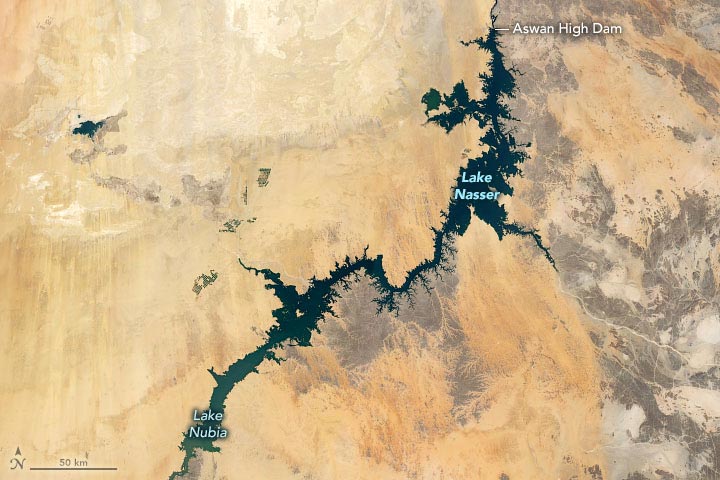
Whatever the rate of filling, there will be plenty of changes to monitor from both the ground and above in the coming years. “Aswan High Dam and GERD together are capable of retaining more than 280 percent of the Nile’s annual flow,” said Heggy. “The world’s longest river will be mainly driven by the operation of two dams rather than by natural processes.”
NASA Earth Observatory images by Lauren Dauphin, using data from the Level-1 and Atmosphere Archive & Distribution System (LAADS) and Land Atmosphere Near real-time Capability for EOS (LANCE), Black Marble data from NASA/GSFC, and Landsat data from the U.S. Geological Survey.
Never miss a breakthrough: Join the SciTechDaily newsletter.
Follow us on Google and Google News.
22 Comments
Is this the real cause of the changing weather large amounts of water evaporating from not its historic place causing it to rain in other locations? Disrupting weather patterns.
And nobody takes all the water that is being captured be reservoirs into consideration when they talk global warming and sea level rise.
That’s because the water captured by the dam is insignificant on a global scale. If you compare the reservoir to the great lakes you’ll realize just how insignificant it is to the worlds climate.
NASA, who was organized by Tax payers, to bring some positive output, back to Earth for better living. But, now it has been sabotaged by Egyptian/Jewish terrorists, to caused political headache, in stead of Scientifical, discoveries.
As a Tax payer, I want NASA, to investigate, its Employees, who are using their positions, for political propaganda.
Shame-on, NASA.
Israel and Saudi Arabia could help Egypt with desalination. Israel has also developed some kinds of tomatoes that can grow in salt water (I have heard). Ethiopia should still fill the dam slowly, and maybe for these consessions Egypt is supportive of an Israel/Gaza Canal that would improve trade around the Mediterranean and Indian Ocean?
The Ethiopian people deserve electricity. It’s amazing the bias some Arab Media like Aljazeera has shown against Ethiopia. Egypt should sign an electric transmission line deal with them & Sudan to Export electricity into Europe and Asia. But the political leaders are trying to act tough which will not garner them any support from the rest of Africa and people of African descent worldwide. We overwhelmingly support Ethiopia and we know the SECESSIONIST MOVEMENT there is funded by Egypt and Amerikkka too!!!
Ethiopian rain and water. Abay belongs to people of Ethiopia full stop
Egypt better invest in desalination technologies rather than military equipment. Water comes first.
Sure the rain lands in Ethiopia but Egypt has been relying on that water for 4000 years. In Colorado (a dry state I am familiar with) water rights are based on who was using the water first. If the same concept was applied to Egypt an Ethiopia Egypt would get a majority of the water rights. I think the 2 countries should come to an agreement where Ethiopia gets enough to develop hydro power with Egypt getting the remaining water.
I think the narrative is more of a political motive than a scientific approach . Retaining water doesn’t have any effect to what ever climate stuff that is written in the above paragraph. Ethiopia doesn’t have a single of those big dams that Egypt is endowed to have and sell its high brand cotton to the west , while Egypt is along the coastline to Mediterranean and Red Sea ..possible for the researching halophilic plants to grow or to desalinate the water for usage. The Nile flow doesn’t stop by the previous two fillings and why would this an issue here ? Let Ethiopia experience its resource and let the peripherals get what they deserve .
That reservoir may never fill up. If dirt were dollars huh!
Ask the article states, this a matter of needs to be resolve by all the fields of all knowledge. And course respect to Ethiopia. I wonder, what other waterways are being affect, which originated from Ethiopia?
Data talk! ” About half of the citizens of Ethiopia have access to electricity … ” Source of this figure please! That would make Ethiopia better than ever. Many Ethiopian mothers use firewood for cooking even today. What are the unwanted consequences?
“About half of the citizens of Ethiopia have access to electricity” Please substantiate the figures.
That would make Ethiopia better than ever. Many Ethiopian mothers use firewood for cooking even today.
Access to electricity (% of population)
World Bank Global Electrification Database from “Tracking SDG 7: The Energy Progress Report” led jointly by the custodian agencies: the International Energy Agency ( IEA ), the International Renewable Energy Agency ( IRENA ), the United Nations Statistics Division ( UNSD ), the World Bank and the World Health Organization ( WHO ).
Data and numbers talk.
Source: World Bank
100% of Egyptians have access to electricity.
How fake level can you attain is surprising, starting with the first sentence. Good luck convincing those who will read further your content.
No one cared when the high dam displaced the Nubians. They has to move so Egypt could benefit. They’ve enjoyed a healthy water supply for the last 60 plus years, it time to share the Nile with the Ethiopia a much larger region who also live near the Nile.
Let’s talk about the Nile River and the down stream country the river been there for so many thousands years what they have done all of this years and all of the sadden they crying out for how it will affect there life bla bla bla they should have think this long time ago not now it’s to late this show’s how the West and there alike justifying not to let this country transform their lives of there natural resources to support the people of Ethiopia and their allies. This country’s want the resources for themselves they don’t want Africa to develop rather than to depend on their left overs. So why other people like this narrator worrying about this dam and mind about his own country problem.we all understand when a county start to use their own resources and becoming independent become a problem to other countries who wants to take advantage of this people. We can say a lot but one day we all have a good understanding and overcome this manipulation and control our destiny
Hum what a positive start saying Half of Ethiopian people have access to electricity but in reality not. This is a propaganda paid by Egypt.
Accessing other countries data and bluntly saying its free is unacceptable. Your report or whatever you call you self inclined to the loss Egyptian due to filling in less time but not for Ethiopian filling in long time.
We all Ethiopian know that you guys tried alot to stop from the beginning this mf Dam, but with the help of God we did it.One fact thing we gonna fill it with in 3 years swallow it.period!
Ethiopia has devastating hunger each year . people die of hunger each year. The government and the people are trying to survive . It’s hard on Ethiopia but nobody seems to care . This article is one sided propaganda that favours Egypt . It says half of Ethiopian population has electricity . That is not true at all . Even in capital electricity is available three or four days a week.
@wardifferent. You can apply prior appropriation system in America, within a country. That principle is a domestic law. Prior appropriation system west of the 100th Meridian, and a riparian system east of the 100th Meridian. You err applying it to a transboundary river that runs in three sovereign countries. faulty logic.
These articles always lack sufficient historical context. While the average amount of water flowing down the Nile stays relatively constant, the population of Egypt has exploded. The country once had enough water and now is officially short of water (see UN stats). Furthermore, the population keeps growing and the amount of water per capita is going down by the hour. None of this has anything to do with Ethiopia! Egypt has been trying to solve this since the 70s even by digging a canal through the Sudd to get more water. Every attempt has failed. Once again, none of this has anything to do with Ethiopia.
When Ethiopia proposed building the dam, Egypt could have proposed co-operation to help with power in exchange for water guarantees, but instead choose to try to stop the dam by blocking funding. This worked, but Ethiopia built the dam anyway. Now Egypt says that they want co-operation!
No matter how much Ethiopia concedes, the Egyptians will have problems and always deny responsibility for the problems that they have created themselves.