
SeaHawk: The Little Satellite That Could
The SeaHawk satellite is both a throwback to a previous era and a glimpse of the future.
In the early days of the Space Age, scientists and engineers built and launched hardware swiftly and frequently—a trial-and-error process that helped them experiment with new measurements and designs. Almost every mission served as a proof of concept. Though today’s headlines focus on larger and more expensive craft, moments of edgy ingenuity can still be found. Launched in December 2018, SeaHawk was an experimental craft that flew into orbit with a lot to prove.
In a future envisioned by some engineers, satellites could be much smaller and less expensive, with constellations of shoebox-sized spacecraft collectively doing the work once done by refrigerator- or car-sized spacecraft. Some of them will be built in public-private partnerships. The past few years have brought launches of such CubeSats and SeaHawk is part of that new lineage.
The Rise of CubeSats and SeaHawk’s Place in Space
SeaHawk is a very small satellite designed to monitor ocean color and coastal ecosystems. It measures just 10 centimeters by 10 centimeters by 30 centimeters (4 inches by 4 inches by 12 inches) and flies in a polar orbit at an altitude of 585 kilometers (363 miles). The mission was funded by private grants and the hardware was built and managed by a team from the University of North Carolina, Wilmington, the Skidaway Institute of Oceanography, Cloudland Instruments, and AAC-Clyde Space. NASA scientists assisted in the development and have since worked to integrate the data with other ocean color datasets.
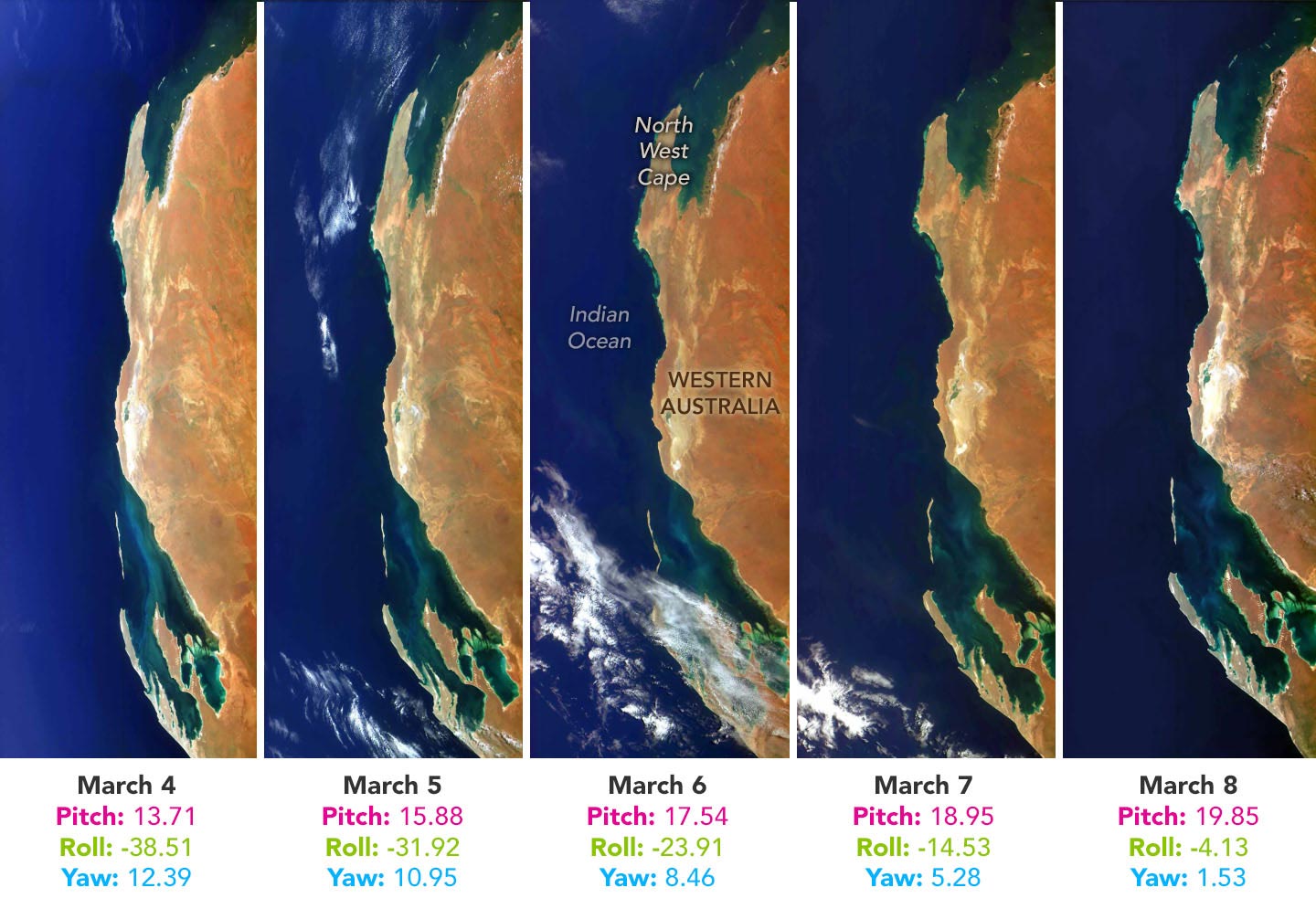
According to long-time NASA ocean scientist Gene Feldman, the team’s primary goal was to demonstrate that scientifically accurate ocean color data could be collected from a cubesat. After accomplishing this over the past year, the SeaHawk team has set new goals. They are currently attempting to demonstrate that they can collect observations of the same patch of water on multiple consecutive days.
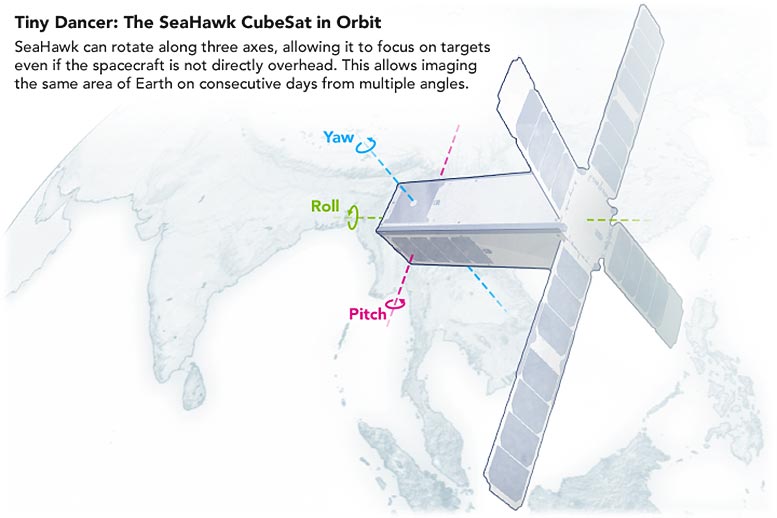
The natural-color images above were acquired on March 3-8, 2022, by the HawkEye sensor aboard the SeaHawk cubesat. Though SeaHawk’s orbit around the Earth changes each day by a few degrees of longitude, mission operators were able to observe the same patch of the Australian coastline for six consecutive days by slightly tilting the satellite on each new overpass.
Advancements in Ocean Observing and Daily Measurements
There was a time when scientists thought it was sufficient, almost revolutionary, to acquire broad images of the ocean once every few days. They were beginning to see the ocean on a broad scale, sketching out the big patterns and rhythms. But today they want fine details, Feldman noted. Where once it was sufficient to say: “the ocean blooms with phytoplankton around this time of year,” now scientists want to see what is happening daily, sometimes hourly, as conditions quickly evolve. In the case of toxic algal blooms in coastal waters or inland lakes, such information is important to the safety of humans and fisheries. Daily measurements can also be useful to researchers working from ships as they study a particular area or even a moving feature in the ocean.
Other ocean-observing satellite instruments—such as the Sea-viewing Wide Field-of-view Sensor (SeaWiFS), the Moderate Resolution Imaging Spectroradiometer (MODIS), or the Visible Infrared Imaging Radiometer Suite (VIIRS)—can observe much of the ocean every day. But because they look straight down at the planet, the reflection of sunlight off the water (sunglint) can make it difficult to distinguish color and features. By observing from an angle, SeaHawk has removed those light effects.
HawkEye: A New Level of Ocean Detail
The tiny HawkEye imager on SeaHawk also observes with significantly greater spatial resolution than MODIS and VIIRS—as much as ten times more detail. And the imager is calibrated to the unique light properties of the ocean, which tend to be darker than landforms; such differences often lead other imagers to capture coastal land details while making it hard to see much in the water.
HawkEye has collected more than 4,000 images since launch and is currently collecting about 100 new images per week. That data is being integrated and archived with other NASA ocean color data sets—likely a first for any cubesat mission. The team accepts imaging requests from members of the science community, and they continue to stretch the limits of multiple-day repeat imaging.
“Our goal from the beginning was to integrate this mission into the infrastructure that we have built over the past 25 years to support ocean color satellites,” Feldman said, “and to demonstrate that a cubesat can be treated like a normal, credible scientific mission. We have proven that, and we never dreamed this little satellite would still be operating after three years, let alone demonstrating new capabilities that we had never envisioned during development. And because they are smaller and less expensive, it will be easier to quickly adapt the second and third generations of CubeSats in a series to take advantage of what we have learned.”
NASA Earth Observatory images by Joshua Stevens, using SeaHawk/HawkEye imagery courtesy of Alan Holmes and Gene Feldman, NASA’s Ocean Color Web. Story by Michael Carlowicz, with reporting from Joseph M. Smith, NASA EOSDIS Science Writer.
Never miss a breakthrough: Join the SciTechDaily newsletter.
Follow us on Google and Google News.