
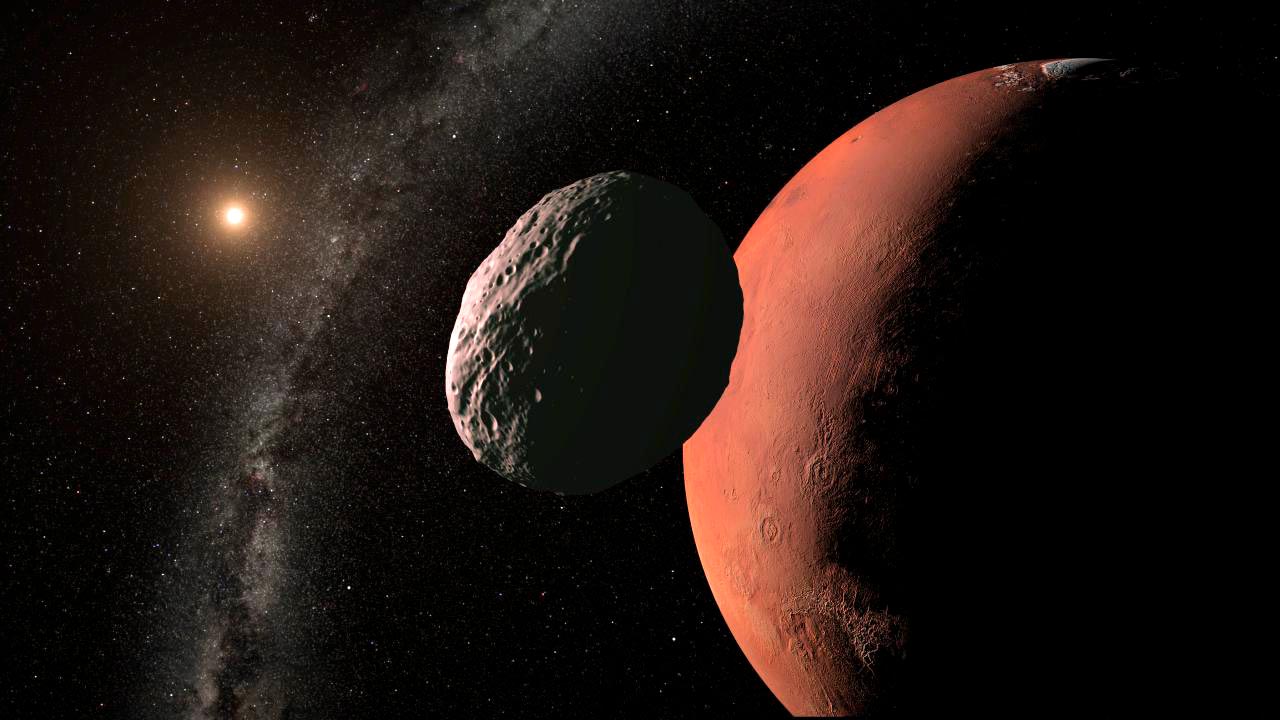
Using observations made with the Gran Telescopio Canarias (GTC) a study led from the Instituto de Astrofísica de Canarias (IAC) and the Universidad Complutense de Madrid (UCM) has confirmed that the asteroid 2023 FW14, discovered last year, is accompanying the red planet in its journey around the Sun, ahead of Mars and in the same orbit. With this new member, the group of Trojans that accompany Mars has increased in number to 17. But it shows differences in its orbit and chemical composition which may indicate that it is a captured asteroid, of a primitive type. The results are published in the prestigious journal Astronomy & Astrophysics.
A team from the Instituto de Astrofísica de Canarias (IAC) and the Universidad Complutense de Madrid (UCM) has observed and described for the first time the object 2023FW14, a Trojan asteroid that shares its orbit with Mars. After Jupiter, the red planet is the one which has the largest number of known Trojans, 17 with this new incorporation.
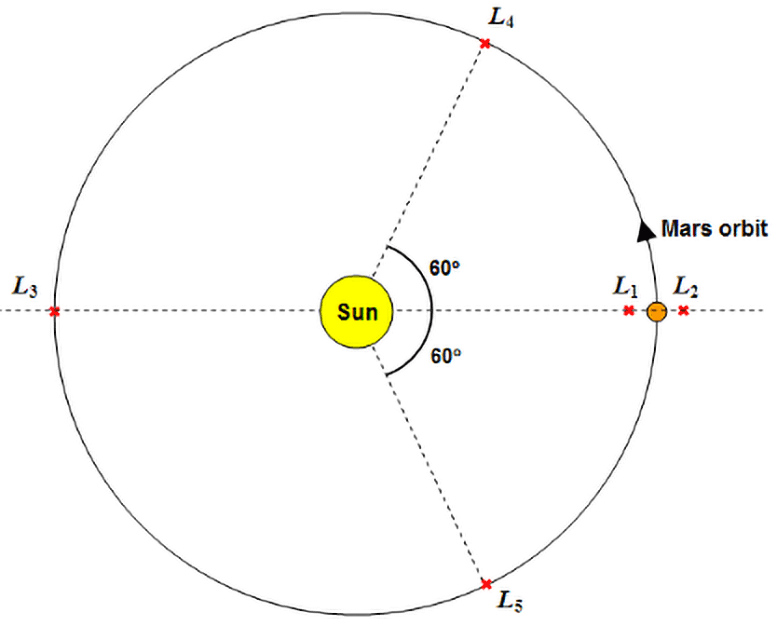
The Trojan asteroids are small bodies of the Solar System that share the orbit of a planet, occupying one of the points of stable equilibrium called the Lagrange points, situated 60º in front of (L4) and 60º behind (L5) the planet.
Nature and Orbit of 2023FW14
For the object 2023 FW14, the numerical simulations carried out at UCM during 2023 and 2024 have confirmed that it is an L4 Trojan, which means that it travels ahead of Mars, and is the second known Trojan of this type, after asteroid 1999 UJ7.
Although the majority of the Martian asteroids seem to have accompanied the planet since the epoch of its formation, 2023 FW14 arrived at its Trojan trajectory about a million years ago, and it may leave it in some 10 million years, according to the numerical results obtained.
Origin, Composition, and Significance
”While the orbital evolution of the 16 previously known Trojans shows long-term stability, the orbit of the new one is not stable” explains Raul de la Fuente Marcos, a researcher in the Department of Earth Science and Astrophysics at the UCM, who has led the study.”There are two possibilities for its origin: it could be a fragment of the Trojan 1999 UJ7, or it may have been captured from the population of asteroids close to the Earth that cross the orbit of Mars” he adds.
The spectrum obtained with the Gran Telescopio Canarias (GTCI) at Roque de los Muchachos Observatory on the Island of La Palma has allowed the researchers to find the chemical composition of 2023 FW14, showing new differences compared to the rest of the Martian Trojans.
“Although the spectrum of 2023 FW14 obtained with the GTC is somewhat different from that of the other L4 Trojan 1999 UJ7, both of them belong to the same composition group, they are asteroids of a primitive type, in contrast to the L5 Trojans, all of them rocky and rich in silicates”, comments Julia de León, an IAC researcher, and co-author of the article.
Increasing the number of known Martian Trojans allows researchers to deepen their understanding of these objects, whose existence was first predicted from mathematical calcuiations. “Studying real Trojans rather than only those predicted mathematically allows us to test the reliability of our theoretical models”, concludes de la Fuente Marcos.
Reference: “Dynamics of 2023 FW14, the second L4 Mars trojan, and a physical characterization using the 10.4 m Gran Telescopio Canarias” by R. de la Fuente Marcos, J. de León, C. de la Fuente Marcos, M. R. Alarcon, J. Licandro, M. Serra-Ricart, S. Geier and A. Cabrera-Lavers, 21 March 2024, Astronomy & Astrophysics.
DOI: 10.1051/0004-6361/202449688
Never miss a breakthrough: Join the SciTechDaily newsletter.
Follow us on Google and Google News.