
Close Menu
    Facebook X (Twitter) Instagram
    SciTechDaily
    • Biology
    • Chemistry
    • Earth
    • Health
    • Physics
    • Science
    • Space
    • Technology
    Facebook X (Twitter) Pinterest YouTube RSS
    SciTechDaily
    Home»Chemistry»Scientists Design a Molecule With Great Potential for Treatment of COVID-19
    Chemistry

    Scientists Design a Molecule With Great Potential for Treatment of COVID-19

    By Uppsala UniversityFebruary 14, 2022No Comments3 Mins Read
    Facebook Twitter Pinterest Telegram LinkedIn WhatsApp Email Reddit
    Share
    Facebook Twitter LinkedIn Pinterest Telegram Email Reddit
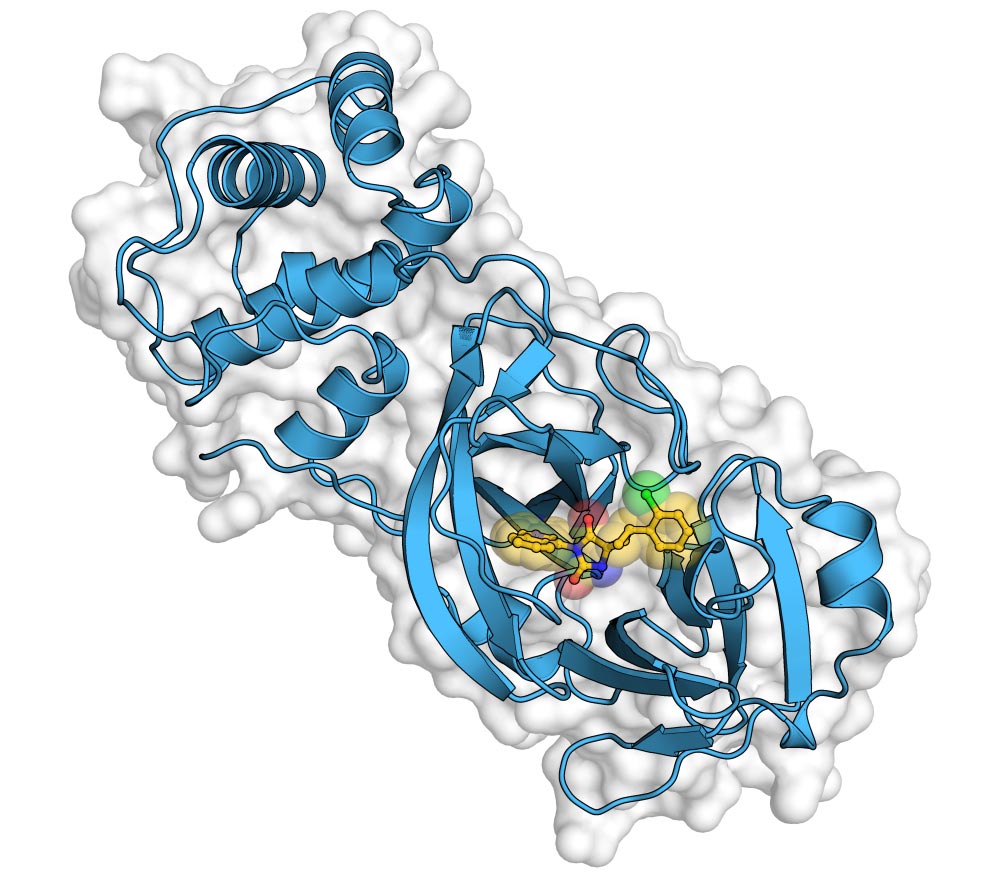
    Coronavirus Enzyme Model
    The image shows a model of the coronavirus enzyme, designed by Jens Carlsson Group at Uppsala University. Credit: Andreas Luttens

    Uppsala researchers have succeeded in designing a molecule that inhibits the replication of coronaviruses and that has great potential for development into a drug suitable for treating COVID-19. The molecule is effective against both the new variant and previously identified coronaviruses. The article has been published in the Journal of the American Chemical Society.

    The new coronavirus has caused more than five million deaths. Many lives could have been saved with antiviral drugs, but no treatment of this type has been available to the healthcare system. During the pandemic, researchers around the world have tried to find a pharmaceutical, but the development of new medications often takes a long time.

    Jens Carlsson
    Senior Lecturer/Associate Professor at Department of Cell and Molecular Biology, Uppsala University and SciLifeLab, Sweden. Credit: Niklas Norberg Wirtén

    During the first months of the pandemic, researchers were able to determine the structure of the coronavirus and how it functions at the molecular level. One of the viral enzymes was identified as a promising target for a drug, which is a strategy that has been successful for other viral diseases, such as AIDS. The idea is to design a molecule with the ability to recognize and bind to the enzyme. This would block its activity and thereby prevent the virus from producing new virus particles, stopping the spread of the virus.

    In 2020, researchers at Uppsala University, in collaboration with the Drug discovery and Development platform at Scilifelab, began to screen for inhibitors of the enzyme. They used computer models to identify molecules that can inhibit the enzyme’s activity. This proved to be a fast way to discover starting points for the design of pharmaceuticals. Access to Swedish supercomputers has made it possible to evaluate several hundred million different molecules to find those that can bind to the enzyme. The molecules predicted by the models were then synthesized and tested in experiments.

    “The most promising molecule shows the same ability to inhibit the replication of the new coronavirus as the active substance in Paxlovid, a combination drug recently approved for treating COVID-19. Our molecule works well on its own, and we have shown that the molecule is also effective against previously identified variants of the coronavirus,” says Jens Carlsson, associate professor and the article’s lead author.

    Reference: “Ultralarge Virtual Screening Identifies SARS-CoV-2 Main Protease Inhibitors with Broad-Spectrum Activity against Coronaviruses” by Andreas Luttens, Hjalmar Gullberg, Eldar Abdurakhmanov, Duy Duc Vo, Dario Akaberi, Vladimir O. Talibov, Natalia Nekhotiaeva, Laura Vangeel, Steven De Jonghe, Dirk Jochmans, Janina Krambrich, Ali Tas, Bo Lundgren, Ylva Gravenfors, Alexander J. Craig, Yoseph Atilaw, Anja Sandström, Lindon W. K. Moodie, Åke Lundkvist, Martijn J. van Hemert, Johan Neyts, Johan Lennerstrand, Jan Kihlberg, Kristian Sandberg, U. Helena Danielson and Jens Carlsson, 10 February 2022, Journal of the American Chemical Society.
    DOI: 10.1021/jacs.1c08402

    Never miss a breakthrough: Join the SciTechDaily newsletter.
    Follow us on Google and Google News.

    COVID-19 Pharmaceuticals Uppsala University Virology
    Share. Facebook Twitter Pinterest LinkedIn Email Reddit

    Related Articles

    Tricking COVID-19 With a Fake “Handshake” to Inactivate the Coronavirus

    Seaweed Extract Outperforms Remdesivir in Blocking COVID-19 Virus in Cell Studies

    The Latest in the Scientific Race to Develop an Effective COVID-19 Vaccine

    FDA Approved Drug May Help Calm Cytokine Storm in COVID-19

    Researchers Developed New Test Method for Safer Dosing of Hydroxychloroquine

    Not Effective: Two Existing Antiviral Drugs Were Tested for Mild-to-Moderate COVID-19

    Diagnostic Biosensor Detects SARS-CoV-2 From Nasopharyngeal Swab in Less Than a Minute

    Does Soap Actually ‘Kill’ the Coronavirus? Here’s the Chemistry [Video]

    Australian Researchers Set to Begin Clinical Trials on COVID-19 Treatment

    Leave A Reply Cancel Reply

    • Facebook
    • Twitter
    • Pinterest
    • YouTube

    Don't Miss a Discovery

    Subscribe for the Latest in Science & Tech!

    Trending News

    The Strange “Spacetime Crystal” That Can Suddenly Turn Into a Black Hole

    The Surprising Way Asteroids May Have Helped Life Begin on Earth

    Vast Hidden Structure Discovered Under Miles of Ice in East Antarctica

    A Surprising Discovery Suggests Autism Is Not One Condition

    New Alzheimer’s Discovery Could Change How Scientists Fight the Disease

    Yale Discovery Overturns Long-Held “Evolutionary Dead End” Theory

    UCLA Scientists Uncover a “Hidden Weakness” in Some of the World’s Deadliest Cancers

    Humpback Whale Stuns Scientists With 15,000 Kilometer Journey Across Oceans

    Follow SciTechDaily
    • Facebook
    • Twitter
    • YouTube
    • Pinterest
    • Newsletter
    • RSS
    SciTech News
    • Biology News
    • Chemistry News
    • Earth News
    • Health News
    • Physics News
    • Science News
    • Space News
    • Technology News
    Recent Posts
    • Food Waste Becomes a Powerful Carbon Trap in Climate Breakthrough
    • Battery-Free Artificial Photosynthesis Turns Sunlight, Water, and CO2 Into Fuel
    • How Ancient People Moved a 6-Ton Stone 700 Kilometers to Stonehenge
    • Scientists Finally See How Antibodies Really Attack Viruses
    • The Unexpected Gut Health Risk of Cutting Out Sugar
    Copyright © 1998 - 2026 SciTechDaily. All Rights Reserved.
    • Science News
    • About
    • Contact
    • Editorial Board
    • Privacy Policy
    • Terms of Use

    Type above and press Enter to search. Press Esc to cancel.