
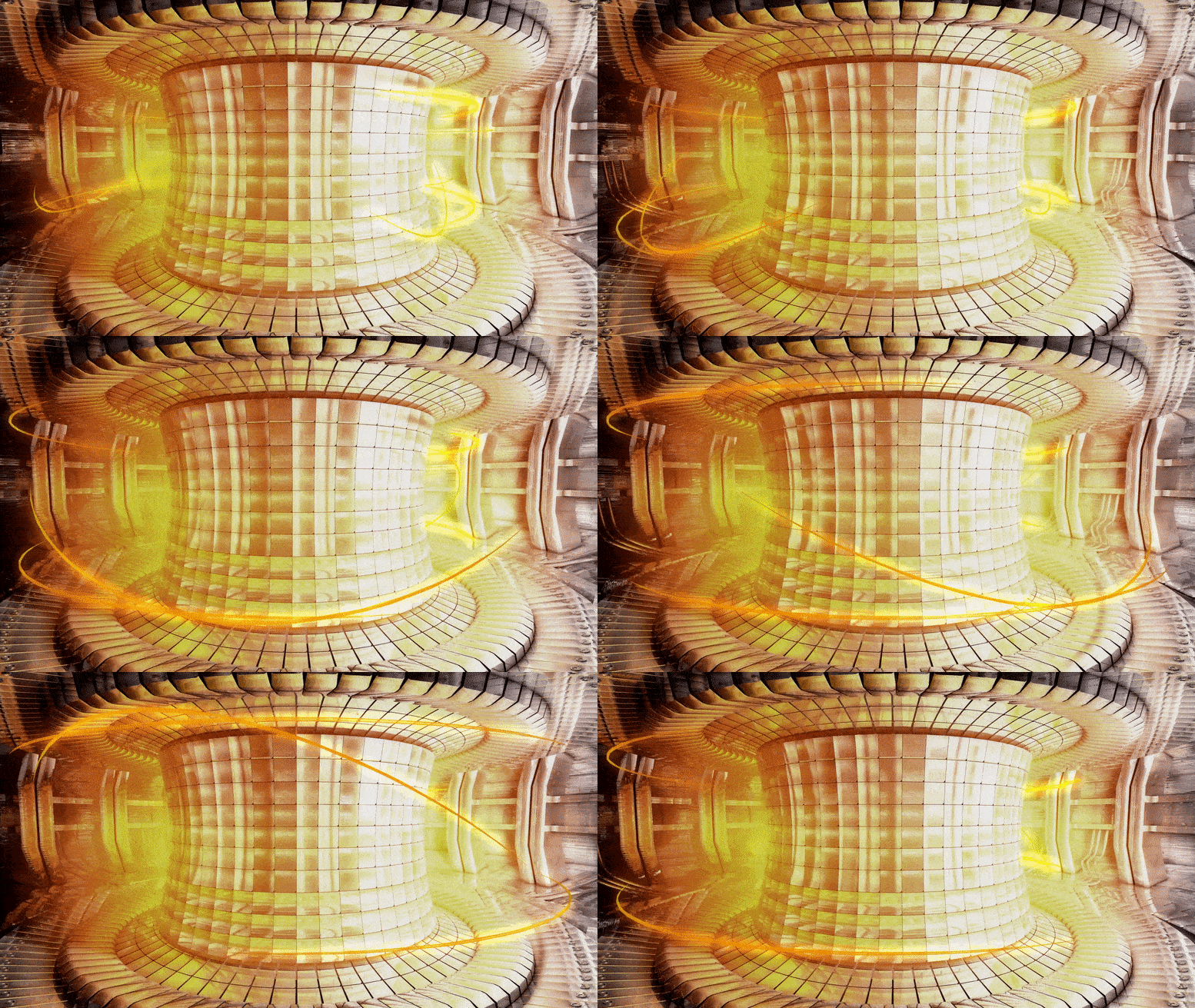
A key challenge for scientists striving to produce on Earth the fusion energy that powers the sun and stars is preventing what are called runaway electrons. These particles are unleashed in disrupted fusion experiments and can bore holes in tokamaks, the doughnut-shaped machines that house the experiments. Scientists led by researchers at the U.S. Department of Energy’s (DOE) Princeton Plasma Physics Laboratory (PPPL) have used a novel diagnostic with wide-ranging capabilities to detect the birth, and the linear and exponential growth phases of high-energy runaway electrons, which may allow researchers to determine how to prevent the electrons’ damage.
Initial Energy
“We need to see these electrons at their initial energy rather than when they are fully grown and moving at near the speed of light,” said PPPL physicist Luis Delgado-Aparicio, who led the experiment that detected the early runaways on the Madison Symmetric Torus (MST) at the University of Wisconsin-Madison. “The next step is to optimize ways to stop them before the runaway electron population can grow into an avalanche,” said Delgado-Aparicio, lead author of a first paper that details the findings in the Review of Scientific Instruments.
Fusion reactions produce vast amounts of energy by combining light elements in the form of plasma — the hot, charged state of matter composed of free electrons and atomic nuclei that makes up 99 percent of the visible universe. Scientists the world over are seeking to produce and control fusion on Earth for a virtually inexhaustible supply of safe and clean power for generating electricity
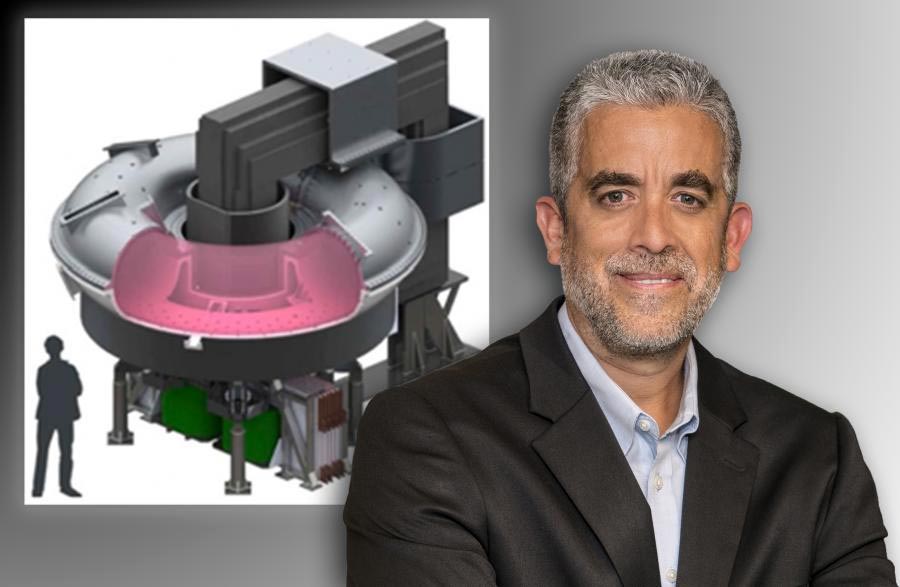
PPPL collaborated with the University of Wisconsin to install the multi-energy pinhole camera on MST, which served as a testbed for the camera’s capabilities. The diagnostic upgrades and redesigns a camera that PPPL had previously installed on the now-shuttered Alcator C-Mod tokamak at the Massachusetts Institute of Technology (MIT), and is unique in its ability to record not only the properties of the plasma in time and space but its energy distribution as well.
That prowess enables researchers to characterize both the evolution of the superhot plasma as well as the birth of runaway electrons, which begin at low energy. “If we understand the energy content I can tell you what is the density and temperature of the background plasma as well as the amount of runaway electrons,” Delgado Aparicio said. “So by adding this new energy variable we can find out several quantities of the plasma and use it as a diagnostic.”
Novel Camera
Use of the novel camera moves technology forward. “This certainly has been a great scientific collaboration,” said physicist Carey Forest, a University of Wisconsin professor who oversees the MST, which he describes as “a very robust machine that can produce runaway electrons that don’t endanger its operation.”
As a result, Forest said, “Luis’s ability to diagnose not only the birth location and initial linear growth phase of the electrons as they are accelerated, and then to follow how they are transported from the outside in, is fascinating. Comparing his diagnosis to modeling will be the next step and of course a better understanding may lead to new mitigation techniques in the future.”
Delgado-Aparicio is already looking ahead. “I want to take all the expertise that we have developed on MST and apply it to a large tokamak,” he said. Two post-doctoral researchers who Delgado-Aparicio oversees can build upon the MST findings but at WEST, the Tungsten (W) Environment in Steady-state Tokamak operated by the French Alternative Energies and Atomic Energy Commission (CEA) in Cadarache, France.
Range of Uses
“What I want to do with my post-docs is to use cameras for a lot of different things including particle transport, confinement, radio-frequency heating and also this new twist, the diagnosis and study of runaway electrons,” Delgado-Aparicio said. “We basically would like to figure out how to give the electrons a soft landing, and that could be a very safe way to deal with them.”
Reference: “Multi-energy reconstructions, central electron temperature measurements, and early detection of the birth and growth of runaway electrons using a versatile soft x-ray pinhole camera at MST” by L. F. Delgado-Aparicio, P. VanMeter, T. Barbui, O. Chellai, J. Wallace, H. Yamazaki, S. Kojima, A. F. Almagari, N. C. Hurst, B. E. Chapman, K. J. McCollam, D. J. Den Hartog, J. S. Sarff, L. M. Reusch, N. Pablant, K. Hill, M. Bitter, M. Ono, B. Stratton, Y. Takase, B. Luethi, M. Rissi, T. Donath, P. Hofer and N. Pilet, 2 July 2021, Review of Scientific Instruments.
DOI: 10.1063/5.0043672
Two dozen researchers participated in the research with Delgado-Aparicio and co-authored the paper about this work. Included were seven physicists from PPPL and eight from the University of Wisconsin. Joining them were a total of three researchers from the University of Tokyo, Kyushi University and the National Institutes for Quantum and Radiological Science and Technology in Japan; five members of Dectris, a Swiss manufacturer of detectors; and one physicist from Edgewood College in Madison, Wisconsin.
Support for this work comes from the DOE Office of Science.
Never miss a breakthrough: Join the SciTechDaily newsletter.
Follow us on Google and Google News.
5 Comments
The fuel cycle for small and large stars isn’t remotely anything like the fuel cycle for every proposed fusion reactor on earth because stars have gravity wells while earth bound reactors run on enthusiasm, endless investments and friendly reporting.
In smaller stars hydrogen has to be turned into deuterium and that fuses into helium3 then normal helium. In larger stars the Carbon cycle prevails and consume 4 protons in turn changing C12->N13->C13 then C13->N14 then N14->O15->N15 then finally N15->O16->C12+H4 and does so 10,000 times faster than the pp cycle in small stars. See wikipedia for details.
On earth the most likely fuel cycle uses Deuterium and Tritium. Deuterium is common enough in water but Tritium has a 12 year half life so doesn’t exist unless man made as a Fission reactor byproduct or by breaking lithium. So current tritium supplies are barely enough to fuel tiny fusion experiments. And all fusion reactors produce neutron flux as the energy output and that irradiates the containment vessel, nothing clean about that.
For more challenges to nuclear fusion with Tokamaks read the article by “Daniel Jassby at thebulletin” he also worked at the Princeton lab and came to a different conclusion.
And the recent NIF story about near unity, where 70% at unity is actually closer to 0.05% when you include the energy inputs to the xenon laser as electrical energy vs the thermal energy output from the fusion event. So 768MJ of electrical energy releases 1.3MJ of heat. It’s these sort of lies by omission that will ruin fusion.
Why is fusion energy so shiny on this blog when MSRs are orders of magnitude easier since we did that 50 years ago. An MSR is really not much more than a tube of passive hot salt with fission within. The rest is largely recirculating molten salt cooling loops not very exotic at all.
Fusion will make electricity unaffordable! Exotic alloys and maintinance is too too much!
Thorium reactors have been in our reach for decade and is found in the sand all over the world.
Wow comments tempered with realism. You never see articles citing actual input output, just grandiose claims. Last week Michio Kaku was hyping NIF, claiming it runs on seawater.
Don’t waste (lots of) money and time… just use Solar Panels to harvest Fusion Energy … from the SUN… (yes The SUN IS A FUSION REACTOR… IS IT NOT…???) how much do you want a TrillionTWhrs/yr… last time I checked the World needs just 150TW of PV Panels generating 180,000TWhrs/yr for ALL its Energy Needs (not just Electric Customers) by 2050 including 20-25% Energy Storage for S2S (Sunset To Sunrise) Energy Needs.
If you use AgriVoltaics(AV) .. you can achieve the above WITHOUT USING ANY ADDITIONAL LAND as AV enables Dual-Use of Agricultural Land (grow food below and generate electricity above… simultaneously).
See Youtube Channel zeropollution2050 (one word) for Details, Answers , Solutions etc…
Jyst FYI.
… You can achieve the above on just 7.5% of the 15 Million km2 of Farmland around the world… TODAY…!!!!
Thought the headline would be extremely high temperature containment materials must withstand. Perhaps there are some in Roswell that can take not only overall temps but differences across structures including transients. Hard enough for gas turbines at 3000 F with their thin casings and thick steam turbine casinos at 1500 F.