
Close Menu
    Facebook X (Twitter) Instagram
    SciTechDaily
    • Biology
    • Chemistry
    • Earth
    • Health
    • Physics
    • Science
    • Space
    • Technology
    Facebook X (Twitter) Pinterest YouTube RSS
    SciTechDaily
    Home»Space»A Link Between Black Hole Accretion Rate and Star Formation Rate
    Space

    A Link Between Black Hole Accretion Rate and Star Formation Rate

    By Harvard-Smithsonian Center for Astrophysics,August 27, 2013No Comments3 Mins Read
    Facebook Twitter Pinterest Telegram LinkedIn WhatsApp Email Reddit
    Share
    Facebook Twitter LinkedIn Pinterest Telegram Email Reddit
    Scientists Discover a Link Between Black Holes and New Stars
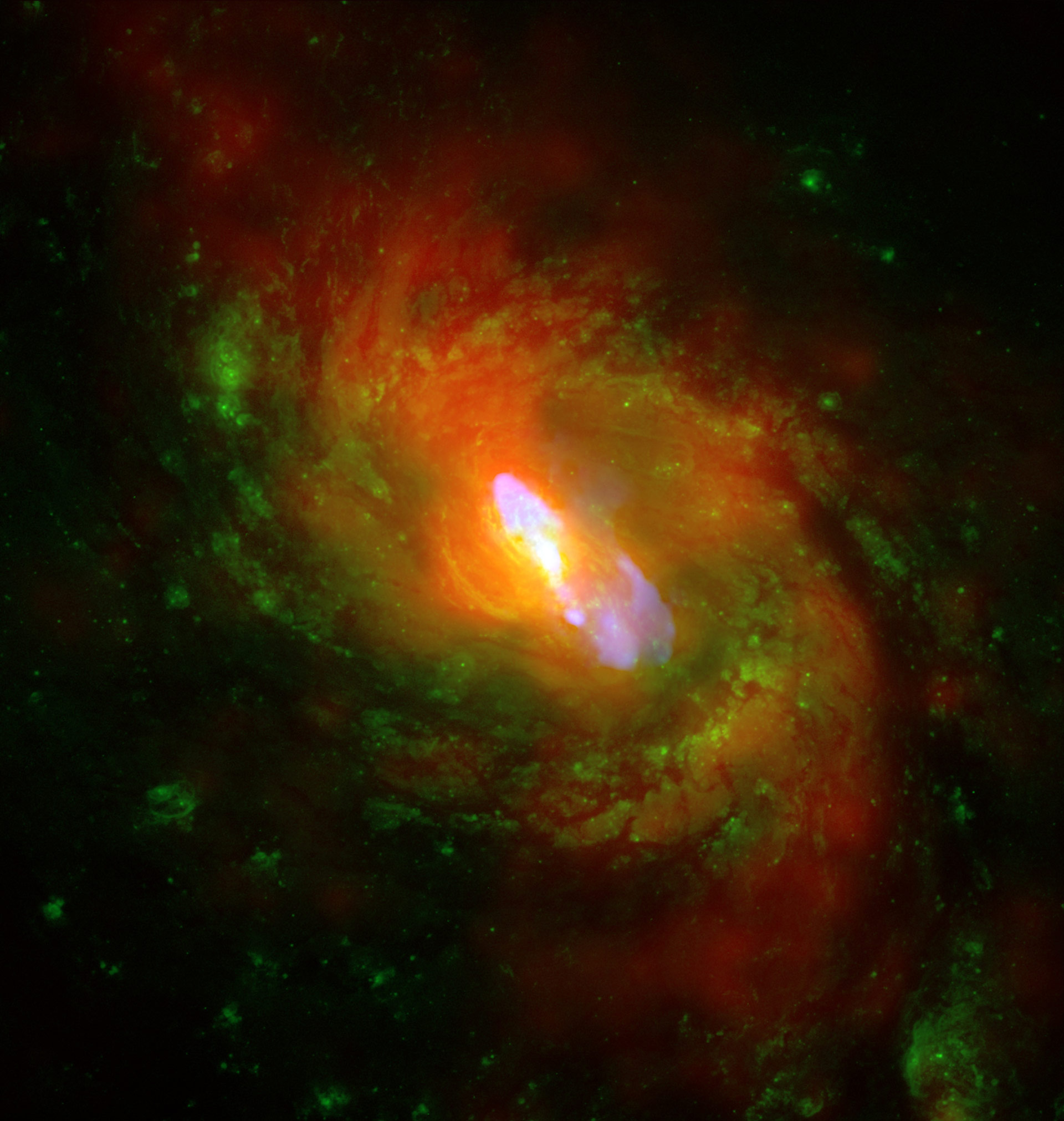
    This is a composite image of NGC 1068, one of the nearest and brightest galaxies containing both a rapidly growing supermassive black hole and star formation. A new study shows that, on average, both black hole accretion and star formation grow at similar rates, perhaps related to how material flow into the respective regions. X-ray data from the Chandra X-ray Observatory are shown in red, optical data from the Hubble Space Telescope in green, and radio data from the Very Large Array in blue. Credit: NASA and Chandra

    By comparing data from the Chandra X-ray Observatory with infrared observations by the Spitzer and Herschel space telescopes, astronomers discovered an almost linear relationship between the average black hole accretion rate and the star formation rate for galaxies across a wide range of luminosities.

    Supermassive black holes (those with millions to billions of solar masses) are thought to reside at the centers of most galaxies. These black holes must have undergone periods of intense accretion activity to grow to their large sizes, during which times they would be observed as active galactic nuclei and especially bright in X-rays. The masses of these black holes have been found to correlate closely with the cumulative mass of the stars that surround the galaxy in its bulge (and which are bound by gravitational forces). In a second discovery, it turns out that the activity of accretion for black holes and of star formation both peaked during a similar cosmic epoch, about three billion years ago, and then declined to the present day. These two results seem to suggest parallel evolutionary paths for the growth of the black holes and stellar mass, but the physical mechanisms that drive this apparent link, if it exists, are poorly understood. To make matters more confusing, some studies of individual objects have concluded that there is little or no correlation, or even an inverse one.

    Both black hole accretion and star formation require a supply of gas, and the clues to uncovering any connections between their growth may lie in the gas fueling mechanisms that supply them. CfA astronomers Christine Jones, Bill Forman, and Andy Golding, along with a team of collaborators, reasoned that because star formation occurs over time scales of hundreds of millions of years whereas active black hole accretion can vary rapidly over millions of years, the most appropriate measure to use when comparing these two processes was a long time average.

    The scientist studied 121 active galaxies studied by the Chandra X-ray Observatory that were also observed in the infrared by the Spitzer and Herschel space telescopes. The former provided an average measure of accretion activity, while the latter, which detected the dust warmed by young stars, sampled the star formation activity. With this approach the astronomers found an almost linear relationship between the average black hole accretion rate and the star formation rate for galaxies across a wide range of luminosities. The result implies that there are indeed tight links between the two activities in galaxies.

    Reference: “A Correlation between Star Formation Rate and Average Black Hole Accretion in Star-forming Galaxies” by Chien-Ting J. Chen, Ryan C. Hickox, Stacey Alberts, Mark Brodwin, Christine Jones, Stephen S. Murray, David M. Alexander, Roberto J. Assef, Michael J. I. Brown, Arjun Dey, William R. Forman, Varoujan Gorjian, Andrew D. Goulding, Emeric Le Floc’h, Buell T. Jannuzi, James R. Mullaney and Alexandra Pope, 18 July 2013, The Astrophysical Journal.
    DOI: 10.1088/0004-637X/773/1/3
    arXiv:1306.1227

    Never miss a breakthrough: Join the SciTechDaily newsletter.
    Follow us on Google and Google News.

    Astronomy Astrophysics Black Hole Harvard-Smithsonian Center for Astrophysics Star Formation
    Share. Facebook Twitter Pinterest LinkedIn Email Reddit

    Related Articles

    Black Hole Lights Up Years After Ripping Star to Shreds – “We’ve Never Seen Anything Like This Before”

    Scientists Have Spotted the Farthest Galaxy Ever – It May Be Home to the Oldest Stars in the Universe

    Astronomers Discover Four Enormous Bubbles Caused by Giant Black Holes

    Astronomers Spy Quartet of Enormous Cavities From Giant Black Holes

    Astronomers Use “X-Ray Magnifying Glass” To Enhance View of Distant Black Holes

    Astronomers Spot Unusual, Enormous Rings Around a Black Hole

    Telescopes Unite in Unprecedented Observations of Famous Black Hole Across the Entire Electromagnetic Spectrum

    Massive X-ray Jet – Extending for 160,000 Light-Years – Spied From Supermassive Black Hole in Early Universe

    Astronomers Detect a Supermassive Black Hole on the Move – Unusual Motion Thus Far Unexplained

    Leave A Reply Cancel Reply

    • Facebook
    • Twitter
    • Pinterest
    • YouTube

    Don't Miss a Discovery

    Subscribe for the Latest in Science & Tech!

    Trending News

    Artificial Sweeteners May Harm Future Generations, Study Suggests

    Splashdown! NASA Artemis II Returns From Record-Breaking Moon Mission

    What If Consciousness Exists Beyond Your Brain

    Scientists Finally Crack the 100-Million-Year Evolutionary Mystery of Squid and Cuttlefish

    Beyond “Safe Levels”: Study Challenges What We Know About Pesticides and Cancer

    Researchers Have Found a Dietary Compound That Increases Longevity

    Scientists Baffled by Bizarre “Living Fossil” From 275 Million Years Ago

    Your IQ at 23 Could Predict Your Wealth at 27, Study Finds

    Follow SciTechDaily
    • Facebook
    • Twitter
    • YouTube
    • Pinterest
    • Newsletter
    • RSS
    SciTech News
    • Biology News
    • Chemistry News
    • Earth News
    • Health News
    • Physics News
    • Science News
    • Space News
    • Technology News
    Recent Posts
    • What if Dark Matter Has Two Forms? Bold New Hypothesis Could Explain a Cosmic Mystery
    • Researchers Expose Hidden Chemistry of “Ore-Forming” Elements in Biology
    • Geologists Reveal the Americas Collided Earlier Than We Thought
    • 20x Difference: Study Reveals True Source of Airborne Microplastics
    • Scientists Uncover Hidden Force Powering Yellowstone’s Supervolcano
    Copyright © 1998 - 2026 SciTechDaily. All Rights Reserved.
    • Science News
    • About
    • Contact
    • Editorial Board
    • Privacy Policy
    • Terms of Use

    Type above and press Enter to search. Press Esc to cancel.