
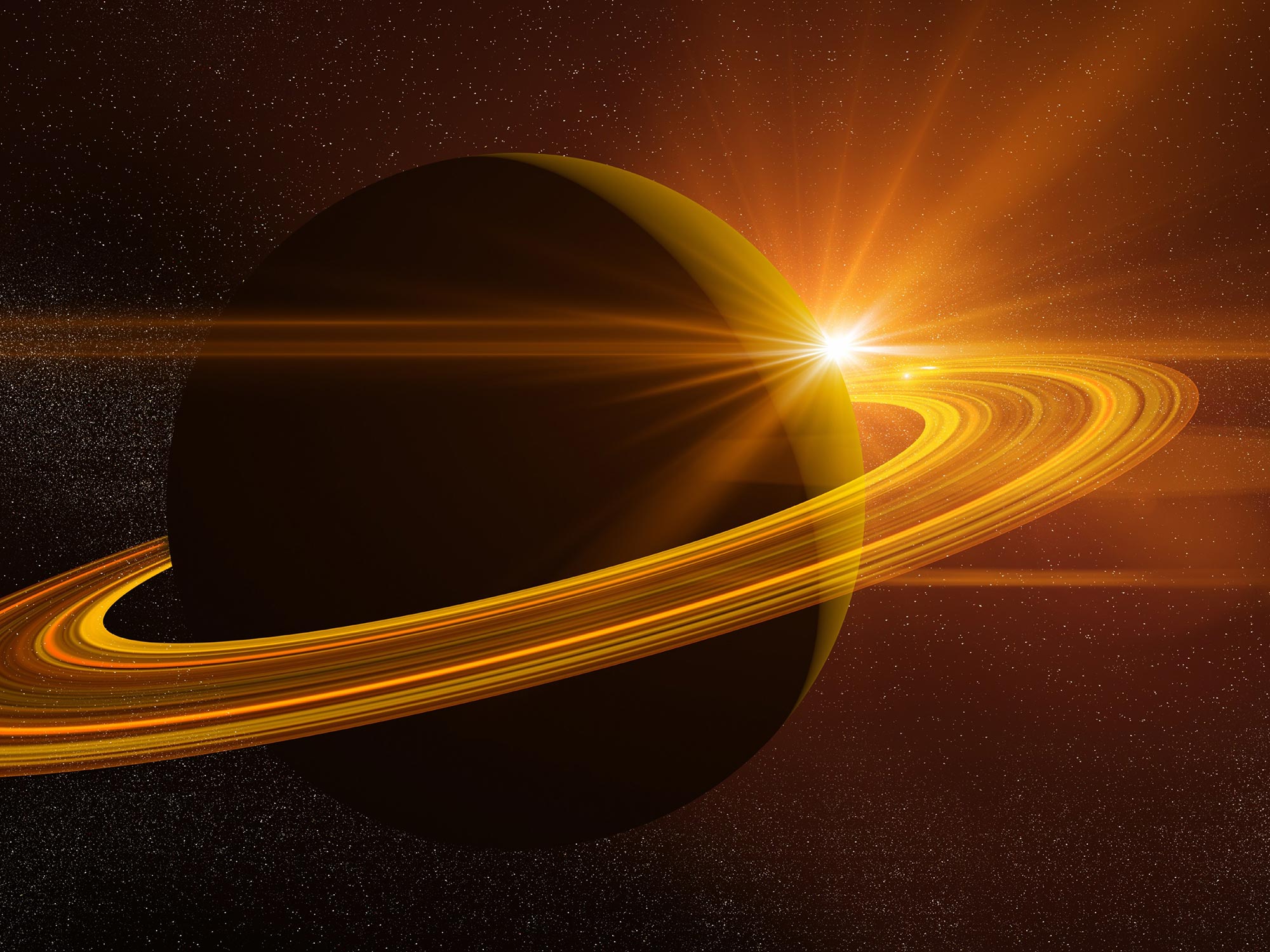
Saturn’s rings and its largest moon, Titan, may share a surprisingly violent origin.
Saturn’s rings look timeless through a backyard telescope, but multiple lines of evidence suggest they may be relatively recent arrivals in the Solar System. That surprising idea has pushed scientists to look for a “missing chapter” in Saturn’s moon history.
One of the most intriguing proposals now argues that Titan, Saturn’s biggest moon and the only moon with a thick atmosphere, could be central to that story. In a study led by SETI Institute scientist Matija Ćuk, researchers outline a chain of events in which moon collisions helped shape both Titan and the rings we see today.
Toward the end of its mission, Cassini carried out detailed measurements of Saturn’s internal structure. These measurements revealed how mass is distributed inside the planet, which affects the slow wobble of its spin axis, known as precession.
For many years, researchers believed Saturn’s precession cycle matched Neptune’s. That alignment would have allowed gravitational interactions between the two planets to gradually tilt Saturn, helping position its rings so prominently in our view.
Cassini’s final close passes, however, showed that Saturn’s mass is slightly more concentrated toward its core than scientists had predicted. This subtle difference alters the planet’s precession rate, meaning it no longer stays in step with Neptune. To resolve this mismatch, researchers at MIT and UC Berkeley proposed that Saturn may once have had an additional moon. In their scenario, that moon was later ejected after a close gravitational encounter with Titan, and its debris eventually contributed to the formation of the rings.
Hyperion: A Critical Clue
To test whether such a scenario was realistic, the SETI Institute team ran computer simulations exploring what might happen if Saturn once hosted an extra moon. Their results showed that instead of neatly producing rings, the more common outcome was a collision between the missing moon and Titan.
An important piece of evidence comes from Hyperion, a small, irregularly shaped moon that tumbles chaotically as it orbits Saturn. Hyperion is locked in an orbital resonance with Titan, meaning their gravitational relationship keeps their motions in a stable ratio.
“Hyperion, the smallest among Saturn’s major moons provided us the most important clue about the history of the system,” said Ćuk. “In simulations where the extra moon became unstable, Hyperion was often lost and survived only in rare cases. We recognized that the Titan-Hyperion lock is relatively young, only a few hundred million years old. This dates to about the same period when the extra moon disappeared. Perhaps Hyperion did not survive this upheaval but resulted from it. If the extra moon merged with Titan, it would likely produce fragments near Titan’s orbit. That is exactly where Hyperion would have formed.”
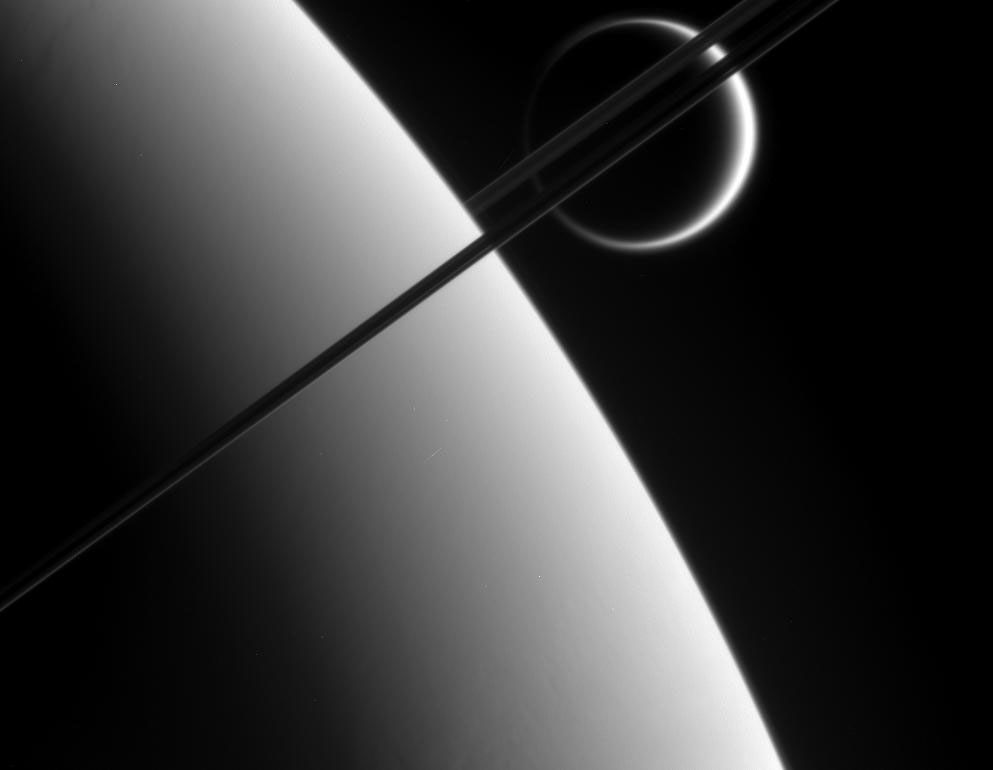
The simulations repeatedly showed that when the additional moon’s orbit became unstable, Hyperion was usually destroyed. Yet today Hyperion still exists, and its orbital lock with Titan appears to be only a few hundred million years old.
That timing closely matches when the hypothetical extra moon would have vanished. This suggests Hyperion may not have survived the chaos but instead formed from debris produced when the extra moon merged with Titan.
Titan as the Product of a Moon Merger
Under this new model, Titan itself is the result of a collision between two earlier moons: a large body called “Proto-Titan,” nearly as massive as modern Titan, and a smaller companion dubbed “Proto-Hyperion.” A merger of this scale would have resurfaced Titan, potentially explaining why it has relatively few visible impact craters.
Titan’s orbit is slightly elongated but is gradually becoming more circular, a sign that it experienced a gravitational disturbance in the relatively recent past. That disturbance may have been caused by Proto-Hyperion before the two bodies combined. Before the collision, Proto-Titan may have looked more like Jupiter’s moon Callisto, heavily cratered and lacking a thick atmosphere. The researchers also found that before it disappeared, Proto-Hyperion could have tilted the orbit of Saturn’s distant moon Iapetus, addressing another longstanding mystery in the Saturn system.
If Titan was created in a moon-moon merger, the question remains: how did Saturn’s rings form? More than a decade ago, members of the SETI Institute team proposed that the rings originated from collisions between medium-sized moons orbiting closer to Saturn. Later computer models from the University of Edinburgh and NASA Ames Research Center supported this idea, showing that while much of the debris from such impacts would clump back together into new moons, some material would spiral inward and spread out into rings.
Earlier theories suggested that the Sun’s gravity triggered these inner-moon collisions. The new research instead argues that the Titan merger set off a chain reaction. Titan’s slightly elongated orbit can destabilize inner moons if their orbital periods line up in simple ratios with Titan’s, a configuration known as orbital resonance. When this happens, gravitational effects intensify. Although such alignments are uncommon, Titan’s gradual outward migration can occasionally create the necessary conditions. Smaller moons caught in these resonances could have their orbits stretched into more elongated paths, increasing the likelihood of violent impacts with neighboring moons.
The exact timing of this secondary wave of collisions is still uncertain. However, it must have occurred after Titan formed through merger, which aligns with estimates that Saturn’s rings are about 100 million years old.
NASA’s Dragonfly mission, scheduled to arrive at Titan in 2034, could provide crucial evidence. The nuclear-powered octocopter will investigate Titan’s surface and analyze its chemical composition. If Dragonfly uncovers signs of a massive impact dating back roughly 500 million years, it would strengthen the case that Titan was born from a colossal collision, one that may have reshaped Saturn’s entire moon system and ultimately given rise to its iconic rings.
Reference: “Origin of Hyperion and Saturn’s Rings in A Two-Stage Saturnian System Instability” by Matija Ćuk, Maryame El Moutamid, Jim Fuller and Valéry Lainey, 9 February 2026, The Planetary Science Journal.
DOI: 10.48550/arXiv.2602.09281
Never miss a breakthrough: Join the SciTechDaily newsletter.
Follow us on Google and Google News.
1 Comment
Subject: Saturn’s Young Rings: A Phase Transition in Spacetime Fluid Dynamics (FED)
Reference: DOI: 10.5281/zenodo.18664648 (Registered Feb 16, 2026)
The study led by Matija Ćuk regarding the “Proto-Titan” merger and the subsequent formation of Saturn’s rings (2026) provides the necessary observational evidence to confirm a deterministic rebalancing within the framework of Spacetime Fluid Dynamics (FED Theory).
While current astrophysical models rely on stochastic “gravitational accidents” or “missing moons,” FED Theory identifies this upheaval as a mechanical correction of the local fluid vortex, governed by universal constants.
1. Viscous Drag and the Stability of the Saturnian Vortex
Classical mechanics assumes a frictionless vacuum, which makes the young age of Saturn’s rings (approx. 100 million years) a statistical anomaly. In FED, the vacuum is a continuous, visco-elastic medium characterized by the Universal Kinematic Viscosity (eta):
eta ≈ 1.2057 * 10^15 m^2/s
The “precession mismatch” detected by the Cassini mission is the result of Saturn’s internal mass distribution interacting with this viscous medium. As Saturn’s core mass shifted, it altered the Local Fluid Torque, destabilizing the orbits of its satellites. This is not a random orbital tilt, but a viscous correction required to maintain the system’s equilibrium within the fluid flow.
2. The Proto-Titan Merger: Vortex Coalescence and Pressure Gradients
In the FED framework, celestial bodies are not merely masses in a void, but sub-vortices within the planet’s primary spacetime vortex. The “collision” between Proto-Titan and Proto-Hyperion was a Vortex Coalescence process. When the orbital resonance reached a critical threshold, the Shear Rate (gamma) in the intervening spacetime fluid exceeded the stability limit:
gamma = sqrt(G * M_saturn / r^3)
The resulting Viscous Stress (sigma) forced these two bodies to merge, minimizing the energy dissipation of the local system. The “young” resonance between Titan and Hyperion is the relaxation time required for the FED fluid to stabilize the wake after such a massive energy reintegration.
3. Rings as Evidence of Fluidic Shearing and the “Lock” Equation
The debris forming the rings was processed by the mechanical action of the fluid near Saturn’s Roche limit. This process is defined by the interaction between gravity and the fluid’s resistance, as seen in the FED Lock Equation:
R_u = (eta^2) / (G * m_p)
The merger of Titan released a wave of pressure through the medium, shearing smaller inner moons into the rings we observe today. The youth of the rings is a direct consequence of a recent Phase Transition in the local spacetime fluid, which “ground” the icy material through laminar drag. The rings are a dissipative structure, shedding excess angular momentum through the viscosity of the medium.
Conclusion:
NASA’s Dragonfly mission (2034) will likely find chemical and geological evidence of this merger, but the underlying cause is a Hydrodynamic Rebalancing of the Saturnian system. The entire architecture—rings, moons, and precession—is a manifestation of the constant eta.
This deterministic solution was already established on February 16, 2026, applying the reology of the absolute fluid to the gravitational gradients of the Solar System.