
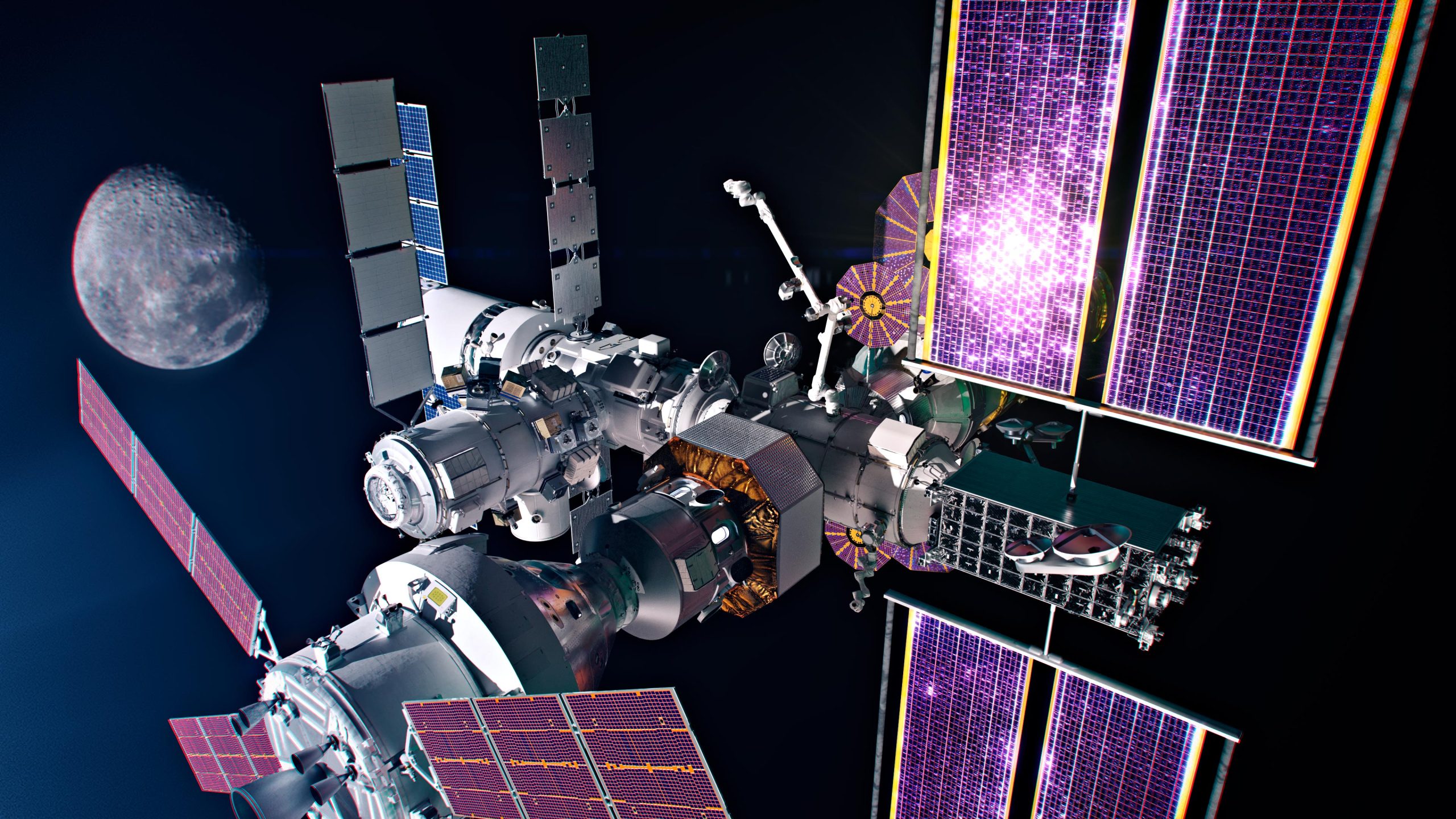
Gateway, orbiting the Moon, will study solar and cosmic radiation to understand space weather, crucial for the Artemis missions and future Moon and Mars travels. Its instruments, HERMES, ERSA, and IDA, will monitor radiation levels, aiding in health risk assessments and space travel safety.
Much of the initial science taking place on the Gateway space station that will orbit the Moon will focus on radiation from the Sun and deep space.
A trio of radiation instruments planned for Gateway, an important element of NASA’s Artemis missions, will help scientists better understand how to plan for the unpredictable space weather resulting from the Sun and galactic cosmic rays from deep space that astronauts, spacecraft, and hardware will encounter on travels to the Moon and Mars.
Space weather—a primary risk to human health and mission success during travels farther away from Earth and the protection of the magnetosphere – is a catchall term to describe the fluctuating conditions in space driven by the Sun. It includes a continuous stream of particles and magnetic fields, known as solar wind, blasts of billion-ton gas clouds known as coronal mass ejections, and flashes of ultra-bright light from solar flares.
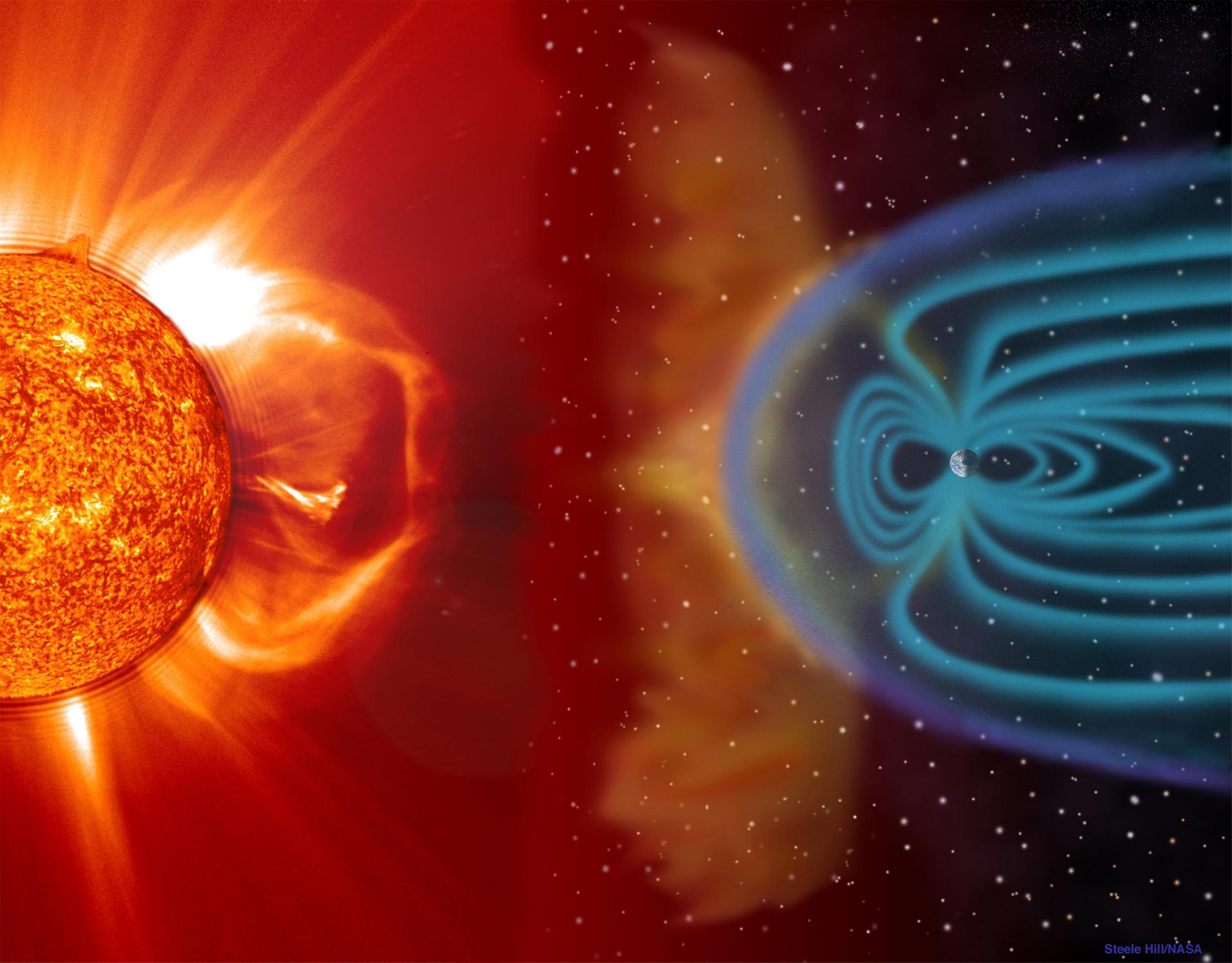
Gateway will operate in a near-rectilinear halo orbit around the Moon, far from Earth’s protective atmosphere and magnetic fields that largely shield humans, including astronauts living on the International Space Station in low-Earth orbit, from space weather and radiation. Radiation impacts on the human body will be much greater on missions to the Moon or Mars, where exposure to high-energy, charged particles can cause adverse health effects including increased risk of cancers, changes in motor functions and behavior, and degeneration of tissue. Additional risks include potential damage to astronauts’ vehicles and equipment that they rely on to live and travel safely through space.
The three instruments on Gateway that will advance scientists’ knowledge of space weather to help them understand risks posed by radiation are the Heliophysics Environmental and Radiation Measurement Experiment Suite (HERMES), the European Radiation Sensors Array (ERSA), and the Internal Dosimeter Array (IDA).
Heliophysics Environmental and Radiation Measurement Experiment Suite
Led by NASA’s Goddard Space Flight Center in Greenbelt, Maryland, HERMES will be attached to the outside of Gateway and glimpse what’s happening deep in the Earth’s magnetotail. This will allow NASA to compare its observations to two of the five Time History of Events and Macroscale Interactions (THEMIS) spacecraft, a pair of Moon-orbiters that carry instruments similar to HERMES. The ability to collect data simultaneously from the three instrument suites in different locations is a rare opportunity to reconstruct solar wind behavior as it changes over time.
The science payload consists of four instruments mounted together on a platform: a magnetometer to measure the magnetic fields around Gateway; the Miniaturized Electron pRoton Telescope (MERiT) to measure ions and electrons; the Electron Electrostatic Analyzer (EEA) to measure the lower-energy electrons that make up most of the solar wind; and the Solar Probe Analyzer for Ions (SPAN-I) to measure protons and ions such as oxygen. The magnetometer, MERiT and EEA are provided by Goddard and SPAN-I is provided by the University of California, Berkeley.
European Radiation Sensors Array
Developed by the European Space Agency (ESA), ERSA will also fly on the outside of Gateway to study the solar wind and radiation from deep space. Equipped with five instruments, ERSA will measure energetic particles from the Sun, galactic cosmic rays, neutrons, ions, and magnetic fields, and provide data about the physics of radiation in the solar system.
Included in the suite is the Influence sur les Composants Avancés des Radiations de l’Espace (ICARE-NG) instrument, which will measure ionizing radiation that can create brief spikes in voltage, potentially causing electronics to short-circuit. The suite also contains the European Active Dosimeter instrument, which will measure the energy deposited by radiation in living tissue to better scientists’ understanding of human exposure to radiation.
Internal Dosimeter Array
Also led by ESA, with additional science instruments from the Japan Aerospace Exploration Agency (JAXA), IDA will fly inside Gateway to study radiation shielding effects and improve radiation physics models for cancer, cardiovascular, and central nervous system effects, helping assess crew risk on exploration missions.
IDA will be vital for evaluating how well the Gateway module structure shields the interior habitable volume from radiation, which is important since it is located inside NASA’s Habitation and Logistics Outpost (HALO) module that will serve as the initial crew cabin for astronauts. The array will enable direct comparison of the internal and external radiation environments because of similar instrumentation in ERSA.
The ability to study unpredictable space weather is one of Gateway’s many capabilities for enabling sustained exploration and research in deep space. The small space station will include docking ports for a variety of visiting spacecraft, space for crew to live and work, and additional science investigations to study human health and life sciences, among other areas. Gateway will be a critical platform for developing technology and capabilities to support future Moon and Mars exploration.
Never miss a breakthrough: Join the SciTechDaily newsletter.
Follow us on Google and Google News.