

Close Menu
    Facebook X (Twitter) Instagram
    SciTechDaily
    • Biology
    • Chemistry
    • Earth
    • Health
    • Physics
    • Science
    • Space
    • Technology
    Facebook X (Twitter) Pinterest YouTube RSS
    SciTechDaily
    Home»Physics»A New Method for Quantum Computing in Trapped Ions
    Physics

    A New Method for Quantum Computing in Trapped Ions

    By University of AmsterdamFebruary 7, 2022No Comments3 Mins Read
    Facebook Twitter Pinterest Telegram LinkedIn WhatsApp Email Reddit
    Share
    Facebook Twitter LinkedIn Pinterest Telegram Email Reddit
    Abstract Qubits Quantum Computing
    Researchers have proposed a new scalable quantum computer architecture. Utilizing the collective motion of particles, they created new, less technically challenging building blocks for quantum computing.

    Physicists from the University of Amsterdam have proposed a new architecture for a scalable quantum computer.

    Making use of the collective motion of the constituent particles, they were able to construct new building blocks for quantum computing that pose fewer technical difficulties than current state-of-the-art methods. The results were recently published in Physical Review Letters.

    The researchers work at QuSoft and the Institute of Physics in the groups of Rene Gerritsma and Arghavan Safavi-Naini. The effort, which was led by the PhD candidate Matteo Mazzanti, combines two important ingredients. One is a so-called trapped-ion platform, one of the most promising candidates for quantum computing that makes use of ions – atoms that have either a surplus or a shortage of electrons and as a result are electrically charged. The other is the use of a clever method to control the ions supplied by optical tweezers and oscillating electric fields.
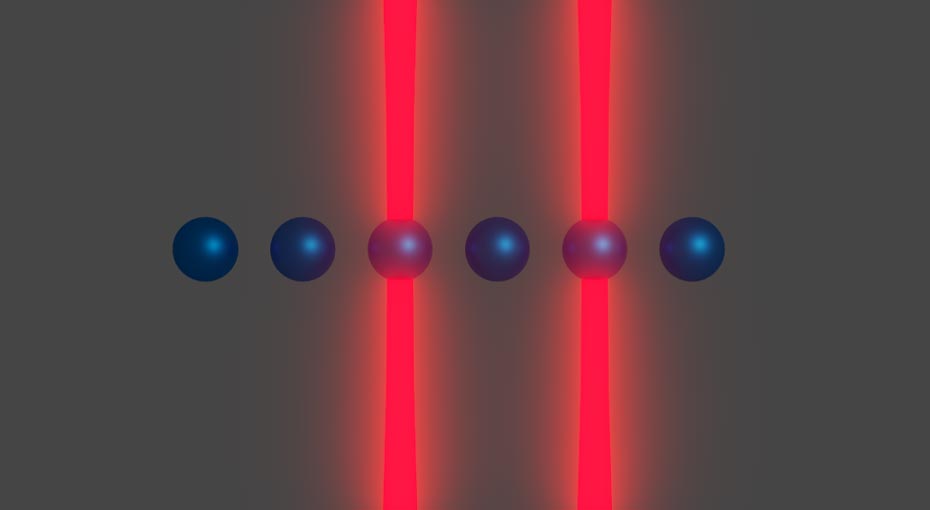
    Two Trapped Ions
    Two trapped ions (in blue) are selected by optical tweezers (in red). A quantum gate between the ions can be implemented using electric fields. Credit: UvA

    As the name suggests, trapped-ion quantum computers use a crystal of trapped ions. These ions can move individually, but more importantly, also as a whole. As it turns out, the possible collective motions of the ions facilitate the interactions between individual pairs of ions. In the proposal, this idea is made concrete by applying a uniform electric field to the whole crystal, in order to mediate interactions between two specific ions in that crystal. The two ions are selected by applying tweezer potentials on them – see the image above. The homogeneity of the electric field assures that it will only allow the two ions to move together with all other ions in the crystal. As a result, the interaction strength between the two selected ions is fixed, regardless of how far apart the two ions are.

    A quantum computer consists of ‘gates’, small computational building blocks that perform quantum analogs of operations like ‘and’ and ‘or’ that we know from ordinary computers. In trapped-ion quantum computers, these gates act on the ions, and their operation depends on the interactions between these particles. In the above setup, the fact that those interactions do not depend on the distance means that also the duration of operation of a gate is independent of that distance. As a result, this scheme for quantum computing is inherently scalable, and compared to other state-of-the-art quantum computing schemes poses fewer technical challenges for achieving comparably well-operating quantum computers.

    Reference: “Trapped Ion Quantum Computing Using Optical Tweezers and Electric Fields” by M. Mazzanti, R. X. Schüssler, J. D. Arias Espinoza, Z. Wu, R. Gerritsma and A. Safavi-Naini, 22 December 2021, Physical Review Letters.
    DOI: 10.1103/PhysRevLett.127.26050

    Never miss a breakthrough: Join the SciTechDaily newsletter.
    Follow us on Google and Google News.

    Quantum Computing University of Amsterdam
    Share. Facebook Twitter Pinterest LinkedIn Email Reddit

    Related Articles

    Physicists Create and Control a Large Quantum Mechanical System Built on Photons

    Quantum Computing Continues To Move Closer to Reality – New Quantum Memory Design

    New Cooling Technique May Be a Stepping Stone to Quantum Computing

    Physicists Use a Switch to Manipulate Light on Superconducting Chips

    Researchers Make Progress on a Quantum-Computing Proposal

    Geometry of “Super Atoms” May Play a Role in Future Quantum Computer Design

    New System Converts Laser Beam Into Controlled Stream of Single Photons

    Quantum Bits Store Data for Nearly Two Seconds Using Laboratory Grown Diamonds

    Evidence of Elusive Majorana Fermions Raises Possibilities for Quantum Computing

    Leave A Reply Cancel Reply

    • Facebook
    • Twitter
    • Pinterest
    • YouTube

    Don't Miss a Discovery

    Subscribe for the Latest in Science & Tech!

    Trending News

    Why Popular Diabetes Drugs Like Ozempic Don’t Work for Everyone: The “Genetic Glitch”

    Scientists Stunned After Finding Plant Thought Extinct for 60 Years

    Scientists Discover Tiny New Spider That Hunts Prey 6x Its Size

    Natural Component From Licorice Shows Promise for Treating Inflammatory Bowel Disease

    Scientists Warn: Popular Sweetener Linked to Dangerous Metabolic Effects

    Monster Storms on Jupiter Unleash Lightning Beyond Anything on Earth

    Scientists Create “Liquid Gears” That Spin Without Touching

    The Simple Habit That Could Help Prevent Cancer

    Follow SciTechDaily
    • Facebook
    • Twitter
    • YouTube
    • Pinterest
    • Newsletter
    • RSS
    SciTech News
    • Biology News
    • Chemistry News
    • Earth News
    • Health News
    • Physics News
    • Science News
    • Space News
    • Technology News
    Recent Posts
    • 100,000-Year-Old Neanderthal Fossils in Poland Reveal Unexpected Genetic Connections
    • Unexpected Hormone Discovery Could Change How We Treat Arthritis
    • Scientists Supercharge “Natural Killer” Cells To Break Through Cancer’s Defenses
    • Simple “Gut Reset” May Prevent Weight Gain After Ozempic or Wegovy
    • 2.8 Days to Disaster: Scientists Warn Low Earth Orbit Could Suddenly Collapse
    Copyright © 1998 - 2026 SciTechDaily. All Rights Reserved.
    • Science News
    • About
    • Contact
    • Editorial Board
    • Privacy Policy
    • Terms of Use

    Type above and press Enter to search. Press Esc to cancel.