
Close Menu
    Facebook X (Twitter) Instagram
    SciTechDaily
    • Biology
    • Chemistry
    • Earth
    • Health
    • Physics
    • Science
    • Space
    • Technology
    Facebook X (Twitter) Pinterest YouTube RSS
    SciTechDaily
    Home»Earth»A New Mineral – From Deep Inside the Earth – Discovered in a Diamond
    Earth

    A New Mineral – From Deep Inside the Earth – Discovered in a Diamond

    By American Association for the Advancement of Science (AAAS)November 19, 2021No Comments3 Mins Read
    Facebook Twitter Pinterest Telegram LinkedIn WhatsApp Email Reddit
    Share
    Facebook Twitter LinkedIn Pinterest Telegram Email Reddit
    Davemaoite Interior Earth Mineral
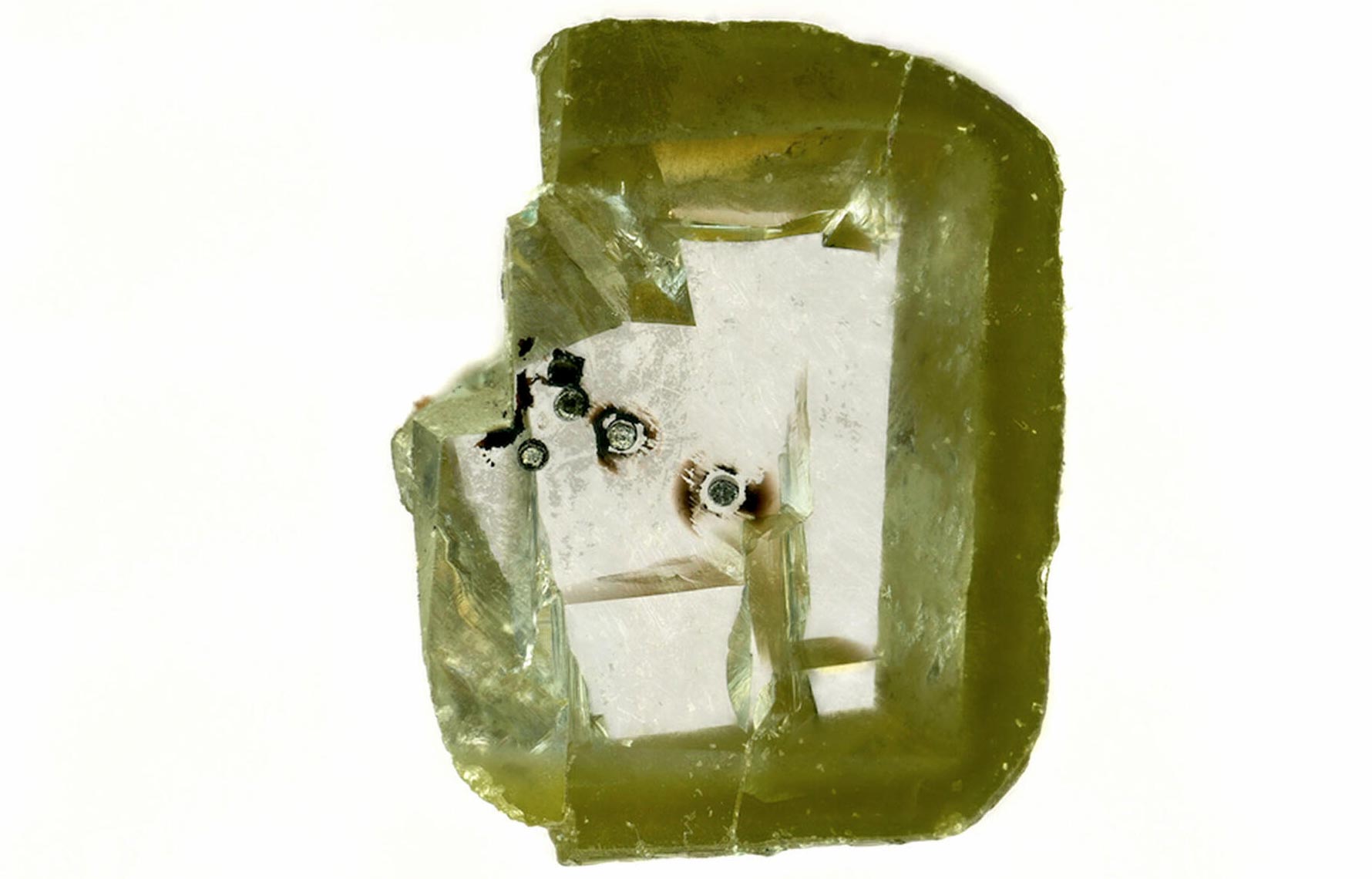
    UNLV mineralogist Oliver Tschauner and colleagues discovered a new mineral that was carried to the surface of the Earth in a diamond (pictured here). Credit: Aaron Celestian, Los Angeles County Natural History Museum

    Davemaoite, a crucial lower-mantle mineral, has been discovered in a diamond, revealing its role in Earth’s heat production.

    For the first time, a high-pressure calcium silicate perovskite (CaSiO3) has been identified as a naturally occurring mineral from Earth’s lower mantle, researchers report.

    The newly discovered crystalline compound, named davemaoite by the authors, was found trapped as an inclusion inside a deep-earth diamond, which formed at high pressure and temperature more than 660 kilometers (410 miles) below the Earth’s surface.

    Davemaoite was named in honor of Ho-kwang (Dave) Mao – a prominent experimental high-pressure geophysicist – and confirmed as a new mineral by the International Mineralogical Association. According to Oliver Tschauner and colleagues, calcium silicate perovskite (CaSiO3) is among the most geochemically important minerals in the lower mantle, largely because it concentrates elements that are incompatible in the upper mantle, including rare-earth elements and radioactive isotopes that make an important contribution to the heat of Earth’s mantle.

    Although theorized for decades, to date, no one has ever successfully retrieved a high-pressure phase silicate from the Earth’s lower mantle, largely because they cannot retain their mineralogical structure after being removed from a high-pressure, high-temperature environment. The only other high-pressure phase silicate mineral confirmed in nature, bridgmanite, was found inside a highly shocked meteorite.

    Implications for Earth’s Heat and Composition

    In this study, Tshauner et al. identified and characterized the davemaoite inclusion within the deep-earth diamond using synchrotron X-ray diffraction. They show its ability to host a wide variety of elements in its structure, including potassium, thorium, and uranium – three of the major heat-producing elements. The findings support the existence of compositional heterogeneity within the lower mantle and, given the mineral’s overall abundance, suggest that davemaoite likely influences heat generation in the deep mantle.

    “The work by Tschauner et al. inspires hope in the discovery of other difficult high-pressure phases in nature, either through careful search in deep-origin diamonds or in highly shocked meteorites,” writes Yingwei Fei in a related Perspective. “Such direct sampling of the inaccessible lower mantle would fill our knowledge gap in chemical composition and heterogeneity of the entire mantle of our planet.”

    For reporters interested in trends, several past Science publications featuring the work of Oliver Tschauner and others have presented findings related to lower mantle minerals, including a November 2014 report that described the discovery of “bridgemanite” in a shocked meteorite – the only other high-pressure mineral confirmed in nature.

    Also, a March 2018 report by Tschauner et al. used deep-earth diamonds to discover inclusions of ice-VII – a cubic crystalline form of ice that forms when aqueous water is trapped and subjected to extremely high pressure.

    For more on this research, see First-Ever Interior Earth Mineral Discovered in Nature – It Shouldn’t Be Here.

    Reference: “Discovery of davemaoite, CaSiO3-perovskite, as a mineral from the lower mantle” by Oliver Tschauner, Shichun Huang, Shuying Yang, Munir Humayun, Wenjun Liu, Stephanie N Gilbert Corder, Hans A. Bechtel, Jon Tischler and George R. Rossman, 11 November 2021, Science.
    DOI: 10.1126/science.abl8568

    Never miss a breakthrough: Join the SciTechDaily newsletter.
    Follow us on Google and Google News.

    American Association for the Advancement of Science Diamonds Geochemistry Geophysics
    Share. Facebook Twitter Pinterest LinkedIn Email Reddit

    Related Articles

    Hydraulic Jump Drives Stratospheric Hydration Above Intense Supercell Thunderstorms

    First-Ever Interior Earth Mineral Discovered in Nature – It Shouldn’t Be Here

    Ancient Diamonds Show Earth Was Primed for Life’s Explosion of Diversity at Least 2.7 Billion Years Ago

    A Billion-Plus Years of Deep-Earth History Hidden Within African Diamonds

    Diamonds That Formed Deep in the Earth’s Mantle Contain Evidence of Deep-Earth Recycling Processes

    Using Google’s 10,000-km-Long Underwater Fiber-Optic Cable as a Seafloor Seismic Sensor

    Earth’s Magnetic Field Reversal 42,000 Years Ago Triggered a Global Environmental Crisis

    Natural Nanodiamonds in Oceanic Rocks – Formed Through Low Pressure and Temperature Geological Processes

    Drastic Reduction in Earth’s Seismic Background Noise Due to COVID-19 Lockdowns

    Leave A Reply Cancel Reply

    • Facebook
    • Twitter
    • Pinterest
    • YouTube

    Don't Miss a Discovery

    Subscribe for the Latest in Science & Tech!

    Trending News

    Nanoscale “Defects” Unlock a Major Heat Transfer Breakthrough

    Adults Taking More Vitamin D Scored 13% Higher on a Cognitive Test

    A 35,000-Year-Old Neanderthal Pelvis May Explain Why Men and Women Walk Differently

    Dual Stem Cell Treatment Restores Vision in First Human Trial

    Your Waist Size May Reveal More About Your Health Than You Think

    Scientists Turn Red Strawberries White With a Single Gene Edit

    A SpaceX Falcon 9 Rocket Hit the Moon and Blasted Open a 60-Foot Crater

    Study Reveals Your Organs May Be Aging at Very Different Speeds

    Follow SciTechDaily
    • Facebook
    • Twitter
    • YouTube
    • Pinterest
    • Newsletter
    • RSS
    SciTech News
    • Biology News
    • Chemistry News
    • Earth News
    • Health News
    • Physics News
    • Science News
    • Space News
    • Technology News
    Recent Posts
    • FDA Clears First-of-Its-Kind Nonmedication Treatment for PTSD
    • Quantum Simulators Put a 40-Year-Old Physics Theory to the Test
    • 125-Million-Year-Old Crocodile Fossil Reveals Astonishing New Secrets
    • Scientists Discover an “Impossible” Way Muscle Filaments Can Grow
    • Scientists Discover a Mysterious New Snake Species Hiding in New Guinea
    Copyright © 1998 - 2026 SciTechDaily. All Rights Reserved.
    • Science News
    • About
    • Contact
    • Editorial Board
    • Privacy Policy
    • Terms of Use

    Type above and press Enter to search. Press Esc to cancel.