
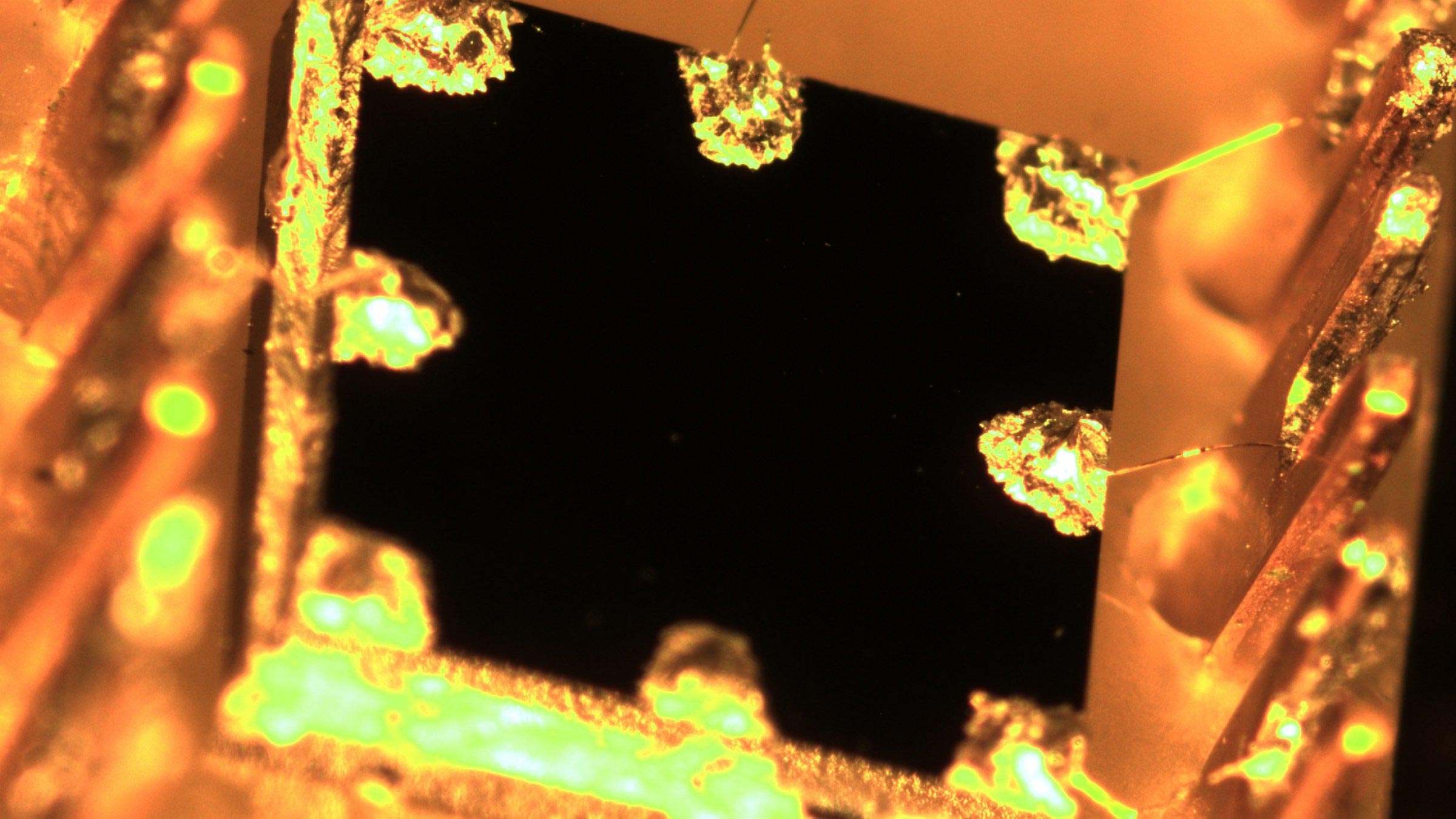
By perfecting gallium arsenide to unprecedented purity, Princeton researchers revealed exotic quantum behaviors at far lower magnetic fields than expected.
Princeton researchers have created the world’s purest sample of gallium arsenide, a semiconductor used in devices that power such technologies as cell phones and satellites.
The team baked their material down to one impurity for every 10 billion atoms, reaching a level of quality that outstrips even the world’s purest silicon sample used in verifying the one-kilogram standard. The finished gallium arsenide chip, a square about the width of a pencil eraser, allowed the team to probe deep into the very nature of electrons.
Rather than sending this chip to space, the researchers took their ultra-pure sample to the basement of Princeton’s engineering quadrangle where they wired it up, froze it to colder-than-space temperatures, enveloped it in a powerful magnetic field, and applied a voltage, sending electrons through the two-dimensional plane sandwiched between the material’s crystalline layers. As they lowered the magnetic field, they found a surprising series of effects.
Surprising Physics Under Weak Magnetic Fields
The results, published in Nature Materials, showed that many of the phenomena driving today’s most advanced physics can be observed under far weaker magnetic fields than previously thought. Lower magnetic fields could empower more labs to study the mysterious physics problems buried within such two-dimensional systems. More exciting, according to the researchers: These less severe conditions present physics that have no established theoretical framework, paving the way for further exploration of quantum phenomena.
One surprise came when the electrons aligned into a lattice structure known as a Wigner crystal. Scientists previously thought Wigner crystals required extremely intense magnetic fields, around 14 Tesla. “Strong enough to levitate a frog,” said Kevin Villegas Rosales, one of the study’s two first authors, who recently completed his Ph.D. in electrical and computer engineering. But this study showed that electrons can crystallize at less than one Tesla. “We just needed the ultra-high quality to see them,” he said.
Quantum Hall Effect and Unexpected Oscillations
The team also observed around 80 percent more “oscillations” in the system’s electrical resistance and a larger “activation gap” of what’s called the fractional quantum Hall effect, a key topic in condensed matter physics and quantum computation. The fractional quantum Hall effect was originally discovered by Daniel Tsui, Princeton’s Arthur Legrand Doty Professor of Electrical and Computer Engineering, Emeritus, who received the Nobel Prize in physics for his discovery.
This study came together as part of ongoing collaboration between principal investigators Mansour Shayegan, professor of electrical and computer engineering, and Loren Pfeiffer, a senior research scholar in ECE.
“There has been a wonderful relationship between our labs,” Shayegan said. Until around a decade ago, he and Pfeiffer, who at the time worked for Bell Labs, had maintained a friendly competition in search of ever purer materials that allowed them to study ever more interesting physics problems. Then Pfeiffer joined Princeton.
No longer trying to best each other, as colleagues in the same department they were free to combine forces. They quickly developed a natural divide-and-conquer approach to the questions they had previously been trying to answer on their own. In the 10-plus years since, Pfeiffer’s group has built one of the world’s finest material-deposition instruments while Shayegan’s has refined leading methods to study the physics those ultra-pure materials reveal.
Reference: “Ultra-high-quality two-dimensional electron systems” by Yoon Jang Chung, K. A. Villegas Rosales, K. W. Baldwin, P. T. Madathil, K. W. West, M. Shayegan and L. N. Pfeiffer, 25 February 2021, Nature Materials.
DOI: 10.1038/s41563-021-00942-3
In addition to addressing their research collaboratively, these two investigators co-advise many of the graduate students who work in their labs, including Villegas Rosales and Edwin Chung, the paper’s other first author. Chung also earned his Ph.D. this year and is now a postdoctoral researcher with the same two groups. Villegas Rosales has since joined Quantum Machines, a quantum computing startup company, as an engineer.
The paper, “Ultra-high-quality two-dimensional electron systems,” published in Nature Materials on February 25, 2021, was supported by grants from the National Science Foundation, the Gordon and Betty Moore Foundation and the U.S. Department of Energy. Additional authors include graduate student Pranav Madathil and senior researchers Kirk W. Baldwin and K. W. West, all of Princeton.
Never miss a breakthrough: Join the SciTechDaily newsletter.
Follow us on Google and Google News.
2 Comments
Very interesting reading, lots of exiting developments being published, if you can….try to contact me I would like to give to you some information to help assist your aspirations if they are good.
If you want to test electrons in a pure environment, then put them in a vacuum.