
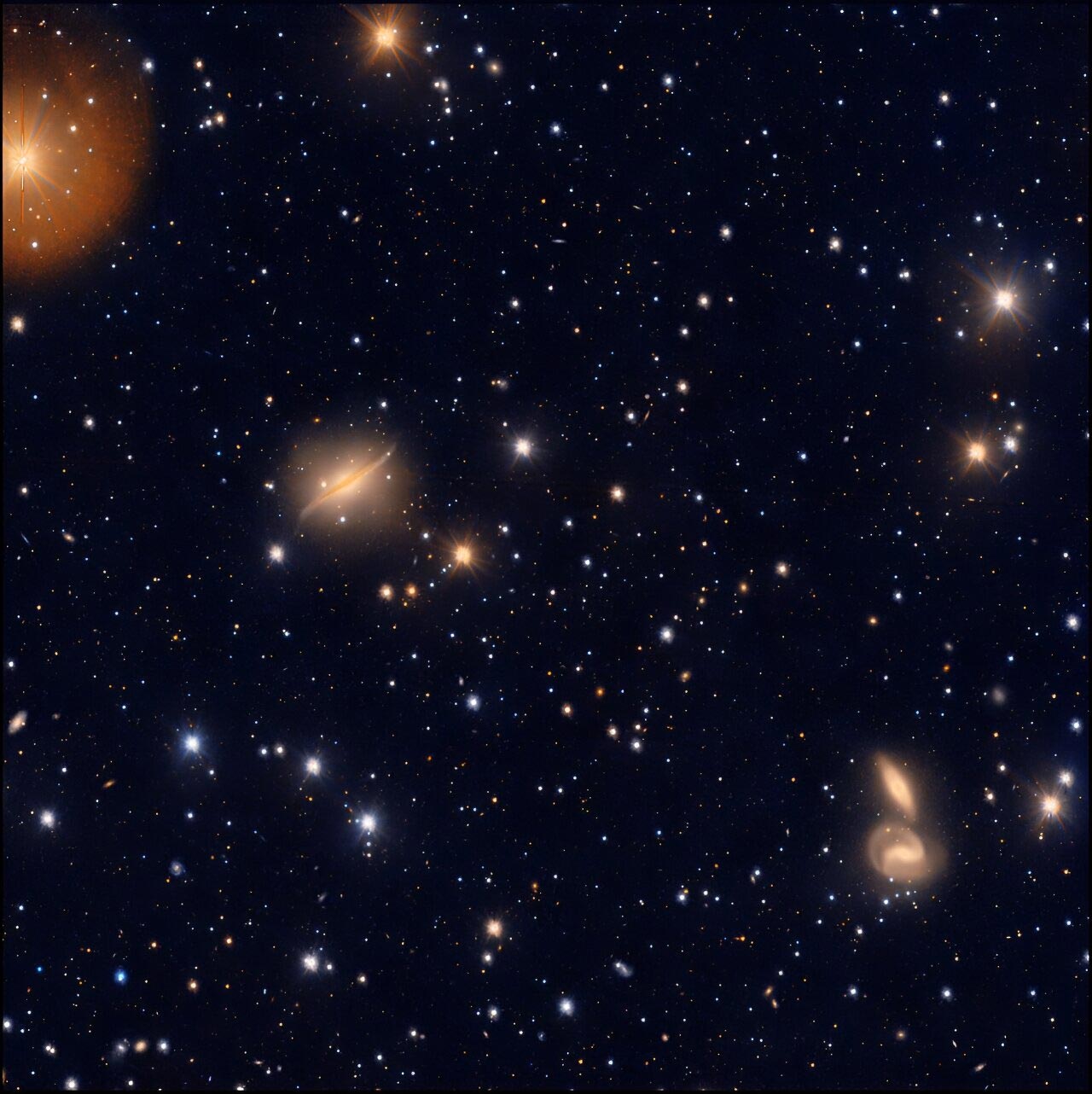
New images from the VLT Survey Telescope depict distant galaxies, including the lenticular ESO 510-G13 and Hickson Compact Group 90, highlighting interactions and the effects of gravity in shaping galaxy formations.
The VLT Survey Telescope (VST) is an optical telescope located at the European Southern Observatory’s Paranal Observatory in Chile. It utilizes a powerful 2.6-meter diameter mirror and a wide field camera, the OmegaCAM, to capture extensive areas of the sky—each image covering an area twice the size of the full Moon’s apparent diameter. The VST, built entirely in Italy, opened in 2011 but is now managed by INAF through the National Coordination Centre for VST.
Public Engagement and Celestial Wonders
The VST Centre has embarked on a new initiative aimed at the general public, capturing stunning images of nebulae, galaxies, and other iconic objects during full Moon nights, a time when the brightness of our natural satellite disturbs the collection of scientific data. This program is designed to engage the public’s interest in astrophysics during periods less optimal for standard observations.
“Besides scientific research, one of the goals of the VST Centre is to disseminate scientific knowledge and to share the wonders of the Universe with the general public. We especially wish that young people can discover and nurture their interest in astrophysics through these amazing images”, explains Enrichetta Iodice, INAF researcher in Naples and responsible for the National Coordination Centre for VST.
Unveiling Interacting Galaxies
The first of three new images portrays ESO 510-G13, a curious lenticular galaxy about 150 million light years from us, in the direction of the Hydra constellation. The central bulge of the galaxy stands out. The dark silhouette of the dust disk, seen from the edge, crosses the bulge, obscuring part of the light. The disk’s distorted shape, vaguely resembling an upside-down S, indicates the turbulent past of ESO 510-G13, which may have acquired its current appearance following a collision with another galaxy.
In the lower right corner, among the many stars of the Milky Way scattered across the image, a pair of spiral galaxies about 250 million light years from us are also visible. Zooming into the image, many more galaxies appear, even at greater distances, as small spots of light elongated among the many dots in the background.

Capturing Galaxy Groups
Another image showcases a small group of four galaxies, called Hickson Compact Group 90 (HGC 90), which is about 100 million light years away from Earth, towards the Piscis Austrinus constellation. The two round, bright spots near the image center are the elliptical galaxies NGC 7173 and NGC 7176.
The bright streak that bifurcates and connects these two galaxies is the third member of the group, the spiral galaxy NGC 7174: its curious shape indicates the ongoing interaction between the three celestial bodies, which has stripped their stars and gas, mixing up their distribution. A halo of diffuse light envelops the three galaxies.
The fourth galaxy belonging to the group, NGC 7172, visible in the upper part of the image, does not seem to participate in this celestial dance: its core, crossed by dark clouds of dust, hides a supermassive black hole that has been actively devouring the surrounding material. The HGC 90 quartet of galaxies is embedded in a much larger structure, including dozens of galaxies, some of which are visible in this image.

Exploring the Abell 1689 Galaxy Cluster
The third image reveals the Abell 1689 galaxy cluster in the Virgo constellation, a rich cluster containing over two hundred galaxies. Abell 1689 contains more than two hundred galaxies, mostly visible as yellow-orange blobs, whose light has traveled for about two billion years before reaching the VST. The enormous mass, including enormous quantities of hot gas and of the mysterious dark matter in addition to the galaxies, deforms space-time in the vicinity of the cluster.
Therefore, the cluster acts as a “gravitational lens” on more distant galaxies, amplifying their light and producing distorted images, much like what a magnifying glass does. Some of these galaxies can be spotted as dots and tiny, slightly curved lines, especially around the cluster’s central regions.
Never miss a breakthrough: Join the SciTechDaily newsletter.
Follow us on Google and Google News.