

A pulsar’s gentle twinkle is revealing how space quietly bends and delays the signals we receive from the cosmos.
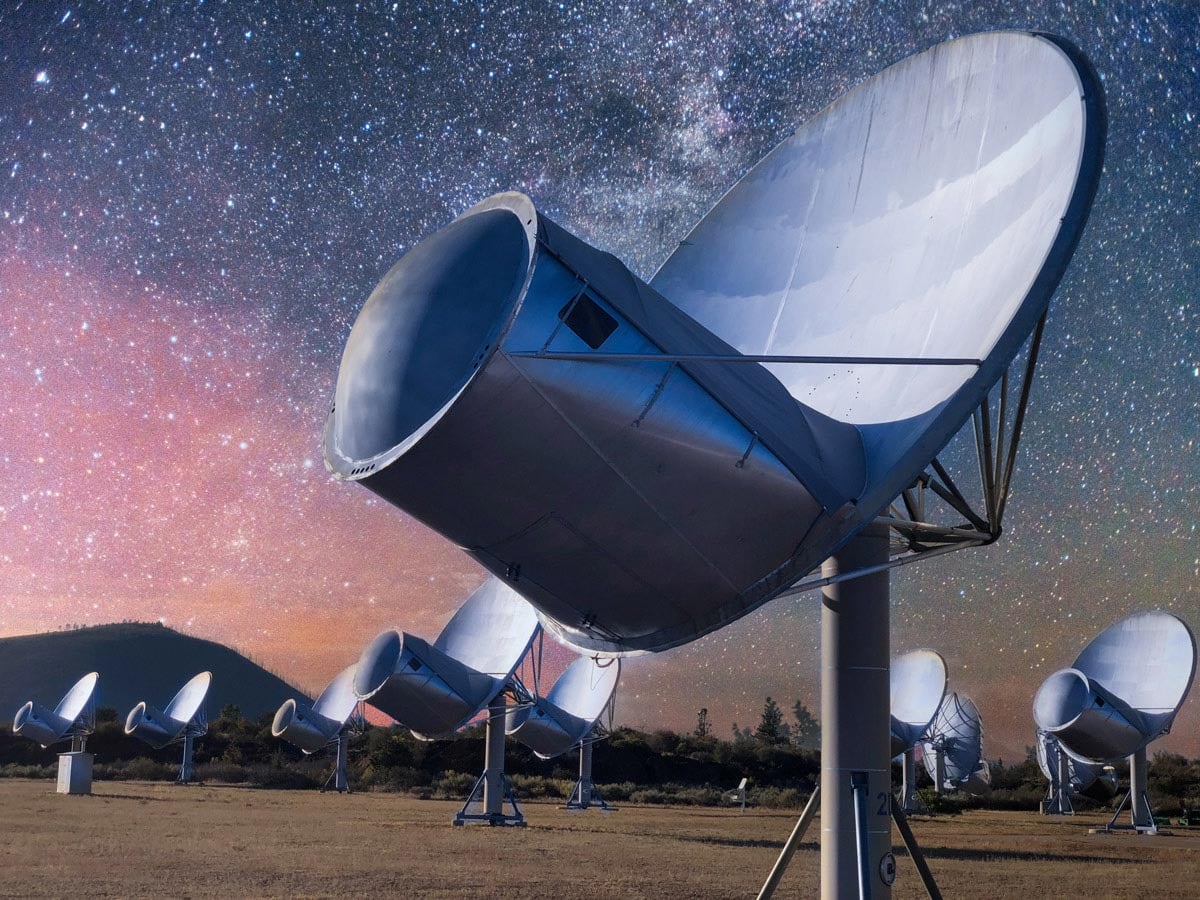
For about ten months, scientists led by the SETI Institute closely monitored the pulsar PSR J0332+5434 (also called B0329+54). Their goal was to see how its radio signal appears to “twinkle” as it travels through gas between the pulsar and Earth. Using the Allen Telescope Array (ATA), the team collected observations across radio frequencies ranging from 900 to 1956 MHz. Over time, they noticed slow but clear changes in this twinkling pattern, known as scintillation.
Why Pulsars Are So Valuable to Astronomers
Pulsars are the dense, fast spinning remains of massive stars that ended their lives in explosions. As they rotate, they send out radio pulses with extraordinary regularity. Because of this steady rhythm and their extreme density and speed, astronomers can use sensitive radio telescopes to record the exact arrival times of each pulse. These precise measurements can reveal subtle patterns linked to phenomena such as low-frequency gravitational waves.
The journey through space complicates things. Gas between stars can scatter the radio waves, spreading them out and slightly delaying when each pulse reaches Earth. These delays can be extremely small, sometimes only tens of nanoseconds (a nanosecond is one-billionth of a second). Learning how to measure and correct these shifting delays is key to keeping pulsar timing as accurate as possible.
How Interstellar Space Makes Signals Flicker
Pulsar signals behave much like starlight seen from Earth. Just as stars appear to twinkle because of Earth’s atmosphere, pulsar radio waves also flicker as they pass through space. Clouds of electrons between the pulsar and Earth cause the signal to form bright and dim patches across different radio frequencies. These patterns change over time as the pulsar moves, the gas drifts, and Earth travels through space.
This changing scintillation affects when each pulse arrives. Stronger twinkling goes hand in hand with larger timing delays. By repeatedly observing one bright and nearby pulsar, the researchers were able to track how these patterns shifted and convert them into precise timing corrections. Those corrections can then be applied to experiments that rely on extremely accurate pulsar measurements.
Implications for SETI and Other Fields
“Pulsars are wonderful tools that can teach us much about the universe and our own stellar neighborhood,” said project leader Grayce Brown, a SETI Institute intern. “Results like these help not just pulsar science, but other fields of astronomy as well, including SETI.”
Every radio signal that passes through the interstellar medium experiences some level of scintillation. For SETI researchers, noticeable scintillation can be useful because it helps separate signals created by human technology from those that originate beyond our solar system.
Long-Term Monitoring Reveals Hidden Cycles
The ATA study relied on a broad span of radio frequencies and many short observation sessions). Nearly every day for around 300 days, the team measured the scintillation bandwidth (the size of the bright spots in the twinkling pattern). They found that the strength of scintillation changed over periods ranging from days to months. The data also pointed to an overall variation that unfolds on a timescale of about 200 days.
The researchers also introduced a new and more reliable technique for estimating how scintillation increases with radio frequency. This approach took advantage of the ATA’s wide frequency coverage.
Why the Allen Telescope Array Was Essential
“The Allen Telescope Array is perfectly designed for studying pulsar scintillation due to its wide bandwidths and ability to commit to projects that need to run for long stretches of time,” said Dr. Sofia Sheikh, co-author and Technosignature Research Scientist at the SETI Institute.
By following how a pulsar’s signal changes as it crosses space, these observations offer insight into the pulsar itself, Earth’s motion, and the material in between. This knowledge helps scientists better tell the difference between ordinary radio interference and a signal that could have an artificial origin.
Reference: “Long-term Monitoring of Scintillation in the Pulsar J0332+5434” by Grayce C. Brown, Sofia Z. Sheikh, Luigi F. Cruz, Wael Farah, Vishal Gajjar, Christian Gilbertson, Brandon Grimaldo, Michael T. Lam, Sofia L. Marquez, Maura McLaughlin, Alexander W. Pollak, Andrew Siemion and Gurmehar Singh, 10 December 2025, The Astrophysical Journal.
DOI: 10.3847/1538-4357/ae0fff
Never miss a breakthrough: Join the SciTechDaily newsletter.
Follow us on Google and Google News.