

Distortions in pulsar signals reveal flaws in galactic models, pointing to new opportunities for understanding the universe and studying cosmic waves.
By analyzing patterns in pulsar signals, researchers discovered discrepancies in existing models of how the galaxy impacts pulsar signals, suggesting that these models need updates. The findings not only deepen our understanding of the universe but also improve our ability to study phenomena like gravitational waves.
Pioneering Research on Pulsar Signals
Dr. Sofia Sheikh from the SETI Institute led a groundbreaking study that explores how pulsar signals—emissions from the spinning remnants of massive stars—become distorted as they travel through space. Published on November 26 in The Astrophysical Journal, this research was conducted by a group of undergraduate students from the Penn State branch of the Pulsar Search Collaboratory, a student club dedicated to pulsar science.
The Pulsar Search Collaboratory was created by Maura McLaughlin, Chair and Eberly Distinguished Professor of Physics and Astronomy at West Virginia University, to involve high school and undergraduate students in cutting-edge astrophysics research. McLaughlin also facilitated access to the archival data used in the study, which was collected by the Arecibo Observatory.
The student team analyzed this data and identified patterns in how pulsar signals change as they pass through the interstellar medium (ISM)—the gas and dust that fills the space between stars. They measured scintillation bandwidths for 23 pulsars, including six that had not been previously studied. In nearly all cases, the observed bandwidths were larger than those predicted by widely used galactic models, highlighting the need to update ISM density models to better reflect the observed data.
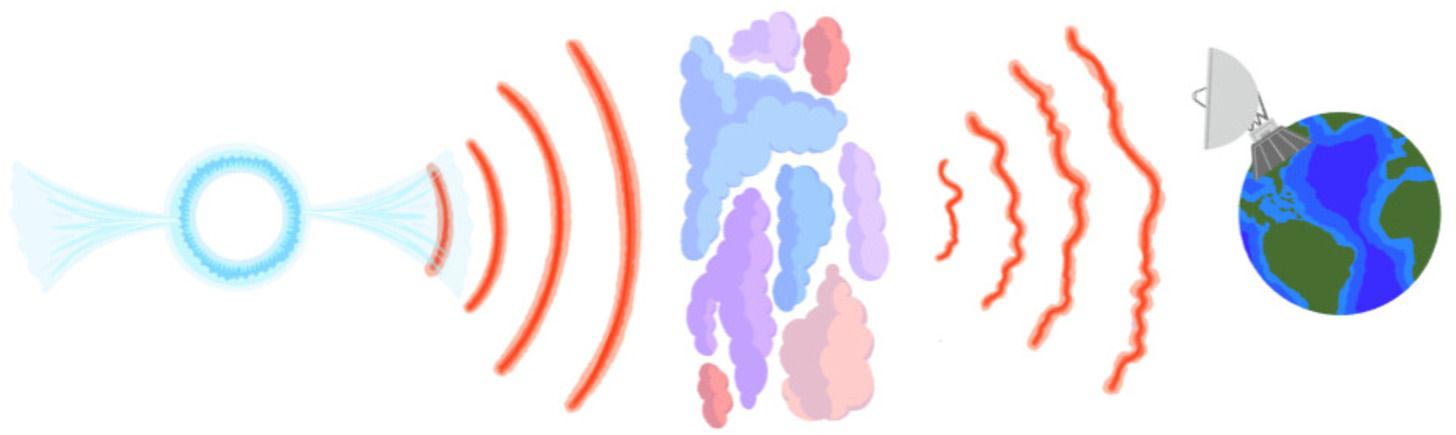
“This work demonstrates the value of large, archived datasets,” said Dr. Sofia Sheikh, SETI Institute researcher and lead author. “Even years after the Arecibo Observatory’s collapse, its data continues to unlock critical information that can advance our understanding of the galaxy and enhance our ability to study phenomena like gravitational waves.”
Unveiling Cosmic Interference
When radio light from a pulsar travels through the ISM, it gets distorted in a process known as “diffractive interstellar scintillation” (DISS). The same physics that makes light refract into patterns on the bottom of a swimming pool or causes stars to twinkle in the night sky also causes DISS. Instead of water in a pool or air in the atmosphere, DISS occurs when clouds of charged particles in space cause a pulsar’s light to “twinkle” across time and frequency.
Advancing Gravitational Wave Research
Collaborations such as the NANOGrav Physics Frontiers Center use pulsars to study the gravitational wave background, which can help researchers understand the early Universe and the prevalence of gravitational-wave sources such as supermassive black-hole binaries. The pulsar timing measurements must be extremely precise to measure the gravitational wave background correctly. The results from this study will help better model the distortions caused by DISS, which will increase the precision of the pulsar timing measurements of projects like NANOGrav.
Challenges in Modeling Galactic Structures
The study found that models incorporating galactic structures, such as spiral arms, tend to better fit the DISS data despite the challenge of accurately modeling the Milky Way’s structure. Moreover, the study showed that the models most accurately predicted the bandwidths of pulsars that were used in their development while predictions of newly discovered pulsars were worse. This suggests limitations that reinforce the need for continual updates to galactic structure models.
Future Directions in Pulsar Research
This pilot study, part of the AO327 survey from Arecibo, serves as a foundation for future research on pulsar scintillation and gravitational waves. By expanding the pilot study to more recently discovered pulsars in the AO327 dataset in the future, the team hopes to further improve ISM density models for collaborations that observe pulsar timing arrays like NANOGrav.
Reference: “Scintillation Bandwidth Measurements from 23 Pulsars from the AO327 Survey” by Sofia Sheikh, Grayce C. Brown, Jackson MacTaggart, Thomas Nguyen, William D. Fletcher, Brenda L. Jones, Emma Koller, Veronica Petrus, Katie F. Pighini, Gray Rosario, Vincent A. Smedile, Adam T. Stone, Shawn You, Maura A. McLaughlin, Jacob E. Turner, Julia S. Deneva, Michael T. Lam and Brent J. Shapiro-Albert, 26 November 2024, The Astrophysical Journal.
DOI: 10.3847/1538-4357/ad8659
This research involves the collaboration between authors at the SETI Institute, Penn State, and the NANOGrav Group at West Virginia University. The team includes SETI Institute researcher Michael Lam and former SETI Institute researcher Grayce Brown.
Never miss a breakthrough: Join the SciTechDaily newsletter.
Follow us on Google and Google News.
3 Comments
No one can challenge me, though. I know very little about space.
Doesn’t surprise me that the uncorrupted mind of the young have found things that the strict overrated less humbled and over celebrated minds of the leading characters in the wide ranges of science were way to involved in their self dominance to take in to consideration of such a simple finding that can change our true understanding of the observations we collect . I also can attest to this in the work I have done and the accomplishments that were taken as to be the highareckeys achievements , I do have the satisfaction that it was me not them that changed the world .
Gravitational waves. Does their wavelength change with distance travelled? Does their amplitude diminish with distance travelled? Does the supposed expansion of the universe alter their frequency? Can gravity waves be “red-shifted”. As gravity waves seem to exist, one might even suppose that they might interfere to produce the sort of peaks and troughs that waves produce. And what would be the result of gravity waves passing through Young’s slits?
Any sane answers out there?