
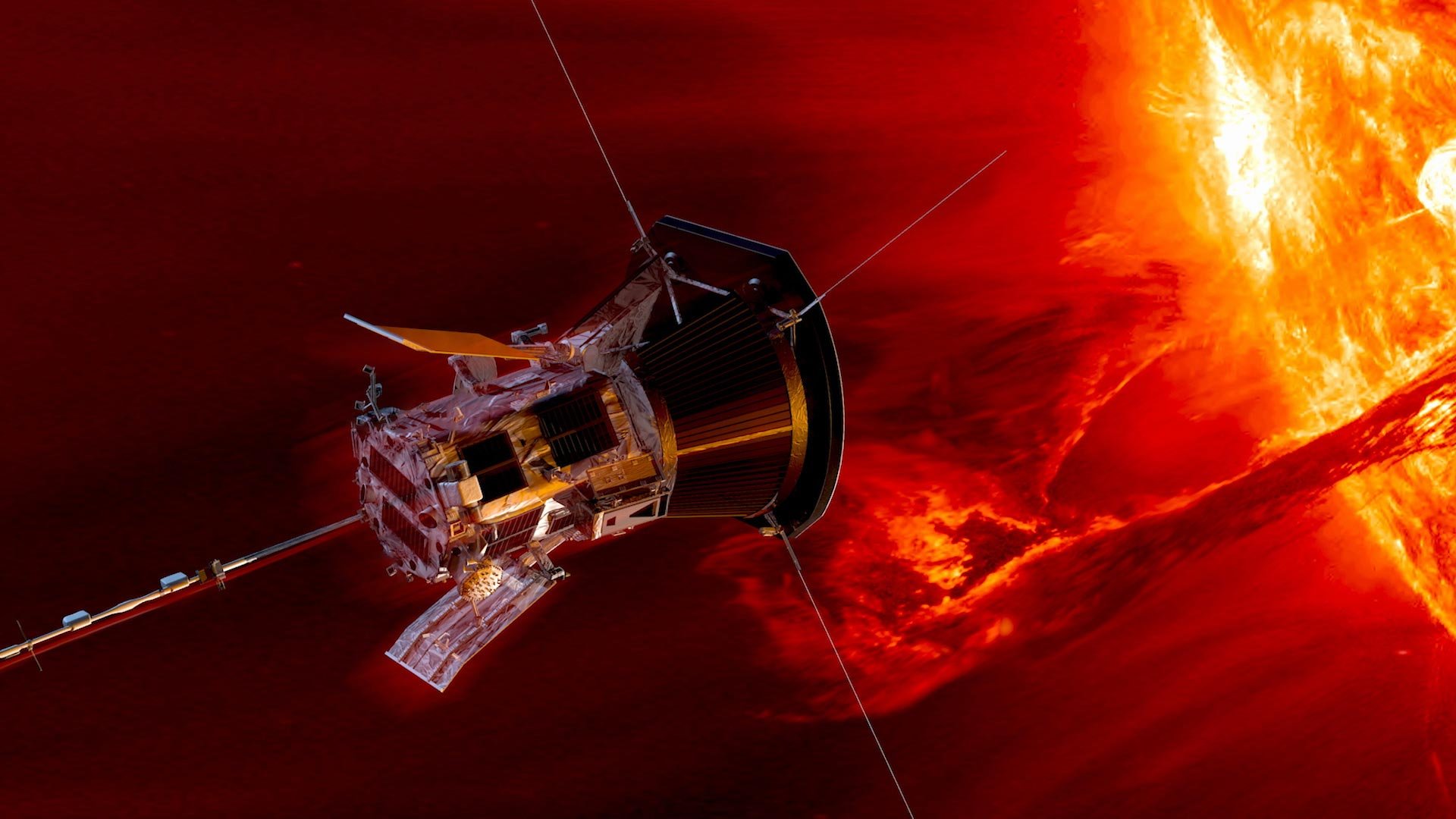
Close-up data from Parker Solar Probe is helping scientists uncover how the solar wind is heated and accelerated, improving predictions of space weather and deepening insight into plasma behavior around the sun and beyond.
Close-up measurements from NASA’s Parker Solar Probe are giving scientists an unprecedented look at how the solar wind gains energy and speeds away from the sun. These insights are sharpening space weather forecasts and expanding scientific understanding of how hot, electrically charged gases behave near stars and throughout space.
The results, published in Geophysical Research Letters, address long-standing questions about how energy and matter move through the heliosphere, the vast region shaped by the sun’s activity. This space environment extends far beyond Earth and the moon, influences every planet in the solar system, and reaches into interstellar space. Changes within the heliosphere can also trigger powerful space weather events.
“One of the things that we care about as a technologically advancing society is how we are impacted by the sun, the star that we live with,” said Kristopher Klein, associate professor in the University of Arizona Lunar and Planetary Laboratory, who led the research study.
One example is a coronal mass ejection, when the sun hurls massive amounts of its atmosphere into space. These eruptions consist of fast-moving, charged particles that can collide with Earth’s magnetic field, disrupting satellites and radio signals. They can also increase radiation exposure for airline passengers on polar routes, Klein noted.
Why the Sun’s Atmosphere Matters for Earth
“If we can better understand the sun’s atmosphere through which these energetic particles are moving, it improves our ability to forecast how these eruptions from the sun will actually propagate through the solar system and eventually hit and possibly impact the Earth,” he said.
Although it may be difficult to picture the sun having an atmosphere, since it is essentially a churning sphere of plasma made of hot, ionized hydrogen gas with no solid surface, decades of research have revealed a detailed internal structure. At the center lies the core, where hydrogen atoms fuse into helium, producing the energy that powers the sun and radiates outward into space.
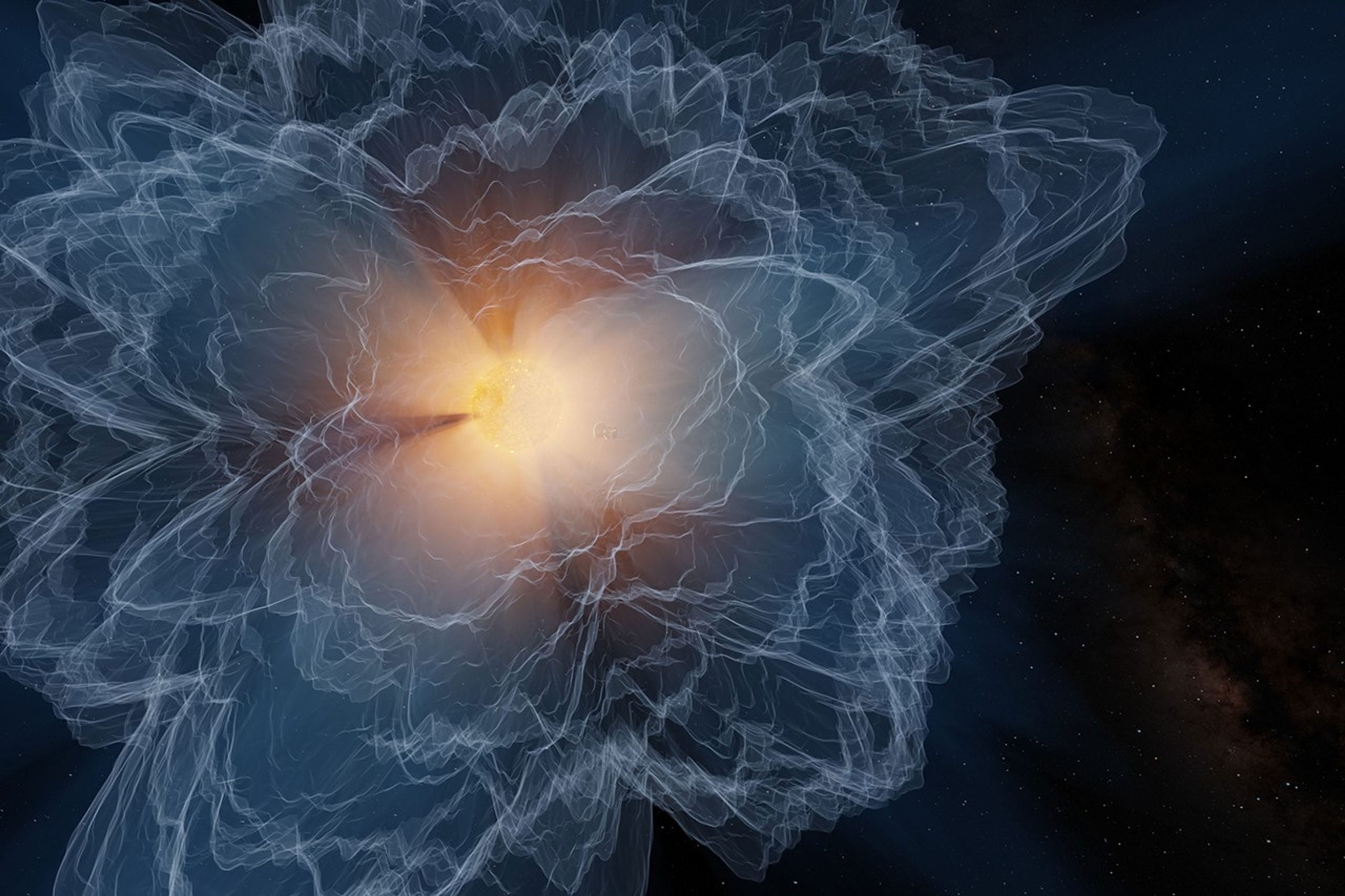
Surrounding the core are several layers, with the outermost forming the sun’s atmosphere. The photosphere is the visible layer where sunspots appear. Above it sits the chromosphere, a thin region that can produce solar flares and creates the mottled appearance seen through specially filtered telescopes designed for safe viewing. Beyond that lies the corona, a faint halo of plasma that is normally hidden by the sun’s intense brightness and becomes visible only during a total solar eclipse.
Since its launch in 2018, Parker Solar Probe has traveled closer to the sun than any previous spacecraft. Following a complex flight path that includes seven gravity assists from Venus, the probe reached its first closest approach on Christmas Eve 2024. These repeated close encounters have allowed scientists to chart the sun’s outer boundary in ways that were previously impossible.
A Puzzling Temperature Reversal in the Corona
One of the biggest puzzles sits in the sun’s temperature pattern. Plasma cools dramatically on its way outward, dropping from about 27 million degrees to around 10,000 degrees Fahrenheit in the visible photosphere, then somehow heats back up in the corona to more than 2 million degrees.
This unexpected heating is driven by complicated interactions between charged particles and intense magnetic fields that twist, stretch, and sometimes snap back into place. Despite decades of study, the details of these processes remain unclear and continue to challenge heliophysicists.
“We know there’s this constant heat that’s being input into the solar wind, and we want to understand what mechanisms are actually leading to that heating,” Klein said. “We have made simplified models, we’ve run computer simulations, but by launching Parker Solar Probe and by doing these detailed calculations of the structure of the velocity distribution of the particles, we can improve those models and calculate actually how the heating occurs at these at these extremely close distances where we have never measured before.”
Before Parker Solar Probe made its daring close passes, sometimes described by the mission team as “kissing the sun,” scientists had limited information. The spacecraft’s closest flyby brought it within 3.8 million miles of the sun’s surface. Before that, researchers relied mainly on simplified assumptions about how charged particles were distributed in space.
New Models Rewrite How Solar Wind Is Heated
“One of the pressing questions we seek to answer is how the solar wind is heated as it is accelerated from the sun’s surface,” he said. “With these new measurements and calculations, we’re rewriting our understanding of how energy moves through the sun’s outer atmosphere.”
To achieve that, Klein’s team developed a numerical tool called Arbitrary Linear Plasma Solver, or ALPS, which can analyze the actual particle distributions measured by Parker rather than forcing the data into idealized shapes. That lets researchers calculate how waves travel through the plasma and how the heating rate changes as particles stream outward. At the point of no return, where the solar wind breaks free, the particles start cooling, but far more slowly than simple expansion would predict. Klein describes that slower cooling as damping, a key clue that still needs a full explanation.
By combining ALPS with Parker’s observations, the team can precisely measure how energy is shared among different types of charged particles in the solar wind. Klein said this capability reshapes understanding not only of the sun but also of many other cosmic environments shaped by hot plasma and magnetic fields.
“If we can understand the damping in the solar wind, we can then apply that knowledge of energy dissipation to things like interstellar gas, accretion disks around black holes, neutron stars, and other astrophysical objects.”
Reference: “Ion-Scale Wave Emission and Absorption for Non-Maxwellian Velocity Distributions in the Inner Heliosphere” by K. G. Klein, D. Larson, R. Livi, M. M. Martinović, A. Rahmati, N. Shankarappa, M. Stevens, D. Verscharen and P. Whittlesey, 29 January 2026, Geophysical Research Letters.
DOI: 10.1029/2025GL118809
This study was funded by NASA Headquarters, UCL’s Advanced Research Computing Centre, International Space Science Institute, NASA Headquarters, NASA Headquarters, NASA Headquarters, and STFC.
Never miss a breakthrough: Join the SciTechDaily newsletter.
Follow us on Google and Google News.
2 Comments
What kind of metal this spacecraft going near the sun that it not melt even at sun’s temperature?
The space craft🐢 looks like it came from the junk yard and NASA put some parts in the space craft and made it start and and it flew to space barely I’m crossing my fingers to see if it doesn’t break down if it does triple AAA has to go up there and tow it, by the way the aircraft is made out of aluminum and cardboard and Scotch tape, 🥴